Dow fell 77, decliners over advancers 5-2 & NAZ sank 48. The MLP index was off 3+ to the 292s (its weakness this year is shown in the chart below) & the REIT index gave back 4+ to the 323s (down 40 from its highs earlier this year). Junk bond funds were sold & Treasuries had a small advance. Oil plunged to the lows 45s on a significant inventory build (more below) & gold is back above 1300.
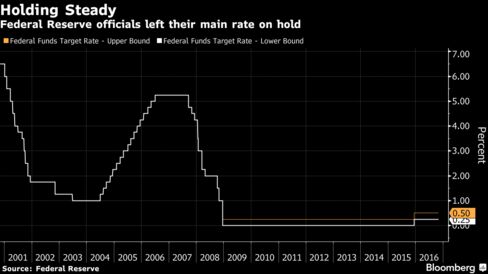
The FMOC left interest rates unchanged while saying the argument for higher borrowing costs strengthened further amid accelerating inflation, reinforcing expectations for a hike next month. “The committee judges that the case for an increase in the federal funds rate has continued to strengthen but decided, for the time being, to wait for some further evidence of continued progress toward its objectives,” the FOMC said. The decision was 8-2. Officials revealed growing confidence that inflation is on track to reach their 2% target. The central bank said that the pace of price gains “has increased somewhat since earlier this year” & that market-based measures of inflation compensation “have moved up.” The committee also omitted previous language saying inflation would probably “remain low in the near term.” This month’s statement said the Fed would wait for “some further evidence” of progress in the economy before raising rates, adding the qualifier “some” to language from Sep, a sign that officials moved incrementally closer to a hike. Cleveland Fed pres Loretta Mester & Kansas City Fed chief Esther George, 2 of the 3 officials who dissented at the committee's Sept session, repeated their objection, calling for raising the federal funds target by a quarter percentage point. The 3rd, Boston Fed pres Eric Rosengren, opted to support the decision to hold rates steady.
When leaving rates unchanged in Sep, the FOMC acknowledged the case for tightening policy had “strengthened.” Minutes of the session showed that was a “close call” for several officials who supported the decision to stand pat & wait for the economy make more progress.
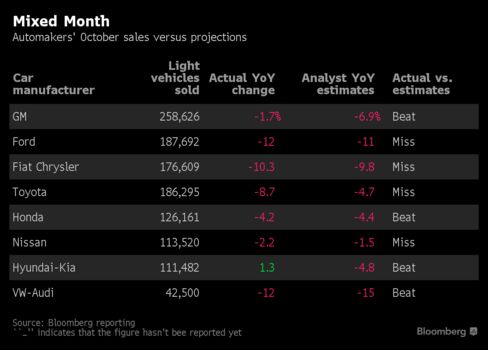
US auto sales in Oct hit the highest annual selling rate in almost a year, fueled by a 14% boost in the discounts it took to coax car buyers into showrooms. The annual selling rate, adjusted for the season, was 18.02M vehicles, the first month to top 18M in a year. While sales fell from a strong year-earlier month, the pace beat the 17.7M average estimate. Ford (F) led the discounting among the largest automakers as the companies dialed up incentives in a market where growth has slowed, albeit with sales at a high level.
Ford’s car sales plunged 28%. The #2 US automaker's report was a day late because a fire at its Dearborn, Michigan, headquarters yesterday made it impossible for dealers to file month-end results on time. YTD, automakers sold 14.48M cars & light trucks, down 0.2% from a year earlier. That marks the first time since Jan that year-to-date sales fell below the comparable 2015 level. The annual sales pace in Oct 2015 was 18.2M, the best for last year.
Oil prices tumbled 3% after a record weekly build in US crude inventories stoked investor worries about a global supply glut, days after analysts estimated higher monthly OPEC crude output. The Energy Information Administration (EIA) said crude inventories rose 14.4M barrels last week, far more than the 1.0M barrels that had expected. It was the biggest weekly rise in US crude stocks, passing a 2012 record & exceeding the American Petroleum Institute's preliminary report yesterday of a 9.3M barrel build. West Texas Intermediate (WTI) crude fell by $1.43 (3%), to $45.24 a barrel. Earlier, it fell below the $45-per barrel support level to a 5-week low of $44.96. Oil prices had surged in recent weeks, with WTI hitting a 15-month peak of $51.93 on OPEC plans to cut output. Prices retreated as some members of the producer group resisted the move. Crude output by OPEC likely reached a record high of 33.82M barrels per day (bpd) in Oct. The group meets Nov 30, hoping to finalize output cuts. This week, 2 OPEC members indicated they were more interested to raise production than cut. Nigeria said its output has recovered to 2.1M bpd while Libya has doubled its output since mid-Sep & is producing about 590K bpd. The US crude build came on the back of 2M bpd jump in imports to just under 9M bpd, the highest rate since Sep 2012. Prior to that, there were drawdowns in 7 out of 8 weeks.
Stocks continue to slide lower with all kinds of fears nagging traders. The next rate hike may come in Dec. Election outcome worries make just about everybody nervous. Earnings were lackluster & the outlook for Q4 looks to be unexciting. No wonder safe haven investment gold is on the rise. Selling into the close took the Dow below 18K. That's scary.
Dow lost 32, decliners over advancers 2-1 & NAZ gave back 13. The MLP index fell 4+ to the 291s for another multi month low & the REIT index was fractionally lower to the 327s. Junk bond funds declined & Treasuries crawled higher. Oil dropped 1 to the 46s on concerns about OPEC's inability to make production cuts & gold shot to go over 1300 again.
Companies added 147K workers in Oct, the fewest in 5 months & marking a more limited pace of job creation, data from the ADP
Research Institute. Private
payrolls increased by 147K (forecast was 165K) after a 202K
gain in Sep that was previously reported as 154K. Goods-producing industries, which include manufacturers & builders, lost 18K workers after an increase of 28K. Service providers boosted payrolls by 165K, also the fewest since May. Firms have remained vocal about the difficulty in finding skilled
workers in the pool of available labor, which has contributed to a
slower hiring pace. Federal Reserve policy makers have been upbeat about progress in
the labor market while citing lingering slack that still might be
absorbed more than 7 years after the end of the last recession. “Job
growth remains strong although the pace of growth appears to be
slowing,” Mark Zandi, chief economist at Moody's Analytics, said. Moody's produces the figures
with ADP. “Behind the slowdown is businesses’ difficulty filling open
positions. However, there is some weakness in construction, education
and mining.”
The OPEC countries claiming exemption from a deal to limit oil
production increased output by almost ½M barrels last
month, potentially jeopardizing the group's agreement unless other
members deepen their own cuts. Libya, Nigeria & Iran, granted
special status after OPEC members reached a supply deal Sep 28, pumped an extra 400K barrels a day in Oct while Iraq,
also demanding an exemption, added 50K barrels a day. OPEC plans to trim output to 32.5-33M barrels a day to balance a market
still swamped by surplus oil. The group pumped a record 34M
barrels a day in Oct, up 170K barrels from Sep. OPEC ministers will meet Nov. 30 to decide how the
burden of cuts will be shared. Nigeria & Libya led the gains in production as their oil industries recover from acts of sabotage &internal chaos. Iran's output continued to
rise following the removal of international sanctions in Jan, though
output growth has slowed in recent months. Increases in these countries
heap pressure on Saudi Arabia and its Gulf allies to cut more from
their own production to achieve OPEC's output target. Saudi Arabia, the biggest producer pumped 10.58M barrels a day,
20K barrels less than in Sep.
The FMOC resumed its 2-day policy meeting & was widely expected to keep interest rates unchanged while setting the
stage for a hike in Dec. A decision on monetary policy
was due later today.
Not much happening ahead of the FOMC announcement which is expected to be a non-event. They will leave the tough decision about interest rates until next month. Oil is sinking into a minor bear market as traders are catching on that OPEC cannot agree to much. Uncertainties about the presidential election are another dark cloud for stocks to deal with.


![Live 24 hours gold chart [Kitco Inc.]](https://lh3.googleusercontent.com/blogger_img_proxy/AEn0k_ulVPZmgkGUWtFJWnvSkt6dUy-JbQGpIkENf-UMT7rLwx9VUwHXY5QqvW_b3PivIhx2af70IG-n_g3EbIRahAgbxy790mepgTwSZ7wIoNIpuORvWkVI35AHkzs5ND88wKw=s0-d)