Dow lost 28, decliners over advancers 5-4 & NAZ gave back 47. The MLP index fell 3+ to the 288s & the REIT index lost 1+ to the 321s. Junk bond funds headed lower & Treasuries were sold, taking the yield on the 10 year Treasury over 1.8%. Oil sank to the 44s on worries of oversupply (more below) & gold retreated but held above 1300.
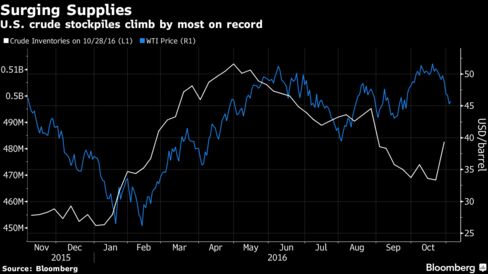
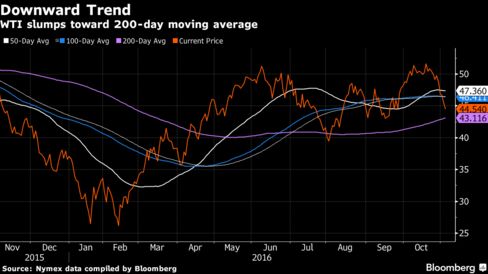
Oil dropped to the lowest since Sep as a global supply glut appears to be expanding. West Texas Intermediate fell more than 2% for a 5th day of losses. North Sea oil producers in Dec will ship the most crude in more than 4 years. Prices tumbled yesterday after the Energy Information Administration said stockpiles increased by a record 14.4M barrels last week. OPEC members who are claiming exemption from an agreement to limit supplies helped boost the group's output to an all-time high last month.
Oil has retreated from near $50 a barrel, triggered by the failure of OPEC to agree on country quotas last week as part of a deal to limit output. WTI for Dec delivery dropped 86¢, today, after touching $44.37, the lowest since Sep 28.
Shipments of North Sea grades should increase 10% month-on-month to about 2.16M barrels a day. If all the cargoes load as planned it would mark the most crude oil shipments from the region since May 2012. The increase just from Sep, when there was field maintenance, would be almost 360K barrels a day. US crude stockpiles increased last week as imports surged the most in almost 20 years. OPEC pumped a record 34M barrels a day in Oct. The gain was led by Libya, Nigeria & Iran, which are exempt from an OPEC deal to cut supply & pumped an additional 400K barrels a day in Oct. Iraq is also demanding an exemption.
Oil Drops to Five-Week Low Amid Signs of Expanding Global Glut
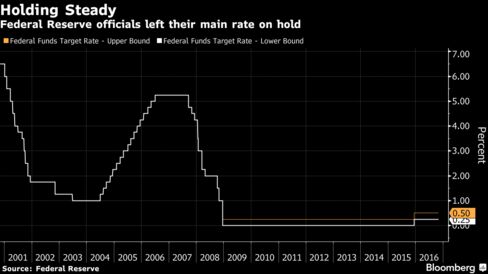
Federal Reserve policy makers left interest rates unchanged while saying the argument for higher borrowing costs strengthened further amid accelerating inflation, reinforcing expectations for a hike next month. “The committee judges that the case for an increase in the federal funds rate has continued to strengthen but decided, for the time being, to wait for some further evidence of continued progress toward its objectives,” the FMOC said. The decision was 8-2. Fed officials revealed growing confidence that inflation is on track to reach their 2% target. The central bank said that the pace of price gains “has increased somewhat since earlier this year” & that market-based measures of inflation compensation “have moved up.” The committee also omitted previous language saying inflation would probably “remain low in the near term.” The decision to forgo a rate increase had been widely expected owing to the proximity of next week's presidential election & the lack of a scheduled press briefing after this meeting. Now the focus will shift to the gathering in Dec, provided the outlook for the economy & inflation isn't thrown into doubt over the next 6 weeks. This month's statement said the Fed would wait for “some further evidence” of progress in the economy before raising rates, adding the qualifier “some” to language from Sep, a sign that officials moved incrementally closer to a hike.
When leaving rates unchanged in Sep, the FOMC acknowledged the case for tightening policy had “strengthened.” Minutes of the session showed that was a “close call” for several officials who supported the decision to stand pat & wait for the economy make more progress.
A British court ruled that the gov parliamentary approval to start the process of leaving the EU, potentially delaying Brexit plans. The government will appeal against the ruling by England's High Court. Britain's Supreme Court is expected to consider the appeal early next month. A spokeswoman for prime minister May said she still planned to launch talks on the terms of Brexit by the end of Mar & added: "We have no intention of letting this derail our timetable." The £ fell sharply after the vote to leave the EU & rose after the ruling. The High Court ruled that the gov needs parliament's backing to trigger Article 50 of the EU's Lisbon Treaty, the formal step needed to start the process of exiting the bloc. Parliament could in theory block Brexit as most lawmakers (MPs) supported staying in the EU in a referendum in Jun. But few expect that outcome, & a Reuters survey last month suggested MPs would back Brexit now. Even so, the court ruling makes the already daunting task of taking Britain out of a political & trading club it joined 43 years ago even more complex.
Stock traders are jittery, not knowing to expect after the election next week. Both candidates are unknowns for the stock market & each is carrying a ton of baggage. While big, the jobs report tomorrow will not calm nerves. Dow remains under 18K & the VIX, volatility index, shot up 2+ to 22, near its 5 year high!
Dow rose 29, advancers over decliners 4-3 & NAZ fell 7. The MLP index dropped 2+ to the 289s (another interim low) & the REIT index was even in the 323s (still down more than 40 from this years highs). Junk bond funds were mixed & Treasuries drifted lower. Oil pulled back in the 45s & gold was also sold, taking it below 1300.
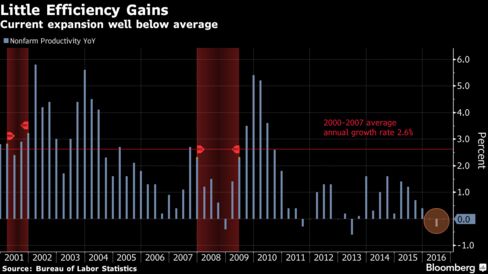
Worker productivity rose in Q3 by the most in 2
years as the economy picked up steam, offering a respite from the weak
efficiency gains that have defined the US expansion. The measure
of employee output per hour increased at a 3.1% annualized rate,
after a revised 0.2% drop in the prior qtr, according to the Labor
Dept. The forecast called for a 2.1% gain. Expenses per worker climbed at a
0.3% pace. The productivity data represent a break from the
longest consecutive string of declines since 1979, as employers
squeezed more output from existing workers. Efficiency was little
changed over the last 12 months, consistent with the long-term downtrend
as businesses have been reluctant to invest in equipment, relying
instead on more hiring. The reading for the prior qtr was initially
reported as a drop of 0.6%. Over the last 5 years, annual productivity gains averaged 0.6%, the weakest since 1978-1982.
Unit
labor costs, adjusted for efficiency gains, were forecast to
rise an annualized 1.2%. They rose 3.9% in Q2, revised from a
previously reported advance of 4.3%. Adjusted for inflation, hourly earnings rose at a 1.7% rate, after increasing at a 1.2% pace. Output climbed at a 3.4% rate, the most in 2 years, following a 1.6% gain the prior qtr. Hours worked rose at a 0.3% pace, the weakest in a year, after a 1.7% advance. Among manufacturers, productivity increased at a 1% rate in Q3 after a 0.5% decrease.
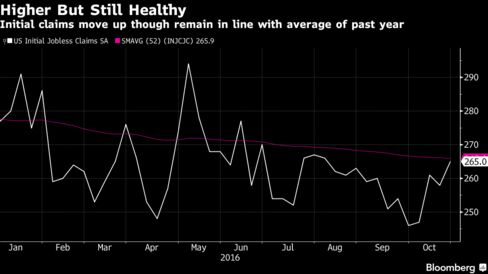
Filings for US unemployment benefits unexpectedly rose to the
highest level in almost 3 months, extending increases from a 4-decade low. Jobless claims increased 7K to 265K, according to the Labor Dept. The forecast called for a drop
to 256K. Continuing claims dropped to the lowest since 2000. Even
with the increase, initial claims are in line with the 264K average
for 2016, as a dwindling pool of skilled & experienced job hunters
keeps employers from laying off workers. While payroll gains have cooled
from last year’s pace, they probably remained solid in Oct, with a
175K rise projected the gov report
due tomorrow.
Filings
for unemployment benefits have been below 300K for 87 straight weeks, the longest streak since 1970 & a level typical for a healthy
labor market. Claims touched 246K in the week ended Oct 1, the lowest since 1973. The 4-week average of claims, a less-volatile measure than the weekly
figure, increased to 257K from 253K in the prior week. The
number continuing to receive jobless benefits dropped 14K to 2.03M & the unemployment rate
among people eligible for benefits held at 1.5%.
A gauge of US service-sector activity fell in Oct, a sign of decelerating growth in key sectors of the economy. The Institute for Supply Management said its
nonmanufacturing index fell to 54.8 from 57.1 in Sep. A
reading above 50 signals expansion while a reading below 50 indicates
contraction. The index has run above the 50 threshold for 81 straight months. The forecast called for a
reading of 56.0. Drops in business activity, new orders & employment
pulled the overall reading down. Americans' spending on services accounts for around 2/3
of overall personal-consumption expenditures & the service sector
provides the bulk of jobs. Job growth was largely concentrated in service
industries such as professional & business services, health care,
retail & restaurants & bars. A separate measure of service-sector activity from private data
provider Markit showed its services business activity index rose to 54.8
in Oct from 52.3 in Sep.
Stocks are looking for direction. Chances are the jobs report tomorrow will give few new insights into where the economy is going. Election jitters are another dark cloud hanging over the market & that will be around until Wed. Next week should see earnings reports from retailers which will also give their outlook for the important holiday season. Times are tough for stocks.


![Live 24 hours gold chart [Kitco Inc.]](https://lh3.googleusercontent.com/blogger_img_proxy/AEn0k_ulKGqBGoTxWgG0YnNG1qZ4VhGWvGJmJGOLdSEpE5d_eCayvI1dbWk-q8XoserVuzhX_E5Kn3QC30c27Yn0SoVzXUFhijEc63J5T6JNJMeLctWWgaiyFOmLAK6YGc2ikw=s0-d)