


Dow added 37 (with a little buying into the close), decliners over advancers about 3-2 & NAZ fell 25. The MLP index rose 1+ to the 291s. Junk bond funds fluctuated & Treasuries were sold again, taking the yield on the 10 year Treasury up to 2.77%. Oil advanced to 66 (more below) & gold shot up 9 to 1352 (nearing multi year highs).
AMJ (Alerian MLP index tracking
![Live 24 hours gold chart [Kitco Inc.]](https://lh3.googleusercontent.com/blogger_img_proxy/AEn0k_uFAY3nBOeZP36YJ7d5rhcadqxpVeiF2tSpy0882_skr_g5NTINT_KN-4yUDoWxXPXx7uNjRlO4A0RQrYo4Yxf9HGbyvanoz7j-H_XkvtjuzKuQ4EeaxYla9tDxVIRW8w=s0-d)


The US economy is on track to grow at a 5.4% annualized rate in Q1 following the latest data on manufacturing & construction spending, the Atlanta Federal Reserve's GDPNow forecast model showed The latest estimate on GDP was faster than the 4.2% growth pace calculated on Mon, the Atlanta Fed said.
Jan US. auto sales are expected to be a little better than a year ago, but most analysts & automakers still predict a small full-year decline despite economic factors that favor the industry. Cox Automotive & JD Power expect Jan sales to rise 1-1.15M vehicles. But Mike Jackson, CEO of AutoNation, the country's largest dealership group, said late-model used cars coming off leases are pulling buyers from higher-priced new vehicles. Despite tax reform, low unemployment & strong consumer confidence, he sees new-car sales falling to 16.8M from last year's 17.2M. During the past few years, automakers pushed leasing to around 30% of sales. Now, Jackson says 4M well-equipped used cars will be available for an average price of $25K. "You have to say 'who is going to buy all these things when they come back?'" he said. "Of course there's going to be a cannibalization and a substitution." Honda sales were down 1.7% to 104K. Truck & SUV sales fell 2.5% while cars were off just under 1%. The CR-V small SUV, which is in the hottest part of the market, saw a 16.9% sales drop while Pilot large SUV sales rose 62%. Nissan sales rose 10% to 123K, a Jan record for the company that sells the Nissan & Infiniti brands. Sales were led by the Rogue small SUV, which was up 26% to 36K. Nissan brand sales rose 12% but Infiniti luxury sales dropped 8%. Ford (F) sales fell 6.6% to 161K, due in part to a decline in sales to rental car fleets. But its average vehicle sales price hit a record $37K, largely due to a 1.6% sales increase in higher priced F-Series pickup. Car sales were down 23.3% as the shift to SUVs & trucks continued. Even SUV sales dropped 5.9% General Motors (GM) sales rose 1% to 198K. Buick & Chevrolet posted gains, but GMC & Cadillac saw lower sales. GM's best-seller, the Chevrolet Silverado pickup, saw a 14.5% jump. A new Silverado will hit the market later this year, so GM is discounting the outgoing truck. Toyota (TM) posted a 16.8% increase to 167K vehicles on strong demand for the RAV4, Highlander & 4Runner SUVs, which hit Jan sales records. Sales of the revamped Camry midsize car rose 21.3%, bucking the trend toward SUV sales. Fiat Chrysler (FCAU) sales were down 13% due to a large reduction in sales to fleet buyers. The company sold nearly 133K vehicles, led by a 2% increase in Jeep sales. But the Chrysler brand fell 21% while Dodge was off 31% & Fiat dropped 43%. Even the Ram truck brand posted a 16% decline. Volkswagen sales were up 5.2% to 24K. The German automaker is recovering from sales losses due to its diesel emissions cheating scandal by introducing new SUVs. Combined sales of the new Atlas large SUV & Tiguan small SUV hit 10K, accounting for 43% of sales.
Microsoft (MSFT), a Dow stock, beat the profit forecast, helped by growth in its cloud computing business, but took a $13.8B one-time charge due to the new US tax law. The qtr was the 10th in a row of more than 90% revenue growth for its flagship Azure cloud computing service. Since CEO Satya Nadella took the helm in 2014, the cloud business (which includes products such as Office 365, Dynamic 365 & Azure) has emerged as a major growth area. Revenue from its intelligent cloud segment rose 15.3% to $7.8 B in its fiscal Q2, including 98% growth for Azure. Analysts had expected $7.51B. The tax charge lead to a net loss of $6.3B (82¢ per share) compared to EPS of 80¢ a year earlier. Excluding one-time items EPS was 96¢, beating the forecast of 86¢. Besides Azure, the other businesses also grew. Revenue from its productivity & business unit, which includes the Office 365 service, was up 24.7% to $8.95B. Revenue at the MSFT "more personal computing" unit (includes Windows, Xbox & Surface) rose 2.36 % to $12.17B. Overall revenue climbed 12% to $28.92B, beating expectations of $28.4B. The stock lost 75¢.
If you would like to learn more amount MSFT, click on this link:
club.ino.com/trend/analysis/stock/MSFT?a_aid=CD3289&a_bid=6ae5b6f7
UPS (UPS) was caught off-guard by the crush of online shopping leading up to Christmas & plans to spend a chunk of its tax-cut savings to invest in its package-delivery network. The company plans $6.5-$7B of capital spending this year on new cargo airplanes & automation in its distribution centers, an increase from $5.2B last year. Rapid growth in online shopping is a double-edged sword. While it reaps higher revenue, it is forced to make major investments in their networks to keep up with demand. It delivered 762M packages during the peak season roughly from Thanksgiving thru Christmas, an increase of 7% over the previous year & 12M more packages than the company expected. It had to spend $125M more than it planned to handle the surge in demand, especially around Thanksgiving & the next several days, dubbed "cyber week." "The volume did exceed the capacity of our network, and it took us some days to dig out and there was a cost to doing so," CEO David Abney said. "The operation ran much better after that." Abney said the extra deliveries around Thanksgiving came from customers throughout its network, not just a few large retail shippers, suggesting that the breadth of the surge made it harder to handle. "No doubt about it, we have to get our arms around better forecasting for cyber week," he added. To perform better in 2018, UPS plans to add 5M square feet & more automation at 18 facilities around its system. UPS announced that it ordered 18 more cargo planes from Boeing (BA), a Dow stock, on top of 14 ordered last year. 9 of those planes will have arrived by the end of 2018 & the rest by the end of 2022. The company owns or leases more than 500 planes & does not plan to retire any of them because of the new order. Execs said they plan to ask the board to increase the div & approve about $1B in share buybacks, which make remaining shares more valuable. UPS predicted 2018 adjusted EPS of $7.03-$7.37. That seemed to be about in line with the forecast of $7.21. Abney said the new tax bill along with rising consumer confidence should boost package deliveries. Execs said UPS will use 1/5 of its expected savings from the new lower corp income-tax rate on improving the business. In Q4, EPS was $1.27, reversing a year-earlier loss of $239M, when results were weighed down by a pension expense. Adjusted EPS, which exclude some pension & tax items, was $1.67, a penny better than the expectation. Revenue rose 11% to $18.83B, also topping expectations. For all of 2017, UPS earned $4.9B, up from $3.4B in 2016. The stock dropped 7.81 (6%).
If you would like to learn more amount UPS, click on this link:
club.ino.com/trend/analysis/stock/UPS?a_aid=CD3289&a_bid=6ae5b6f7
Oil rose after a survey showed OPEC's commitment to its supply cuts remains in place, even as US production topped 10M barrels per day for the first time since 1970. Brent Apr crude futures rose 59¢ to $69.48 a barrel, while NYMEX crude for Mar delivery also rose 59¢ to $65.32. Brent crude rose 3.3% in Jan, its strongest start to the year for 5 years, in line with a broad rise in other risk-linked assets such as US equities, which hit record highs last month & marked their biggest Jan increase since 1997. With investors now pondering which of oil's current key driving forces will prove dominant, rising US crude output or OPEC's adherence to its supply cuts, the relationship with equities & even the $ is likely to erode. OPEC oil output rose in Jan from 8-month lows as higher output from Nigeria & Saudi Arabia offset declines in Venezuela & strong compliance with the OPEC-led supply pact. Oil prices are unlikely to advance much above $70 a barrel in 2018, given the tug of war between OPEC & the US shale industry. US crude oil production in Nov surpassed 10M bpd for the first time since 1970 & neared the output record, the Energy Information Administration said.
Oil rises as OPEC compliance eclipses boom in US output
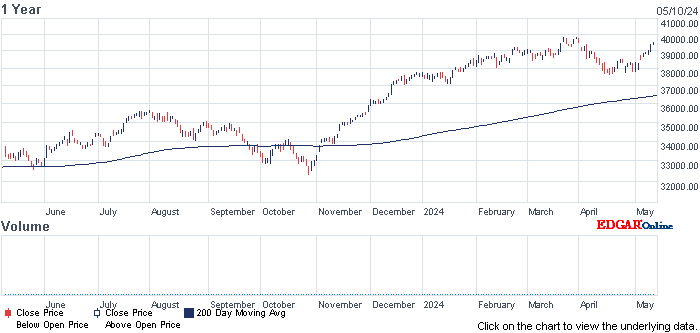
Higher interest rates & the threat of a rate hike by the Fed in Mar is keeping stocks buyers away. Economic news is favorable & the new US tax code is bringing wage increases to workers & increased capital spending. That's what it was designed to do. Increased divs are being declared & more will come this year. However, traders have turned nervous. Tomorrow's job report is expected to be good, but may not be good enough to bring back stock buyers. The Dow is hanging in above 26K & the longer term chart continues to look good.
Dow Jones Industrials


AMJ (Alerian MLP index tracking


The US economy is on track to grow at a 5.4% annualized rate in Q1 following the latest data on manufacturing & construction spending, the Atlanta Federal Reserve's GDPNow forecast model showed The latest estimate on GDP was faster than the 4.2% growth pace calculated on Mon, the Atlanta Fed said.
Atlanta Fed sees 1Q GDP growth surpassing 5%
Jan US. auto sales are expected to be a little better than a year ago, but most analysts & automakers still predict a small full-year decline despite economic factors that favor the industry. Cox Automotive & JD Power expect Jan sales to rise 1-1.15M vehicles. But Mike Jackson, CEO of AutoNation, the country's largest dealership group, said late-model used cars coming off leases are pulling buyers from higher-priced new vehicles. Despite tax reform, low unemployment & strong consumer confidence, he sees new-car sales falling to 16.8M from last year's 17.2M. During the past few years, automakers pushed leasing to around 30% of sales. Now, Jackson says 4M well-equipped used cars will be available for an average price of $25K. "You have to say 'who is going to buy all these things when they come back?'" he said. "Of course there's going to be a cannibalization and a substitution." Honda sales were down 1.7% to 104K. Truck & SUV sales fell 2.5% while cars were off just under 1%. The CR-V small SUV, which is in the hottest part of the market, saw a 16.9% sales drop while Pilot large SUV sales rose 62%. Nissan sales rose 10% to 123K, a Jan record for the company that sells the Nissan & Infiniti brands. Sales were led by the Rogue small SUV, which was up 26% to 36K. Nissan brand sales rose 12% but Infiniti luxury sales dropped 8%. Ford (F) sales fell 6.6% to 161K, due in part to a decline in sales to rental car fleets. But its average vehicle sales price hit a record $37K, largely due to a 1.6% sales increase in higher priced F-Series pickup. Car sales were down 23.3% as the shift to SUVs & trucks continued. Even SUV sales dropped 5.9% General Motors (GM) sales rose 1% to 198K. Buick & Chevrolet posted gains, but GMC & Cadillac saw lower sales. GM's best-seller, the Chevrolet Silverado pickup, saw a 14.5% jump. A new Silverado will hit the market later this year, so GM is discounting the outgoing truck. Toyota (TM) posted a 16.8% increase to 167K vehicles on strong demand for the RAV4, Highlander & 4Runner SUVs, which hit Jan sales records. Sales of the revamped Camry midsize car rose 21.3%, bucking the trend toward SUV sales. Fiat Chrysler (FCAU) sales were down 13% due to a large reduction in sales to fleet buyers. The company sold nearly 133K vehicles, led by a 2% increase in Jeep sales. But the Chrysler brand fell 21% while Dodge was off 31% & Fiat dropped 43%. Even the Ram truck brand posted a 16% decline. Volkswagen sales were up 5.2% to 24K. The German automaker is recovering from sales losses due to its diesel emissions cheating scandal by introducing new SUVs. Combined sales of the new Atlas large SUV & Tiguan small SUV hit 10K, accounting for 43% of sales.
January US auto sales expected to rise only a little
Microsoft (MSFT), a Dow stock, beat the profit forecast, helped by growth in its cloud computing business, but took a $13.8B one-time charge due to the new US tax law. The qtr was the 10th in a row of more than 90% revenue growth for its flagship Azure cloud computing service. Since CEO Satya Nadella took the helm in 2014, the cloud business (which includes products such as Office 365, Dynamic 365 & Azure) has emerged as a major growth area. Revenue from its intelligent cloud segment rose 15.3% to $7.8 B in its fiscal Q2, including 98% growth for Azure. Analysts had expected $7.51B. The tax charge lead to a net loss of $6.3B (82¢ per share) compared to EPS of 80¢ a year earlier. Excluding one-time items EPS was 96¢, beating the forecast of 86¢. Besides Azure, the other businesses also grew. Revenue from its productivity & business unit, which includes the Office 365 service, was up 24.7% to $8.95B. Revenue at the MSFT "more personal computing" unit (includes Windows, Xbox & Surface) rose 2.36 % to $12.17B. Overall revenue climbed 12% to $28.92B, beating expectations of $28.4B. The stock lost 75¢.
If you would like to learn more amount MSFT, click on this link:
club.ino.com/trend/analysis/stock/MSFT?a_aid=CD3289&a_bid=6ae5b6f7
Microsoft's cloud computing business grows, stock edges up
UPS (UPS) was caught off-guard by the crush of online shopping leading up to Christmas & plans to spend a chunk of its tax-cut savings to invest in its package-delivery network. The company plans $6.5-$7B of capital spending this year on new cargo airplanes & automation in its distribution centers, an increase from $5.2B last year. Rapid growth in online shopping is a double-edged sword. While it reaps higher revenue, it is forced to make major investments in their networks to keep up with demand. It delivered 762M packages during the peak season roughly from Thanksgiving thru Christmas, an increase of 7% over the previous year & 12M more packages than the company expected. It had to spend $125M more than it planned to handle the surge in demand, especially around Thanksgiving & the next several days, dubbed "cyber week." "The volume did exceed the capacity of our network, and it took us some days to dig out and there was a cost to doing so," CEO David Abney said. "The operation ran much better after that." Abney said the extra deliveries around Thanksgiving came from customers throughout its network, not just a few large retail shippers, suggesting that the breadth of the surge made it harder to handle. "No doubt about it, we have to get our arms around better forecasting for cyber week," he added. To perform better in 2018, UPS plans to add 5M square feet & more automation at 18 facilities around its system. UPS announced that it ordered 18 more cargo planes from Boeing (BA), a Dow stock, on top of 14 ordered last year. 9 of those planes will have arrived by the end of 2018 & the rest by the end of 2022. The company owns or leases more than 500 planes & does not plan to retire any of them because of the new order. Execs said they plan to ask the board to increase the div & approve about $1B in share buybacks, which make remaining shares more valuable. UPS predicted 2018 adjusted EPS of $7.03-$7.37. That seemed to be about in line with the forecast of $7.21. Abney said the new tax bill along with rising consumer confidence should boost package deliveries. Execs said UPS will use 1/5 of its expected savings from the new lower corp income-tax rate on improving the business. In Q4, EPS was $1.27, reversing a year-earlier loss of $239M, when results were weighed down by a pension expense. Adjusted EPS, which exclude some pension & tax items, was $1.67, a penny better than the expectation. Revenue rose 11% to $18.83B, also topping expectations. For all of 2017, UPS earned $4.9B, up from $3.4B in 2016. The stock dropped 7.81 (6%).
If you would like to learn more amount UPS, click on this link:
club.ino.com/trend/analysis/stock/UPS?a_aid=CD3289&a_bid=6ae5b6f7
UPS posts $1.1 billion profit for 4Q on high online shopping
Oil rose after a survey showed OPEC's commitment to its supply cuts remains in place, even as US production topped 10M barrels per day for the first time since 1970. Brent Apr crude futures rose 59¢ to $69.48 a barrel, while NYMEX crude for Mar delivery also rose 59¢ to $65.32. Brent crude rose 3.3% in Jan, its strongest start to the year for 5 years, in line with a broad rise in other risk-linked assets such as US equities, which hit record highs last month & marked their biggest Jan increase since 1997. With investors now pondering which of oil's current key driving forces will prove dominant, rising US crude output or OPEC's adherence to its supply cuts, the relationship with equities & even the $ is likely to erode. OPEC oil output rose in Jan from 8-month lows as higher output from Nigeria & Saudi Arabia offset declines in Venezuela & strong compliance with the OPEC-led supply pact. Oil prices are unlikely to advance much above $70 a barrel in 2018, given the tug of war between OPEC & the US shale industry. US crude oil production in Nov surpassed 10M bpd for the first time since 1970 & neared the output record, the Energy Information Administration said.
Oil rises as OPEC compliance eclipses boom in US output
Higher interest rates & the threat of a rate hike by the Fed in Mar is keeping stocks buyers away. Economic news is favorable & the new US tax code is bringing wage increases to workers & increased capital spending. That's what it was designed to do. Increased divs are being declared & more will come this year. However, traders have turned nervous. Tomorrow's job report is expected to be good, but may not be good enough to bring back stock buyers. The Dow is hanging in above 26K & the longer term chart continues to look good.
Dow Jones Industrials


