


Dow dropped 132, advancers over decliners about 2-1 & NAZ lost 65. The MLP index went up 1+ to the 261s & the REIT index gained 2+ to the 353s. Junk bond funds were mixed & Treasuries rose in price as stocks were sold. Oil finished a little higher (more below) & gold added 11 to 1253.
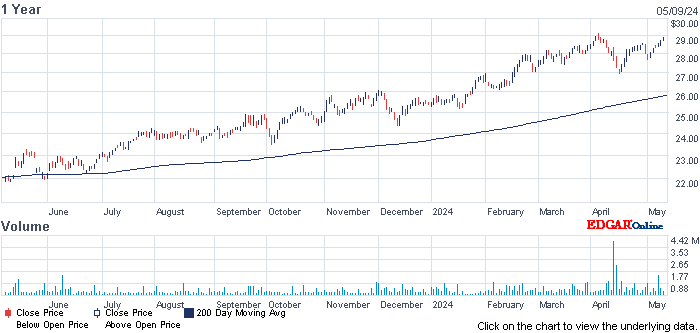
AMJ (Alerian MLP Index tracking fund)
![Live 24 hours gold chart [Kitco Inc.]](https://www.kitco.com/images/live/gold.gif?0.8116015171332475)


US stocks close lower, Dow off triple digits
By the Fourth of Jul, drivers usually see the highest gas prices of summer in the rear-view mirror. That may not be the case this year, even though the national average is down about 14¢ from the near $3 a gallon drivers paid in late May. Consumers are paying the highest Fourth of Jul gasoline prices in 4 years. The uncertainty surrounding US efforts to sanction Iranian oil, as well as unexpected outages in other oil-producing countries, has driven West Texas Intermediate Crude futures to fresh 3½-year highs. Earlier today, it traded briefly above $75 per barrel, & futures for Brent, the intl bench mark, rose above $78 per barrel. US refineries are running at full throttle, taking in last week 18M barrels of oil to process. US drivers consumed 9.7M barrels of gasoline per day, close to the year's high of 9.85M barrels reached in Apr. The US also exports gasoline, & for the latest week, 613K barrels a day were sent out of the country, mostly to Mexico & other parts of Latin America.
Consumers hit with highest 4th of July gas prices in four years
Oil prices steadied in he PM, following a volatile session that saw US crude top $75 a barrel for the first time since Nov 2014 before falling sharply & suddenly in mid-morning trading. The American benchmark broke thru the threshold as the market grew increasingly concerned about a shortage of oil amid supply disruptions in Libya & Canada & as tough US sanctions on Iran loom. US West Texas Intermediate crude rose to a session peak of $75.27 a barrel, the highest level since Nov 2014, & then tumbled to a low of $72.73. The contract ended the session up 20¢ at $74.14. Benchmark Brent crude oil was up 46¢ at $77.76, after topping out at $78.55. The oil market's early gains added to last week's rally, which saw WTI surge more than 8% & Brent rise about 5%. Those increases were fueled by a supply disruption at a major Canadian oil sands facility & concerns about Libya's crude exports. Exacerbating those surprise events, a Trump administration official told reporters that American diplomats are pushing oil buyers to cut off all purchases of Iranian crude by the beginning of Nov. A senior State Dept official reaffirmed the tougher-than-anticipated policy yesterday. After oil prices turned lower, analysts pointed to a report from Saudi Arabia's state media agency saying the kingdom's Council of Ministers, chaired by King Salman bin Abdulaziz, is ready to deploy the nation's spare capacity to add more oil to the market. Pres Trump has asked the king to raise output by as much as 2M barrels per day. OPEC, the Saudi-dominated group of 14 oil producers, reached an agreement with Russia & other exporters last month to raise output by about 1M bpd. OPEC pumped 32.32M bpd in Jun, up 320K bpd from May. The Jun total is the highest since Jan 2018. The UAE's Abu Dhabi National Oil Co said today it could increase production by several hundred thousand barrels per day if needed.
US crude rises 20 cents, settling at $74.14, after topping $75 for first time since 2014
It is a seller’s market, undeniably. The supply of homes for sale is low, demand is high, & now prices are heating up even more. But sellers today see more reasons to stay put than to profit. Home prices jumped 7.1% annually in May, according to a new report from CoreLogic, the biggest jump in 4 years. Annual price gains had been shrinking slightly, as mortgage rates rose, but apparently higher rates are not hurting demand. They are, however, exacerbating the already critical supply shortage. “During the first quarter, we found that about 50 percent of all existing homeowners had a mortgage rate of 3.75 percent or less,” said Frank Nothaft, chief economist for CoreLogic. “May’s mortgage rates averaged a seven-year high of 4.6 percent, with an increasing number of homeowners keeping the low-rate loans they currently have, rather than sell and buy another home that would carry a higher interest rate.” If mortgage rates were to rise further, fewer homeowners would want to move. In fact, if today's homeowners just considering a move were faced with a mortgage rate 1 percentage point higher than their current one, 24% would not move, according to a recent survey, & 36% said they “may not” move. The average rate on the 30-year fixed is now slightly more than 1 percentage point higher than the lows following the recession. The median price of an existing home sold in May was $264K, according to the National Association of Realtors. Of course, all real estate is local, & certain markets are hotter than others. Seattle, Denver & San Francisco continue to see some of the biggest price gains, as they also have the leanest supply. The supply of homes for sale has been dropping on an annual basis for the past 36 months, according to the National Association of Realtors. The shortage is most acute at the lower end of the market, where demand is highest & where investors bought thousands of distressed properties during the housing crash, turning them into lucrative rentals. Younger potential buyers have already delayed homeownership due to the recession & high levels of student loan debt. They have also been hampered by high rents, making it more difficult to save for a downpayment. Higher rents, combined with higher home prices, are the number one reason for the decline in young homeowners, followed by lower marriage & fertility rates, according to a recent study by Freddie Mac.
Home prices make the biggest jump in four years
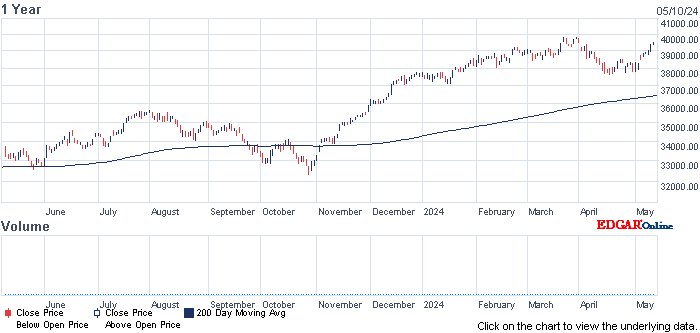
Stocks began the day higher, but without conviction. In the last hour of the shortened session of trading, there was substantial selling. The Dow dropped about 200. Intl trade worries are not far from the minds of traders. The chart below shows the Dow keeps lumbering along a little above 24K as it has for much of this year. That is not pretty.
Dow Jones Industrials


AMJ (Alerian MLP Index tracking fund)


The major US stock indices finished the day with losses – with the Dow & S&P 500 erasing earlier gains
in late trading while NAZ flipped from positive to negative
shortly after trading commenced & its losses accelerated in the
last hour. US equity markets will remain
closed on tomorrow in observance of Independence Day. When traders
return from their break, the next major market moving piece of economic
data will be the Jun jobs report, which the Commerce Dept will
release on Fri. Analysts expect that the
US economy added 195K jobs in Jun while the unemployment rate
should hold steady at 3.8%, the lowest since 2000. The measure
that could garner the most intention is the reading on wage inflation.
Jun wage inflation is expected to rise 0.3%, taking the annual growth
rate to 2.8%, just below the 2.9% annual clip hit back in
Jan that triggered a market selloff. Today has also been a volatile session for oil with the commodity swinging between gains & losses.
US stocks close lower, Dow off triple digits
By the Fourth of Jul, drivers usually see the highest gas prices of summer in the rear-view mirror. That may not be the case this year, even though the national average is down about 14¢ from the near $3 a gallon drivers paid in late May. Consumers are paying the highest Fourth of Jul gasoline prices in 4 years. The uncertainty surrounding US efforts to sanction Iranian oil, as well as unexpected outages in other oil-producing countries, has driven West Texas Intermediate Crude futures to fresh 3½-year highs. Earlier today, it traded briefly above $75 per barrel, & futures for Brent, the intl bench mark, rose above $78 per barrel. US refineries are running at full throttle, taking in last week 18M barrels of oil to process. US drivers consumed 9.7M barrels of gasoline per day, close to the year's high of 9.85M barrels reached in Apr. The US also exports gasoline, & for the latest week, 613K barrels a day were sent out of the country, mostly to Mexico & other parts of Latin America.
Consumers hit with highest 4th of July gas prices in four years
Oil prices steadied in he PM, following a volatile session that saw US crude top $75 a barrel for the first time since Nov 2014 before falling sharply & suddenly in mid-morning trading. The American benchmark broke thru the threshold as the market grew increasingly concerned about a shortage of oil amid supply disruptions in Libya & Canada & as tough US sanctions on Iran loom. US West Texas Intermediate crude rose to a session peak of $75.27 a barrel, the highest level since Nov 2014, & then tumbled to a low of $72.73. The contract ended the session up 20¢ at $74.14. Benchmark Brent crude oil was up 46¢ at $77.76, after topping out at $78.55. The oil market's early gains added to last week's rally, which saw WTI surge more than 8% & Brent rise about 5%. Those increases were fueled by a supply disruption at a major Canadian oil sands facility & concerns about Libya's crude exports. Exacerbating those surprise events, a Trump administration official told reporters that American diplomats are pushing oil buyers to cut off all purchases of Iranian crude by the beginning of Nov. A senior State Dept official reaffirmed the tougher-than-anticipated policy yesterday. After oil prices turned lower, analysts pointed to a report from Saudi Arabia's state media agency saying the kingdom's Council of Ministers, chaired by King Salman bin Abdulaziz, is ready to deploy the nation's spare capacity to add more oil to the market. Pres Trump has asked the king to raise output by as much as 2M barrels per day. OPEC, the Saudi-dominated group of 14 oil producers, reached an agreement with Russia & other exporters last month to raise output by about 1M bpd. OPEC pumped 32.32M bpd in Jun, up 320K bpd from May. The Jun total is the highest since Jan 2018. The UAE's Abu Dhabi National Oil Co said today it could increase production by several hundred thousand barrels per day if needed.
US crude rises 20 cents, settling at $74.14, after topping $75 for first time since 2014
It is a seller’s market, undeniably. The supply of homes for sale is low, demand is high, & now prices are heating up even more. But sellers today see more reasons to stay put than to profit. Home prices jumped 7.1% annually in May, according to a new report from CoreLogic, the biggest jump in 4 years. Annual price gains had been shrinking slightly, as mortgage rates rose, but apparently higher rates are not hurting demand. They are, however, exacerbating the already critical supply shortage. “During the first quarter, we found that about 50 percent of all existing homeowners had a mortgage rate of 3.75 percent or less,” said Frank Nothaft, chief economist for CoreLogic. “May’s mortgage rates averaged a seven-year high of 4.6 percent, with an increasing number of homeowners keeping the low-rate loans they currently have, rather than sell and buy another home that would carry a higher interest rate.” If mortgage rates were to rise further, fewer homeowners would want to move. In fact, if today's homeowners just considering a move were faced with a mortgage rate 1 percentage point higher than their current one, 24% would not move, according to a recent survey, & 36% said they “may not” move. The average rate on the 30-year fixed is now slightly more than 1 percentage point higher than the lows following the recession. The median price of an existing home sold in May was $264K, according to the National Association of Realtors. Of course, all real estate is local, & certain markets are hotter than others. Seattle, Denver & San Francisco continue to see some of the biggest price gains, as they also have the leanest supply. The supply of homes for sale has been dropping on an annual basis for the past 36 months, according to the National Association of Realtors. The shortage is most acute at the lower end of the market, where demand is highest & where investors bought thousands of distressed properties during the housing crash, turning them into lucrative rentals. Younger potential buyers have already delayed homeownership due to the recession & high levels of student loan debt. They have also been hampered by high rents, making it more difficult to save for a downpayment. Higher rents, combined with higher home prices, are the number one reason for the decline in young homeowners, followed by lower marriage & fertility rates, according to a recent study by Freddie Mac.
Home prices make the biggest jump in four years
Stocks began the day higher, but without conviction. In the last hour of the shortened session of trading, there was substantial selling. The Dow dropped about 200. Intl trade worries are not far from the minds of traders. The chart below shows the Dow keeps lumbering along a little above 24K as it has for much of this year. That is not pretty.
Dow Jones Industrials


