


Dow advanced 264 (closing at the highs), advancers over decliners 3-1 & NAZ rose a big 128. The MLP index gained 2+ to the 253s & the REIT index gave back 4 to 342. Junk bond funds went up & Treasuries inched higher. Oil slumped to the 63s (more below) & gold soared 21 to 1236.
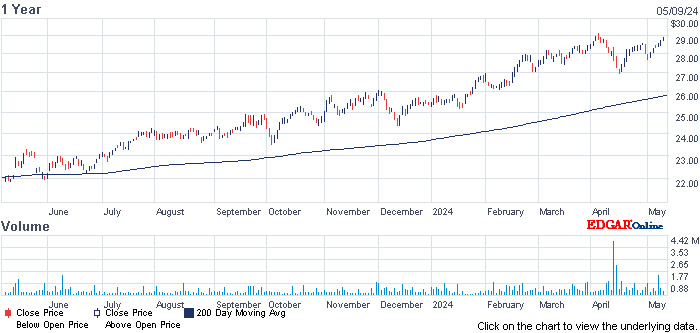
AMJ (Alerian MLP Index tracking fund)
![Live 24 hours gold chart [Kitco Inc.]](https://www.kitco.com/images/live/gold.gif?0.2180338269244485)


The Justice Dept has charged companies in China & Taiwan along with 3 individuals with stealing trade secrets from a US semi-conductor company. Attorney General Jeff Sessions & other officials were announced the case today. The prosecution comes amid a mounting tariff battle between China & the US, & as American officials raise alarms about the threat of Chinese economic espionage. The defendants include a Chinese-owned company singled out this week by the Trump administration. The Justice Dept says the company targeted Idaho-based Micron (MU) over a technology that it produces that stores memory in electronics. The Trump administration yesterday imposed restrictions on technology exports to one of the indicted companies, Fujian Jinhua Integrated Circuit. The administration has characterized China, along with Russia, as a strategic competitor of the US.
US charges Chinese companies in trade secrets theft
US online spending during the holiday shopping season is likely to grow 14.8% this year to $124B, far outpacing the 2.7% growth predicted for brick-&-mortar locations & highlighting the ongoing switch from stores to web shopping. The forecast was released by Adobe Analytics, the web analytics arm of Adobe Systems. The company measures transactions from 80 of the top 100 US retailers & customer visits to US retail sites. Online sales this year will benefit from an extra day between Cyber Monday to Christmas, which is likely to provide a $284M sales boost. Adobe also forecast the best days for shopping online based on prices across product categories during previous years. For example, Thanksgiving is likely to be a good day to buy sporting goods as prices could be 13% lower than their average in the first 10 months of the year. Black Friday will still be a good option for television purchases as prices could be about 22% lower. Apparel discounts could make items cheaper by 22% than average on Nov.25 & toys are likely to be 19% cheaper on Cyber Monday. The Nov-Dec holiday shopping season are critical for retailers, when they book an outsized portion of their annual sales & profits. Overall US holiday sales including stores & online in 2018 will increase by 4.3-4.8% from a year ago, when consumer spending surged to a 12-year high, according to The National Retail Federation. The trade body said holiday sales growth will be higher than an average increase of 3.9% over the past 5 years but slower than last year’s 5.3% gain, when consumer spending grew the most since 2005, boosted by tax cuts.
US online spending set to rise 14.8% in 2018 holiday season
Top US automakers reported another month of rising sales for sports utility vehicles & pick-up trucks as American consumers continued to shun sedans & hatchbacks. The country's #2 producer, (Ford (F), reported a 6.7% rise in SUV sales to 67K units in Oct, while smaller rival Fiat Chrysler (FCAU) saw overall sales rise 16% on higher demand for its Jeep & Ram vehicles. US car sales, which dropped 2% last year from a record high of 17.55M in 2016, are expected to fall further in 2018, hurt by rising interest rates & the return of more late-model used cars to dealer lots. But automakers have been helped by a shift by US consumers away from traditional passenger cars towards larger, more comfortable SUVs & trucks, which tend to be more profitable for producers. Sport utility vehicles contributed about 35% of Ford's total US sales volumes in Oct, up from 31.6% a year ago. Ford, which is also gradually phasing out production of most passenger cars in the US, said total sales fell 3.9% to 193K, hurt by lower passenger car demand. Japan's Toyota (TM) separately said its US sales rose about 1.4% to 191K units, due to increased demand for Highlander & Tacoma SUVs.
US auto sales rise as SUVs, trucks dominate
Oil prices fell more than 2%, with US crude hitting its lowest level in nearly 7 months as last month's steep losses continued into Nov. US West Texas Intermediate (WTI) crude ended the session down $1.62 (2.5%) at a nearly 7-month low of $63.69. The contract bottomed out at $63.11 earlier in the session, its weakest price since Apr 9. Brent crude, the intl benchmark for oil prices, was down $2.07 (2.8%) at $72.97 after falling as low as $72.56. Both benchmarks posted their worst monthly drop since Jul 2016 in Oct, with WTI down nearly 11% & Brent tumbling almost 9%. Crude futures got caught up in a broader sell-off in global equity markets in Oct, sinking as investors sold risk assets. But oil prices have continued to drop even as stocks claw back some gains. US crude is now trading at levels not seen since the month before Pres Trump restored sanctions sanctions against Iran, OPEC's 3rd biggest oil producer. The looming sanctions on Iran’s energy sector, which go into full force next week, have played a major role in the oil market's rally to nearly 4-year highs just one month ago. Iran's oil exports have shrunk by about a 1/3 as crude importers wind down their purchases ahead of the Nov 4 deadline. Iran was still selling about 1.7-1.9M barrels per day in Sep. The Trump administration is reportedly nearing deals with India & South Korea that would allow the countries to keep buying some of Iranian oil. The market is also growing confident that output from other sources can offset the declines.
US crude falls to 7-month low below $64, deepening October's losses
Early economic data for Oct looks fairly good. Tomorrow's number on jobs created in Oct will move markets. The oil market has gotten very ugly in just 4 weeks. Some of that bearish sentiment has to do with a gloomier outlook for the global economy which could reduce demand for oil. The Dow started the day higher & then traded flat for the rest of the session (still down over 1K since the close in Sep). Tomorrow's trading may be more exciting.
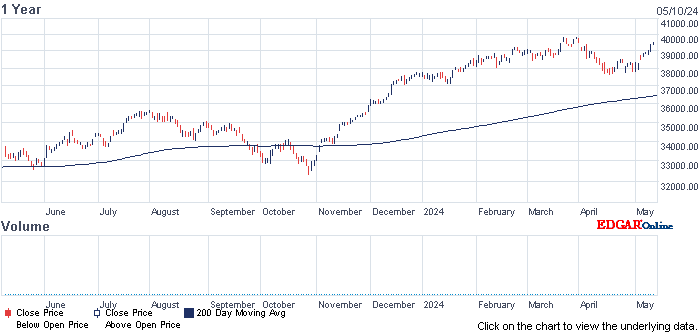
Dow Jones Industrials


AMJ (Alerian MLP Index tracking fund)


US productivity grew at an annual rate of 2.2% in Q3, a slowdown from the previous quarter but
still better than the lackluster gains of the last decade. Labor costs
accelerated but remained at a low level. The
rise in productivity in the Jul-Sep period followed a 3%
rate of increase in Q2, which had been the strongest
figure in 3 years. Labor costs rose at a 1.2% rate after
having fallen at a 1% rate in Q2. Productivity,
the amount of output per hour of work, has been weak throughout the
current recovery that began in 2009. Analysts have been unable to
come up with definitive reasons for the slowdown. Productivity
last year rose by just 1.1%. Over the past decade, productivity
has been up at an average annual rate of 1.3%, a little over ½
the 2.1% gains seen in the 7 decades starting in 1947. The
2000-2007 period saw even stronger annual gains of 2.7%, a
burst that was credited to efficiency improvements achieved with the
introduction of high-tech computers & other devices to the workplace. A slowdown in Q3 had been expected
given that overall output, as measured by the GDP,
slowed to a still-strong annual rate of 3.5% in Q3 after a sizzling 4.2% growth rate in Q2.
With less output & hours worked rising at a rate of 1.8%,
productivity edged lower. Economists said they
were not concerned about the slight acceleration in labor costs. The
Federal Reserve closely watches various gauges of compensation to make
sure that wages & salaries, the biggest component of business
expenses, are not rising at such a rapid pace that the economy could be
in danger of overheating. Finding
a solution to the slowdown in productivity growth is one of the key
economic challenges facing the country. Rising productivity is critical
to boosting standards of living because productivity gains allow
companies to pay workers more without having to increase the cost of
their products, which can be inflationary.
US productivity growth slows to 2.2 percent rate in Q3
The Justice Dept has charged companies in China & Taiwan along with 3 individuals with stealing trade secrets from a US semi-conductor company. Attorney General Jeff Sessions & other officials were announced the case today. The prosecution comes amid a mounting tariff battle between China & the US, & as American officials raise alarms about the threat of Chinese economic espionage. The defendants include a Chinese-owned company singled out this week by the Trump administration. The Justice Dept says the company targeted Idaho-based Micron (MU) over a technology that it produces that stores memory in electronics. The Trump administration yesterday imposed restrictions on technology exports to one of the indicted companies, Fujian Jinhua Integrated Circuit. The administration has characterized China, along with Russia, as a strategic competitor of the US.
US charges Chinese companies in trade secrets theft
US online spending during the holiday shopping season is likely to grow 14.8% this year to $124B, far outpacing the 2.7% growth predicted for brick-&-mortar locations & highlighting the ongoing switch from stores to web shopping. The forecast was released by Adobe Analytics, the web analytics arm of Adobe Systems. The company measures transactions from 80 of the top 100 US retailers & customer visits to US retail sites. Online sales this year will benefit from an extra day between Cyber Monday to Christmas, which is likely to provide a $284M sales boost. Adobe also forecast the best days for shopping online based on prices across product categories during previous years. For example, Thanksgiving is likely to be a good day to buy sporting goods as prices could be 13% lower than their average in the first 10 months of the year. Black Friday will still be a good option for television purchases as prices could be about 22% lower. Apparel discounts could make items cheaper by 22% than average on Nov.25 & toys are likely to be 19% cheaper on Cyber Monday. The Nov-Dec holiday shopping season are critical for retailers, when they book an outsized portion of their annual sales & profits. Overall US holiday sales including stores & online in 2018 will increase by 4.3-4.8% from a year ago, when consumer spending surged to a 12-year high, according to The National Retail Federation. The trade body said holiday sales growth will be higher than an average increase of 3.9% over the past 5 years but slower than last year’s 5.3% gain, when consumer spending grew the most since 2005, boosted by tax cuts.
US online spending set to rise 14.8% in 2018 holiday season
Top US automakers reported another month of rising sales for sports utility vehicles & pick-up trucks as American consumers continued to shun sedans & hatchbacks. The country's #2 producer, (Ford (F), reported a 6.7% rise in SUV sales to 67K units in Oct, while smaller rival Fiat Chrysler (FCAU) saw overall sales rise 16% on higher demand for its Jeep & Ram vehicles. US car sales, which dropped 2% last year from a record high of 17.55M in 2016, are expected to fall further in 2018, hurt by rising interest rates & the return of more late-model used cars to dealer lots. But automakers have been helped by a shift by US consumers away from traditional passenger cars towards larger, more comfortable SUVs & trucks, which tend to be more profitable for producers. Sport utility vehicles contributed about 35% of Ford's total US sales volumes in Oct, up from 31.6% a year ago. Ford, which is also gradually phasing out production of most passenger cars in the US, said total sales fell 3.9% to 193K, hurt by lower passenger car demand. Japan's Toyota (TM) separately said its US sales rose about 1.4% to 191K units, due to increased demand for Highlander & Tacoma SUVs.
US auto sales rise as SUVs, trucks dominate
Oil prices fell more than 2%, with US crude hitting its lowest level in nearly 7 months as last month's steep losses continued into Nov. US West Texas Intermediate (WTI) crude ended the session down $1.62 (2.5%) at a nearly 7-month low of $63.69. The contract bottomed out at $63.11 earlier in the session, its weakest price since Apr 9. Brent crude, the intl benchmark for oil prices, was down $2.07 (2.8%) at $72.97 after falling as low as $72.56. Both benchmarks posted their worst monthly drop since Jul 2016 in Oct, with WTI down nearly 11% & Brent tumbling almost 9%. Crude futures got caught up in a broader sell-off in global equity markets in Oct, sinking as investors sold risk assets. But oil prices have continued to drop even as stocks claw back some gains. US crude is now trading at levels not seen since the month before Pres Trump restored sanctions sanctions against Iran, OPEC's 3rd biggest oil producer. The looming sanctions on Iran’s energy sector, which go into full force next week, have played a major role in the oil market's rally to nearly 4-year highs just one month ago. Iran's oil exports have shrunk by about a 1/3 as crude importers wind down their purchases ahead of the Nov 4 deadline. Iran was still selling about 1.7-1.9M barrels per day in Sep. The Trump administration is reportedly nearing deals with India & South Korea that would allow the countries to keep buying some of Iranian oil. The market is also growing confident that output from other sources can offset the declines.
US crude falls to 7-month low below $64, deepening October's losses
Early economic data for Oct looks fairly good. Tomorrow's number on jobs created in Oct will move markets. The oil market has gotten very ugly in just 4 weeks. Some of that bearish sentiment has to do with a gloomier outlook for the global economy which could reduce demand for oil. The Dow started the day higher & then traded flat for the rest of the session (still down over 1K since the close in Sep). Tomorrow's trading may be more exciting.
Dow Jones Industrials


