


Dow went up 64 (below session highs), advancers over decliners about 5-4 & NAZ lost 17. The MLP index rose 1+ to 250 & the REIT index gained 3+ to the 364s. Junk bond funds were slightly higher & Treasuries dropped in price. Oil shot up 1+ to the 55s (more below) & gold slid back 2 to 1323 after its recent rally.
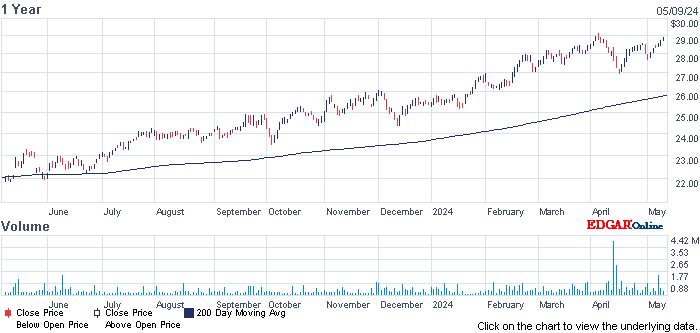
AMJ (Alerian MLP Index tracking fund)
![Live 24 hours gold chart [Kitco Inc.]](https://www.kitco.com/images/live/gold.gif?0.2180338269244485)


Construction spending rose 0.8% to a seasonally adjusted annual rate of $1.3T in Nov from a revised $1.29T in Oct, helped by housing, the Commerfce Dept said. The forecast called for a 0.2% increase, but Oct figures were revised down. Outlays in Nov were 3.4% higher than a year ago, & for the first 11 months of 2018, were 4.5% higher than the same period in the prior year. Residential construction spending was up 3.4% during the month & was 0.6% higher for the year. That's good news for the supply-starved housing sector. In Nov, overall private-sector spending was 1.3% higher for the month, edging out a 0.9% decline in public-sector spending.
The Univ of Mich consumer-sentiment index plunged to a reading of 91.2 in Jan from 98.3 in Dec, the worst since Trump was elected pres. That was a touch better than the mid-Jany reading of 90.7. The gov shutdown rattled consumers &, unlike previous bouts, the numbers didn't materially improve even after 800K workers went back to work. That's because there’s the possibility of another shutdown on Feb 15, as Congressional negotiators remain at an impasse over funding the border wall desired by Trump. Both the current conditions & expectations index fell during Jan. This level of confidence is consistent with 2.6% annual growth in consumer spending, the Univ of Mich said. If job gains continue — & in Jan, the US added 304K positions — spending should continue. “Even small spending cutbacks, occurring simultaneously across the majority of consumers, could push the economy into a recessionary downturn. Each proponent in the shutdown debate appears to put more weight on the political rather than on the economic implications of their actions,” said Richard Curtin, chief economist of the survey.
American manufacturers say business picked up in the first month of 2019 after moderating sharply in Dec. The Institute for Supply Management said its manufacturing index rebounded in Jan to 56.6% from 54.3% in the prior month & was up 58.8 in Nov. The latest reading, derived from a survey of execs, exceeded the forecast of 54.3%. Readings over 50% indicate more companies are expanding instead of shrinking & readings above 55% are seen as exceptional. New orders picked up sharply in Jan after a decline in the prior month. Production & employment also increased while prices contracted. 14 of the 18 manufacturing industries surveyed expanded in Jan. Only one industry, nonmetallic mineral products, reported contraction. Tim Fiore, chair of the ISM manufacturing survey, said the ISM factory index looks like it can stay in a range of 54%-56% this year. While down from the last year's pace, it’s still quite positive, he said. The index hit 60.8 in Aug, the best reading since May 2004. “We’re transitioning from very high level of expansion to expansion,” he added. The rebound in Jan removed some concern with the manufacturing sector. Economists were worried that foreign growth, the strong $ & the gov shutdown might weigh on manufacturing sentiment.
Oil futures settled higher, with US benchmark prices up almost 3% for the week. Political turmoil in Venezuela, declines in OPEC crude output & a weekly fall in the US oil-rig count all contributed to the price gains. Mar West Texas Intermediate oil rose $1.47 (2.7%) to settle at $55.26 a barrel, the highest finish for a front-month contract since Nov 19.
Pres Trump said, "I think there's a good chance we'll have to" declare a national emergency in order to appropriate the funds to build his border wall. Trump wouldn't say he would definitely declare it, but he said reporters that such a declaration "would help the process." The remarks came as a specially created committee in Congress is poised to spend the next 2 weeks trying to reach a compromise on border security before the current short-term gov funding bill expires on Feb 15. If no deal is reached, then Trump could decide to either partially shut down the gov for the 2nd time this year, or potentially sign a bill funding federal agencies, & then use his exec powers to declare a national emergency on the southern border. This could allow the pres to commandeer funds that have already been appropriated by Congress for other purposes, such as disaster relief, & use them to pay for the construction of a wall. But such a declaration would almost certainly be challenged in court. There, the administration could find it challenging to make the argument that the immigration situation on the southern border, which has not materially changed in several months, merits an emergency declaration only now, after Trump was unable to secure the needed funds from Congress. When asked if he was concerned about courts halting an emergency declaration, Trump replied, "we have very, very strong legal standing to win," adding it would be "very hard" for a court to enjoin the declaration. Trump also declared several times that the wall was already being built. He was presumably referring to stretches of both new wall & replacement wall that were approved & paid for last year with 2018 funding, but which are slated to begin construction later this winter. "We're building the wall, and we're building a lot of wall," the pres said, "but I can do it a lot faster the other way."
Trump: ‘There’s a good chance we’ll have to’ declare a national emergency to build the wall
The bulls were busy calculating their recent profits, so they were largely absent from trading. The Dow did well in the AM. But sellers returned & trimmed most of the early gains (although it finished above 25K). NAZ was in the red for most of the day. While less than spectacular, economic data has been fairly good all considered. After one week working on a southern boarder solution, dysfunctional DC has shown it continues to live up to its name. It's mind boggling that those guys will get their act together with just 2 weeks left. They could not even pass a resolution to kick the can down the road for another month (whatever). Then there are the talks with China. On that there is a chance something will be decided this month, especially with China being pressured by its stumbling economy. The Brexit future is another problem that needs fixing. This work has gotten less attention than it deserves. The post Christmas eve rally shown below is difficult to understand given a sharp increase in uncertainty. Next week we may learn more.
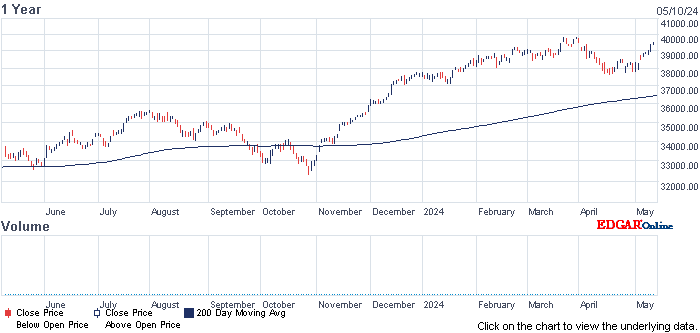
Dow Jones Industrials


AMJ (Alerian MLP Index tracking fund)


Construction spending rose 0.8% to a seasonally adjusted annual rate of $1.3T in Nov from a revised $1.29T in Oct, helped by housing, the Commerfce Dept said. The forecast called for a 0.2% increase, but Oct figures were revised down. Outlays in Nov were 3.4% higher than a year ago, & for the first 11 months of 2018, were 4.5% higher than the same period in the prior year. Residential construction spending was up 3.4% during the month & was 0.6% higher for the year. That's good news for the supply-starved housing sector. In Nov, overall private-sector spending was 1.3% higher for the month, edging out a 0.9% decline in public-sector spending.
Construction spending ticks up, led by housing
The Univ of Mich consumer-sentiment index plunged to a reading of 91.2 in Jan from 98.3 in Dec, the worst since Trump was elected pres. That was a touch better than the mid-Jany reading of 90.7. The gov shutdown rattled consumers &, unlike previous bouts, the numbers didn't materially improve even after 800K workers went back to work. That's because there’s the possibility of another shutdown on Feb 15, as Congressional negotiators remain at an impasse over funding the border wall desired by Trump. Both the current conditions & expectations index fell during Jan. This level of confidence is consistent with 2.6% annual growth in consumer spending, the Univ of Mich said. If job gains continue — & in Jan, the US added 304K positions — spending should continue. “Even small spending cutbacks, occurring simultaneously across the majority of consumers, could push the economy into a recessionary downturn. Each proponent in the shutdown debate appears to put more weight on the political rather than on the economic implications of their actions,” said Richard Curtin, chief economist of the survey.
Consumer sentiment in January falls to worst level since Trump election
American manufacturers say business picked up in the first month of 2019 after moderating sharply in Dec. The Institute for Supply Management said its manufacturing index rebounded in Jan to 56.6% from 54.3% in the prior month & was up 58.8 in Nov. The latest reading, derived from a survey of execs, exceeded the forecast of 54.3%. Readings over 50% indicate more companies are expanding instead of shrinking & readings above 55% are seen as exceptional. New orders picked up sharply in Jan after a decline in the prior month. Production & employment also increased while prices contracted. 14 of the 18 manufacturing industries surveyed expanded in Jan. Only one industry, nonmetallic mineral products, reported contraction. Tim Fiore, chair of the ISM manufacturing survey, said the ISM factory index looks like it can stay in a range of 54%-56% this year. While down from the last year's pace, it’s still quite positive, he said. The index hit 60.8 in Aug, the best reading since May 2004. “We’re transitioning from very high level of expansion to expansion,” he added. The rebound in Jan removed some concern with the manufacturing sector. Economists were worried that foreign growth, the strong $ & the gov shutdown might weigh on manufacturing sentiment.
ISM manufacturing index rebounds in January, easing worries about the sector
Oil futures settled higher, with US benchmark prices up almost 3% for the week. Political turmoil in Venezuela, declines in OPEC crude output & a weekly fall in the US oil-rig count all contributed to the price gains. Mar West Texas Intermediate oil rose $1.47 (2.7%) to settle at $55.26 a barrel, the highest finish for a front-month contract since Nov 19.
Oil futures settle higher for the session, with the U.S. benchmark up nearly 3% for the week
Pres Trump said, "I think there's a good chance we'll have to" declare a national emergency in order to appropriate the funds to build his border wall. Trump wouldn't say he would definitely declare it, but he said reporters that such a declaration "would help the process." The remarks came as a specially created committee in Congress is poised to spend the next 2 weeks trying to reach a compromise on border security before the current short-term gov funding bill expires on Feb 15. If no deal is reached, then Trump could decide to either partially shut down the gov for the 2nd time this year, or potentially sign a bill funding federal agencies, & then use his exec powers to declare a national emergency on the southern border. This could allow the pres to commandeer funds that have already been appropriated by Congress for other purposes, such as disaster relief, & use them to pay for the construction of a wall. But such a declaration would almost certainly be challenged in court. There, the administration could find it challenging to make the argument that the immigration situation on the southern border, which has not materially changed in several months, merits an emergency declaration only now, after Trump was unable to secure the needed funds from Congress. When asked if he was concerned about courts halting an emergency declaration, Trump replied, "we have very, very strong legal standing to win," adding it would be "very hard" for a court to enjoin the declaration. Trump also declared several times that the wall was already being built. He was presumably referring to stretches of both new wall & replacement wall that were approved & paid for last year with 2018 funding, but which are slated to begin construction later this winter. "We're building the wall, and we're building a lot of wall," the pres said, "but I can do it a lot faster the other way."
Trump: ‘There’s a good chance we’ll have to’ declare a national emergency to build the wall
The bulls were busy calculating their recent profits, so they were largely absent from trading. The Dow did well in the AM. But sellers returned & trimmed most of the early gains (although it finished above 25K). NAZ was in the red for most of the day. While less than spectacular, economic data has been fairly good all considered. After one week working on a southern boarder solution, dysfunctional DC has shown it continues to live up to its name. It's mind boggling that those guys will get their act together with just 2 weeks left. They could not even pass a resolution to kick the can down the road for another month (whatever). Then there are the talks with China. On that there is a chance something will be decided this month, especially with China being pressured by its stumbling economy. The Brexit future is another problem that needs fixing. This work has gotten less attention than it deserves. The post Christmas eve rally shown below is difficult to understand given a sharp increase in uncertainty. Next week we may learn more.
Dow Jones Industrials


