Tuesday, April 2, 2019

Markets pause after yesterday's rally

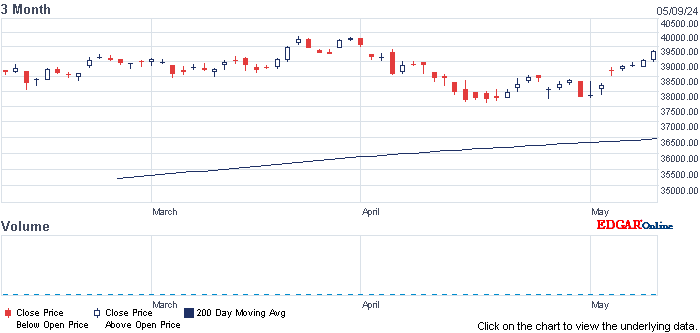
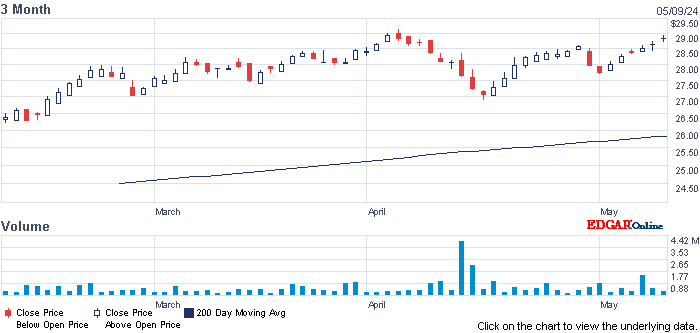
Dow sank 84, advancers over decliners 4-3 & NAZ edged up 10.  The MLP index inched up to the 258s & the REIT index fluctuated.  Junk bond funds were mixed & Treasuries crawled higher in price.  Oil climbed to the 62s & gold was steady at 1294.

AMJ (Alerian MLP Index tracking fund

CL=FCrude Oil62.19
+0.60+1.0%

GC=FGold   1,294.10
 -0.10 -0.0%


3 Stocks You Should Own Right Now - Click Here!


Federal banking agencies proposed a rule they said was aimed at limiting the impact of the failure of a large bank.  At the moment, the world's biggest banks are required to issue debt that would convert to equity if they go bankrupt.  The proposed rule from the Federal Reserve, the Federal Deposit Insurance Corp & the Office of the Comptroller of the Currency is meant to discourage the largest global banks from buying the debt-to-equity issuance from their peers by essentially putting a penalty on such purchases.  "This would reduce interconnectedness between large banking organizations and, if [one] were to fail, reduce the impact on the financial system from that failure," the agencies said in a notice seeking public comment.

U.S. regulators propose rule aimed at limiting impact of large bank failure


Walgreens Boots Alliance (WBA), a Dividend Aristocrat, reported quarterly earnings & revenue that missed & lowered its forecast for 2019 in what CEO Stefano Pessina called the "most difficult" quarter since acquiring European drugstore chain Alliance Boots in late 2014.  The company now expects full-year EPS for 2019 to be roughly flat, compared with its previous forecast of 7-12% growth.  The company also said it would cut more than $1.5B in costs by fiscal 2022, up from the $1B it announced last qtr.  "The market challenges and macro trends we have been discussing for some time accelerated, resulting in the most difficult quarter we have had since the formation of Walgreens Boots Alliance," Pessina said.  EPS was $1.64, missing the estimate for $1.72 & revenue also fell short, coming in at $34.53B.   Analysts had been looking for $34.56B.  It generated $1.24 per share, down from $1.36 per share a year earlier.  On an adjusted basis, which excluded foreign currency fluctuations & a few other items, EPS was $1.64, below the $1.72 expected.   While analysts were expecting a bad qtr, they weren't prepared for it to be as bad as it was & for WBA to fall short in so many different areas.  Same-store sales declined 3.8%, which was primarily because of a weak cough, cold & flu season compared to last year.  The stock tumbled 7.72 (12%).
If you would like to learn more about WBA, click on this link:
club.ino.com/trend/analysis/stock/WBA?a_aid=CD3289&a_bid=6ae5b6f

Walgreens shares slide as drugstore chain misses earnings estimates, lowers 2019 forecast

General Motors (GM) reported Q1 sales that fell 7% from the same period last year, but the automaker said buyers are still flocking to its sport utility vehicles & pickup trucks.  Transaction prices, the final sales price, on the newest pickups rose $8040 compared with the outgoing models in the same qtr of 2018, reflecting the continued interest among buyers for well-equipped trucks.  More than 96% of the GMC Sierra crew cab pickup, a 4-door full-size truck, were sold with more expensive high-end trims.  Signs have shown that new car sales are slowing in the US.  Yet demand for trucks & SUVs, which tend to be more profitable, could buoy automakers & somewhat offset the effects of a slowdown.  Trucks, SUV's & crossovers made up 80% of GM's sales, the company said. The company said sales of smaller crossovers such as the Chevrolet Trax & Equinox, as well as its midsize Chevrolet Colorado pickup, all set first qtr sales records, while the GMC Acadia SUV had its best qtr ever.  GM plans to launch more full-size pickup trucks in H2 with 2 new heavy duty pickups from Chevrolet & GMC.  "We are bullish on pickups and expect to gain sales momentum throughout the year," said GM VP-US sales operations Kurt McNeil.  "We are installing capacity in Flint to build more HD pickups in total, more crew cab models, more dualies and diesel models, too, all in response to dealer and customer demand."  The stock added 12¢.
If you would like to learn more about GM, click on this link:
club.ino.com/trend/analysis/stock/GM?a_aid=CD3289&a_bid=6ae5b6f

GM sales fall, but buyers continue to clamor for trucks and SUVs

After selling at the opening, buyers are coming back but slowly.  With an absence of economic news, not much for traders to do.  The bulls have their eyes on setting a new record for the Dow.

Dow Jones Industrials


Monday, April 1, 2019

Markets surge on optimism for the new quarter

Dow soared 329 (closing near session highs), advancers over decliners 5-2 & NAZ went up an impressive 99.  The MLP index added 2+ to the 257s & the REIT index was off 1 to the 279s (still lofty levels for the index).  Junk bond funds also rose as they were purchased & Treasuries were hit with selling pressure, taking the yield on the 10 year Treasury up a very big 8 basis points to about 2.5%.  Oil jumped up 1+ to the 61s (more below) & gold fell 6 to 1292.

AMJ (Alerian MLP Index tracking fund)


Manufacturing activity in China expanded unexpectedly in Mar at its fastest pace in 8 months, a private survey showed.  The Caixin/Markit Manufacturing Purchasing Managers' Index (PMI) came in at 50.8 for Mar.  Analysts had expected it to come in at 49.9 for a 2nd month.  A reading below 50 signals contraction, while a reading above that level indicates expansion.  New orders climbed to their highest level in 4 months, while the index for new export orders returned to expansionary territory, "showing that both domestic & external demand rebounded moderately," according to the CEBM Group, a subsidiary of Caixin.  Markit & Caixin said that staffing levels at factories rose in Mar to mark their first expansion since Oct 2013.  Some firms also hired additional workers to support greater production & new business developments, they added.  "Overall, with a more relaxed financing environment, government efforts to bail out the private sector and positive progress in Sino-U.S. trade talks, the situation across the manufacturing sector recovered in March," said the survey director.  Results of the private survey came after data showed the official Purchasing Managers' Index rose to 50.5 in Mar from Feb's 3-year low of 49.2.  It marked the first expansion in 4 months, according to data released by China's National Bureau of Statistics.  The manufacturing numbers come amid ongoing tariff talks between the US & China aimed at resolving their trade differences.  High-level trade negotiations between the 2 economic powerhouses are set to resume in DC this week following last week's talks in Beijing.  The Caixin PMI is a private survey focused on smaller businesses & offers a first glimpse into the operating environment.  It is closely watched as an alternative to the official PMI.

China's factory activity unexpectedly grows in March, a private survey shows

The S&P 500 just posted its best start to a year in more than 2 decades & according to a majority of professionals, the market outlook remains positive.  More than 96% of respondents to CNBC's survey said they do not see a recession in the next year & about 70% saying they are optimistic.  Not a single strategist among the 27 respondents had a negative outlook.  Just under 30% are neutral overall, which is lower than the 34% from last qtr's survey.  Stocks started the year on a strong foot after a steep slide at the end of 2018.  Fears that rocked markets in Q4 — namely concerns over a global growth slowdown, uncertainty surrounding ongoing trade negotiations between the US & China & worries that the Federal Reserve might be making a policy mistake, seemed to abate over the last qtr.  Investors reentered the market  in Jan, leading to a gain over 13% YTD for the S&P.  A solid majority, 81%, said they believe stocks are correctly valued.  Just under 15% said equities look cheap, while less than 4% think valuations are stretched.  Some bears have cited a slowdown in corp earnings as a reason to get out of the market.  While Q1 earnings expectations may be negative, according to the latest data which is expected to contract 1.9%, a majority of pros are still optimistic.  About 59% said they believe results will top expectations, with 22% expecting earnings to match estimates.  Part of this optimism could be a belief that companies were overly conservative when lowering expectations.  As Brexit uncertainty, weakness in Japan & falling German yields weigh on global markets, US equities saw record inflows last month, according to Bank of America Merrill Lynch.  While the picture in the US might not be entirely rosy, ¾ of survey respondents said it is still the best place to invest.  Nearly 78% said they favor the US, with about 19% saying emerging markets is the better bet.  The EEM (an ETF that tracks emerging economies) has gained roughly 10% this year.  Tech is the top-performing sector this year & a majority of respondents indicated that they believe the group will continue to lead.  Nearly 78% called it a top pick.  Health care & energy were 2 other popular choices, with roughly 48% & 30%, respectively, of strategists saying they look attractive at current levels.  Health care did turn in a positive Q1, but its 6% gain lagged all other sectors.  Energy is one of only 2 sectors still in correction territory, more than 10% off its recent high.  Financials is the sole other sector in correction & about 26% of pros saying they think there's opportunity in bank stocks.

Majority of Wall Street pros say no recession on the horizon, US still best place to be: CNB

Oil bulls began Q2 where they left off the first, pushing crude sharply higher on signs of tightening supplies & fading worries over global economic growth.  West Texas Intermediate crude for May delivery rose $1.45 (2.4%) to settle at $61.59 a barrel, its highest close since Nov 7.  The US benchmark logged a 32.4% rise over the first 3 months of 2019, its strongest quarterly advance since the Q2-2009.  The global benchmark, Jun Brent crude ended $1.43 higher at $69.01 a barrel, a 2.1% gain.  Brent logged a roughly 25% quarterly rise, also its strongest since 2009.  Bloomberg said its survey found output from OPEC will fall for a 4th month in Apr, with Saudi Arabia continuing to curb output & Venezuelan production suffering as an economic & political crisis deepened.  OPEC output fell 295K barrels a day to 30.385M, the survey found.  Another survey found OPEC members pumped 30.4M barrels a day in Mar, down 280K barrels a day from Feb & the lowest OPEC total since 2015.  Demand-side optimism picked up after the Caixin-Markit China manufacturing purchasing managers index rose above 50 in Mar, indicating growth.  The Feb reading came in below 50, which showed economic contraction.  But analysts cautioned that rising prices could lead to a pickup in US output after a recent stall in drilling activity.  Futures prices remain solidly higher YTD on signs of reduced global supplies on the back of efforts by major oil producers to curb production.  Members of OPEC & other major oil producers, including Russia, have pledged to curb crude production by around 1.2M barrels a day from Oct levels for H1 to prop up markets.

Oil surges to nearly 5-month high on tightening supply, fading worries over global growth


A high level of optimism brought out stock buyers today.  They are feeling good about the new qtr even if the last one was sluggish.  This level of optimism will be tested.  The US economy will have to show a significant pickup, currently plagued with 2 major sectors (home building & autos) stumbling.  The US-China trade talks need a lot more work, to say the least.  Brexit is going nowhere fast & other economies are not doing well.  The Fed should be helpful for investors if there are no more rate hikes this year.  And safe haven investments (gold & Treasuries) were sold recently.  To make the bulls happy, the global economies will have to deliver growth to support the current level of optimism.

Dow Jones Industrials


Higher markets on strong US and China data

Dow shot up 236, advancers over decliners 5-2 & NAZ gained 58.  The MLP index added 3+ to the 258s (still stuck in a sideways pattern) & the REIT index gave back 1 to the 379s.  Junk bond funds climbed higher & Treasuries were hit with heavy selling as stocks werre purchased.  Oil rose to nearly 61 & gold slid back 2 to 1296.

AMJ (Alerian MLP Index tracking fund


CL=FCrude Oil60.76
+0.62+1.0%

GC=FGold   1,300.30
+1.80+0.1%


3 Stocks You Should Own Right Now - Click Here!


Stocks began Q2 with robust gains on strong China manufacturing data from two reports.  The Chinese gov statistics bureau said its monthly purchasing manufacturers' index (PMI) rose to 50.5 on a 100-point scale on which numbers above 50 show activity rising, up 1.3 points from Fe.  Also, China's Caixin/Markit Manufacturing PMI unexpectedly rose to 50.8 versus forecasts it would hold steady at 49.9.  Like the official gov report it's also the first reading above 50 since Nov, in addition to being the strongest growth since Mar.  Both reports are easing worries about an economic slowdown in China, particularly after some recent disappointing data on industrial output.  US-Chinese trade talks are due to resume in DC after a round in Beijing last week that Treasury Secretary Steve Mnuchin described as "constructive."  Prospects of a resolution to the trade conflict between the 2 largest economies buoyed investor sentiment.  Chinese & American officials are aiming to put to rest a dispute over technology & other issues.  Chinese Vice Premier Liu He is expected to travel to DC next week.  Japan's Nikkei 225 index rose 1.4% to 21,509, easing off earlier highs after economic data showed conditions for manufacturers deteriorating.  The Shanghai Composite index popped 2.6% to 3170 & Hong Kong's Hang Seng increased 1.7% to 29,554.  European shares were climbing despite bad economic reports there, with Germany's DAX gaining 1% to 11,645.  The CAC40 in Fran advanced 0.5%  to 5378 & Britain's FTSE 100 rose 0.6% to 7324.

US stocks climb on strong China manufacturing data

US retail sales unexpectedly fell in Feb, the latest sign economic growth has shifted into low gear as stimulus from $1.5T in tax cuts & increased gov spending fades.  The weak report from the Commerce Dept joined a raft of other soft data, including housing starts & manufacturing production that have left economists anticipating a sharp slowdown in growth in Q1.  The loss of economic momentum also reflects higher interest rates, slowing global growth, the trade war with China & uncertainty over Britain's departure from the EU.  These factors contributed to the Federal Reserve's decision last month to abruptly end its 3-year campaign to tighten monetary policy.  The central bank abandoned projections for any interest rate hikes this year after increasing borrowing costs 4 times in 2018.  Retail sales dropped 0.2% as households cut back on purchases of furniture, clothing, food & electronics & appliances, as well as building materials & gardening equipment.  Data for Jan was revised higher to show retail sales increasing 0.7% instead of gaining 0.2% as previously reported.  The forecast called for retail sales rising 0.3% in Feb.  Retail sales in Feb advanced 2.2% from a year ago.  The surprise drop in sales in Feb could partly reflect delays in processing tax refunds in the middle of the month.  Tax refunds have also been smaller on average compared to prior years following the revamping of the tax code in Jan 2018.  Cold & wet weather could also have hurt sales.  The Feb retail sales report was delayed by a 35-day partial gov shutdown.  Growth estimates for the Jan-Mar qtr are as low as a 0.8%  annualized rate.  The economy grew at a 2.2% rate in Q4 after expanding at a 3.4% clip in the Q3 period.

US retail sales weak in February, underscore slowing economy

US manufacturing activity rebounded a bit more than expected in Mar, according to an industry report, as production, new orders & hiring all picked up.  The Institute for Supply Management (ISM) said its index of national factory activity rose to 55.3 from 54.2 in Feb, which had marked the lowest level since Nov 2016.  The reading was slightly above expectations of 54.5.  A reading above 50 indicates expansion in the manufacturing sector & a reading below 50 indicates contraction.  The employment index rose to 57.5 from 52.3 a month earlier.  Expectations called for a reading of 52.4. The new orders index rose to 57.4 from 55.5 in Feb.  The prices paid index rose to 54.3, indicating that prices producers are paying for materials rose for the first time since Dec.  Production also picked up, with that index at ticking up to 55.8 from 54.8 the month before.  Construction spending increased for a 3rd straight month, boosted by gains in both private & public construction projects, offering some good news on the economy following a string of weak reports.  The Commerce Dept said that construction spending rose 1.0% to a 9-month high after an upwardly revised 2.5% surge in Jan.  The forecast called for construction spending falling 0.2% in Feb after a previously reported 1.3% jump in Jan.  Construction spending increased 1.1% on a year-on-year basis in Feb.  Spending on private construction projects rose 0.2% after vaulting 1.5% in Jan.  Investment in private residential projects increased 0.7%, rising for a 3rd straight month.  The strong gains are despite a sluggish housing market, which has been held back by higher mortgage rates, expensive building materials as well as land & labor shortages.  But there are signs of green shoots emerging in the housing market as mortgage rates have declined from last year's lofty levels.  Spending on private nonresidential structures, which includes manufacturing & power plants, fell 0.5% in Feb after jumping 1.1% in Jan.  Investment in public construction projects rose 3.6% after accelerating 5.7% in the prior month.  Spending on federal gov construction projects rose 0.9% to the highest level since Oct 2017, after soaring 5.7% in Jan.  Investment in state & local gov construction projects rose 3.8% after surging 5.7% in Jan.

Manufacturing activity rebounds in March, construction spending hits 9-month high in February

Americans are finally tapping the brakes when it comes to buying new vehicles, according to analysis of Q1 sales by JD Power.  The firm, which analyzed data from automakers and dealers in the first 3 months of year, estimates the annual sales rate during Q1 was 16.7M vehicles in the US.  Depending on the final numbers reported by automakers later this week, the pace of sales during Q1 could be lowest since Q4-2014, when the research firm Autodata calculated a sales rate of 16.69M vehicles.  "I think we're starting to see a slowdown," said Dave Habiger, CEO of JD Power.  "That said, the consumer remains strong."  Most execs in the auto industry have predicted 2019 will be the first year since 2014 when annual sales in the US fall below 17M vehicles.  Factors including the number of new vehicles sold in recent years, higher interest rates & higher monthly auto loan payments are expected to prompt some potential buyers to rethink their plans.  But JD Power says the end of "peak auto" doesn't mean sales & profits will plunge for automakers.  In fact, its data shows the shift from less profitable cars to far more expensive SUVs & pickups, a transition that will help ease the impact of overall sales cooling off.  In Q1, 48% of the new vehicles sold were utility vehicles — pickups, SUVs & crossover utility vehicles, an increase of 2% from a year earlier.  In addition, the average revenue per utility vehicle collected by automakers in Q1 climbed $800 to $33,100 according to JD Power.  The firm's analysis found the average revenue per pickup truck sold in Q1 jumped $1200 to $41,500 over the same time last year.  While retail sales of new vehicles fell in Q1, used auto sales at franchise auto dealers continued to climb, increasing 5.3% from the first Q1-2018.

Auto sales projected to slow to lowest level in more than 4 years despite SUV and truck

The stock market began the new month/qtr with the investors bidding up prices.  The Dow is well over 26K & closing in on its record high.  However, retail sales were not encouraging & much of the economic data for Feb may also be unimpressive.  For the time being, the bulls are in command.

Dow Jones Industrials