


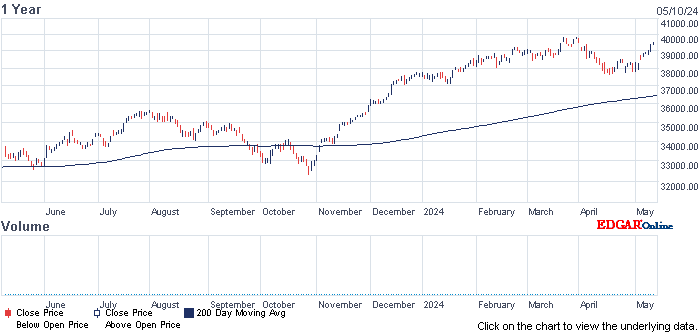
Dow dropped 162 (session lows), decliners over advancers almost 2-1 & NAZ pulled back 45. The MLP index went up about 1 to 251 & the REIT index rose fractionally to 379. Junk bond funds were mixed & Treasuries slid lower in price. Oil fell in the 63s (more below) & gold fell 8 to 1277.
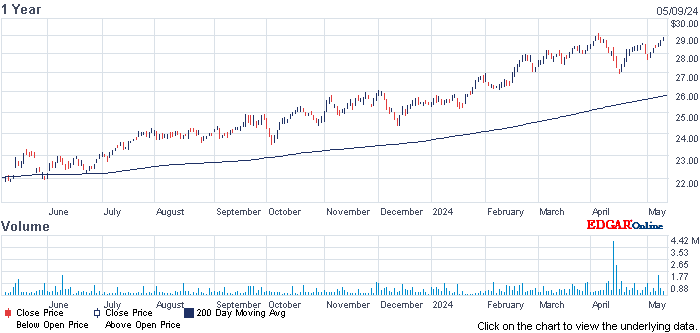
AMJ (Alerian MLP Index tracking fund)
![Live 24 hours gold chart [Kitco Inc.]](https://www.kitco.com/images/live/gold.gif?0.2180338269244485)


The Federal Reserve feels comfortable with current policy & is likely to keep interest rates steady for an extended period of time, Chairman Jerome Powell said. “We do think our policy stance is appropriate right now. We don’t see a strong case for moving in either direction,” Powell said after the central bank's policy meeting. In a move that met market expectations, the FOMC unanimously voted to keep the benchmark rate at 2.25-2.5%. Pres Trump has exerted an unusual level of public pressure to get the Fed to lower rates, suggesting yesterday that a 1 percentage point cut would be in order. Without addressing Trump's criticisms directly, Powell said that absent a significant change in conditions, the current policy will prevail. The pres has cited low inflation as a key reason for the Fed to cut. Powell, though, said that he expects inflation to run close to the central bank's 2% goal. “If we did see inflation running persistently below [the goal], that is something the committee would be concerned about, something we would take into account when setting policy,” Powell said. The Fed's favored inflation gauge showed a 12-month gain of 1.6% in Mar. Powell acknowledged that the reading was below what he had expected, but he called the pressures that drove inflation lower “transient” & likely to revert as the reading gets closer to the Fed's goal.
Powell says Fed doesn’t see strong case for rate cut or hike
A US-China trade deal is ‘possible’ by next Friday, sources say
US oil prices finished lower after a US gov report revealed a nearly 10M-barrel rise in domestic crude supplies, the biggest weekly climb YTD. Global benchmark prices for oil, however, ended the session modestly higher, finding continued support from risks to global supplies. The latest move for prices follows gains seen in Apr as Saudi Arabia looked to defy Pres Trump's request to pump more oil to keep down prices & as a fresh uprising in Venezuela fed uncertainty over the country's output. West Texas Intermediate crude for Jun delivery lost 31¢ (0.5%) to settle at $63.60 a barrel. Front-month contract prices notched an Apr rise of 6.3%, their 4th straight monthly gain. WTI prices saw some support, paring a bit of their earlier losses, as the $ weakened further in the immediate wake of the Fed's decision to hold the rate policy steady. The $ then moved back up just as oil futures settled. Global benchmark Jul Brent crude which is now the front month, added 12¢ to $72.18 a barrel on. Front-month contract prices were up about 6.5% for last month. Brent hit a 6-month high above $75 as recently as last week before drifting mostly lower since. The Energy Information Administration reported that US crude supplies rose 9.9M barrels last week. That surpassed the rise of 1.4M barrels expected. Data from the American Petroleum Institute yesterday had shown an increase of 6.8M. Earlier this week, Saudi Arabia’s energy minister Khalid al-Falih said that The Kingdom won't rush to raise oil supplies to make up for Iranian oil lost due to US sanctions. He also said the Saudis will adhere to the production-cut agreement led by OPEC & may extend that agreement, which expires in late Jun, to the end of this year. OPEC oil supply hit a 4-year low of 30.2M barrels a day in Apr. Lower supply in 2 of the producers exempt from the OPEC pact, Iran & Venezuela, more than offset gains elsewhere. Meanwhile, supplies on the global market from Venezuela remain in question. US-backed Venezuelan opposition leader Juan Guaidó has called for an uprising with military support to overthrow Pres Nicolás Maduro. Protests from both sides continued today. In Venezuela, supply fell by 100K barrels per day due to the impact of US sanctions on state oil company PDVSA & a long-term decline in production.
Stocks declined after Powell described subdued inflation as "transitory" which may have upset traders. Apple (AAPL), a Dow & NAZ stock, finished the session up 10 (off session highs) after its earnings report. But that wasn't good to calm investor nerves for stocks. A possible trade deal with China is being worked on. Now investor want to see results.
Dow Jones Industrials


AMJ (Alerian MLP Index tracking fund)


Federal Reserve officials unanimously voted to leave interest
rates unchanged during their 2-day meeting this week, with
policymakers continuing to signal that they will be patient with
monetary policy moving forward. "We do think
our policy stance is appropriate right now," Chairman Jerome Powell said
after the meeting's conclusion. "We don’t
see a strong case for moving in either direction." Keeping rates steady was widely expected by the central bank as it sought to strike a
balance between overarching geopolitical concerns, muted inflation &
otherwise "solid" economic growth. In Q1, GDP
increased at a better-than-expected annualized rate of 3.2% & unemployment, meanwhile, remained at 3.8%. But Fed officials mostly looked beyond the good rate of economic growth in the 3-month period from Jan-Mar,
instead favoring a wait-&-see approach as they watch how certain
economic & financial developments – like a global trade war, &
uncertainties surrounding Brexit – play out. “In
light of global economic & financial developments and muted inflation
pressures, the Committee will be patient as it determines what future
adjustments to the target range for the federal funds rate may be
appropriate to support these outcomes,” the Fed statement said. The decision, however, could provide additional fodder to Pres Trump, who's frequently suggested that policymakers should cut interest rates by one percentage point & implement more quantitative easing because inflation is so low. At
their last meeting, Fed policymakers signaled there would be no rate
hikes for the remainder of 2019 in light of global economic &
financial developments, as well as muted inflation. The move was a stark
turn from the Dec meeting when Fed Chairman Jerome Powell
suggested there could be as many as 2 hikes this year. Since
then, inflation has considerably decelerated, running below the target
range of 2%. Powell has previously emphasized the importance of
the 2% inflation range, which he said is consistent with a
healthy economy. In Mar, the core personal consumption expenditures
index -- which excludes food & energy prices -- was up 1.6%,
compared to the year-ago period.
Fed keeps interest rates steady, citing muted inflation
The Federal Reserve feels comfortable with current policy & is likely to keep interest rates steady for an extended period of time, Chairman Jerome Powell said. “We do think our policy stance is appropriate right now. We don’t see a strong case for moving in either direction,” Powell said after the central bank's policy meeting. In a move that met market expectations, the FOMC unanimously voted to keep the benchmark rate at 2.25-2.5%. Pres Trump has exerted an unusual level of public pressure to get the Fed to lower rates, suggesting yesterday that a 1 percentage point cut would be in order. Without addressing Trump's criticisms directly, Powell said that absent a significant change in conditions, the current policy will prevail. The pres has cited low inflation as a key reason for the Fed to cut. Powell, though, said that he expects inflation to run close to the central bank's 2% goal. “If we did see inflation running persistently below [the goal], that is something the committee would be concerned about, something we would take into account when setting policy,” Powell said. The Fed's favored inflation gauge showed a 12-month gain of 1.6% in Mar. Powell acknowledged that the reading was below what he had expected, but he called the pressures that drove inflation lower “transient” & likely to revert as the reading gets closer to the Fed's goal.
Powell says Fed doesn’t see strong case for rate cut or hike
The announcement of a US trade deal with China is “possible” by next Fri, leakers have said. A
US delegation met with Chinese negotiators in Beijing today as
the world's 2 largest economies try to hammer out details of an
agreement. Chinese Vice Premier Liu He will travel to DC for
talks next week. The US & Beijing have pushed to resolve a trade dispute that led to a series
of tariffs & raised fears about spiraling economic damage. While both
sides have repeatedly touted progress in talks, disputes such as
whether to immediately remove existing tariffs or keep them in place as
an enforcement measure to stop practices such as intellectual property
theft have derailed a final deal. Pres Trump also wants China to buy more US goods to reduce the trade deficit between the countries. Today, the White House said the latest talks moved DC &
Beijing closer to an agreement. White House press
secretary Sarah Huckabee Sanders said “discussions remain focused
toward making substantial progress on important structural issues and
rebalancing the US-China trade relationship.” White House chief of staff Mick Mulvaney said yesterday that the US should know “one way or the other in the next couple weeks” how the trade talks will be resolved. Reports have suggested the Trump administration could yield on some provisions as part of the deal. As part of a final agreement, the US
could immediately remove a 10% duty on part of the $200B in
Chinese goods on which it levied tariffs
A US-China trade deal is ‘possible’ by next Friday, sources say
US oil prices finished lower after a US gov report revealed a nearly 10M-barrel rise in domestic crude supplies, the biggest weekly climb YTD. Global benchmark prices for oil, however, ended the session modestly higher, finding continued support from risks to global supplies. The latest move for prices follows gains seen in Apr as Saudi Arabia looked to defy Pres Trump's request to pump more oil to keep down prices & as a fresh uprising in Venezuela fed uncertainty over the country's output. West Texas Intermediate crude for Jun delivery lost 31¢ (0.5%) to settle at $63.60 a barrel. Front-month contract prices notched an Apr rise of 6.3%, their 4th straight monthly gain. WTI prices saw some support, paring a bit of their earlier losses, as the $ weakened further in the immediate wake of the Fed's decision to hold the rate policy steady. The $ then moved back up just as oil futures settled. Global benchmark Jul Brent crude which is now the front month, added 12¢ to $72.18 a barrel on. Front-month contract prices were up about 6.5% for last month. Brent hit a 6-month high above $75 as recently as last week before drifting mostly lower since. The Energy Information Administration reported that US crude supplies rose 9.9M barrels last week. That surpassed the rise of 1.4M barrels expected. Data from the American Petroleum Institute yesterday had shown an increase of 6.8M. Earlier this week, Saudi Arabia’s energy minister Khalid al-Falih said that The Kingdom won't rush to raise oil supplies to make up for Iranian oil lost due to US sanctions. He also said the Saudis will adhere to the production-cut agreement led by OPEC & may extend that agreement, which expires in late Jun, to the end of this year. OPEC oil supply hit a 4-year low of 30.2M barrels a day in Apr. Lower supply in 2 of the producers exempt from the OPEC pact, Iran & Venezuela, more than offset gains elsewhere. Meanwhile, supplies on the global market from Venezuela remain in question. US-backed Venezuelan opposition leader Juan Guaidó has called for an uprising with military support to overthrow Pres Nicolás Maduro. Protests from both sides continued today. In Venezuela, supply fell by 100K barrels per day due to the impact of US sanctions on state oil company PDVSA & a long-term decline in production.
U.S. oil prices fall as U.S. crude supplies post biggest weekly climb of the year
Stocks declined after Powell described subdued inflation as "transitory" which may have upset traders. Apple (AAPL), a Dow & NAZ stock, finished the session up 10 (off session highs) after its earnings report. But that wasn't good to calm investor nerves for stocks. A possible trade deal with China is being worked on. Now investor want to see results.
Dow Jones Industrials


