Tuesday, July 2, 2019

Markets waver on trade uncertainties

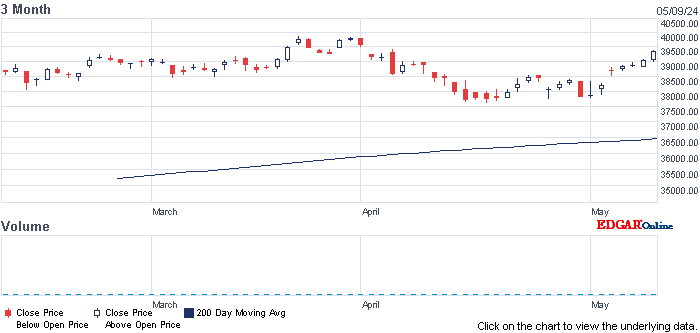
Dow  went up 6, advancers slightly ahead of decliners & NAZ was flattish.  The MLP index lost 1 to the 249s & the REIT index rebounded 5+ to the 387s.  Junk  bond funds crawled higher & & Treasuries were purchased again.  Oil fell 1+ to the 57s after yesterday's advance & gold rose 6 to 1395.

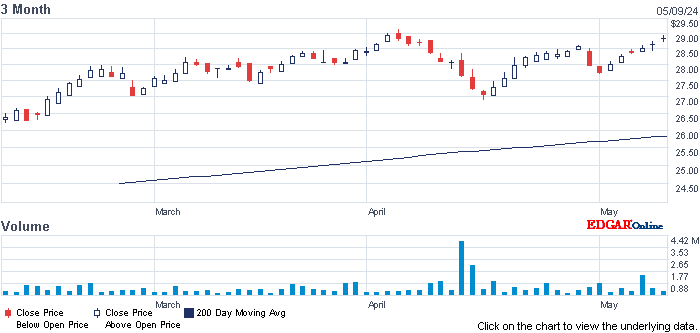
AMJ (Alerian MLP Index tracking fund)

CL=FCrude Oil58.11
  -0.98 -1.7%

GC=F   Gold1,395.00
 +5.70+0.4%


3 Stocks You Should Own Right Now - Click Here!


Stocks are trading lower, a day after  the S&P 500 set its 6th record close of the year.  After yesterday's rally, investors were skeptical of further gains for equities after discouraging manufacturing surveys & a US threat of additional tariffs on European goods.  In Asia, the major markets closed mixed.  China's Shanghai slipped back & Hong Kong's hang Seng added 1.2% as the market caught up to yesterday's rally when Hong Kong markets were closed for a holiday.  Japan's Nikkei inched higher.  In Europe, London's FTSE was higher by 0.5% Germany's DAX was little changed & France's CAC was slightly higher.  The broad-based S&P 500 stock index set a record high yesterday, beginning July trading on a robust note as investors reacted to the US & China agreeing at the G20 summit to restart trade talks.

US stocks take a breather after record day

China will broaden the ability of some foreign firms to invest in the country a year earlier than expected, a move that comes as trade talks with the US begin again in earnest.  “We will move up the lifting of foreign capital limits in securities, futures and life insurance, from 2021 to 2020,” Premier Li Keqiang, China's 2nd-ranking official, said at the World Economic Forum.  “This shows China’s commitment to opening up.”  While it's a small gesture towards improving the relationship with the Trump administration after trade talks fell apart in May, the move won't satisfy the White House's more sweeping demands that China amend its laws to protect US business interests in the country.  At the recent G20 summit in Japan, Trump & Chinese Pres Xi Jinping agreed to relaunch trade talks & withhold the imposition of any new tariffs.  Negotiations between the 2 nations broke down when China backtracked on previously agreed upon terms.  In Mar, China made changes to its existing law governing foreign investment in an effort to address complaints that the gov doesn't adequately ensure the safety of American intellectual property, but critics said the overly broad measure did not go far enough in addressing those concerns.  Alongside the decision on financial investment, Li also made a tenuous commitment to not devalue its currency, a pledge that could help stabilize the trading relationship with the US.  As the value of the renminbi, the Chinese currency, declines relative to the $, it makes exports from the Asian nation cheaper in comparison.

China just extended an olive branch to the US as trade talks restart

This month marks the 121st month of the economic expansion arising out of the great financial crisis, making it the longest run on record going back to 1854.  This cycle, starting in Jun 2009, breaks the record of 120 months of economic growth from 1991-2001, according to the National Bureau of Economic Research.  Perhaps because of the overhang of the housing crisis, this run has been weaker than past expansions in total.  The cumulative total of quarterly GDP growth figures equals 25%, far lower than previous booms.  While the unemployment rate has dropped from a peak of 10% in Oct to 3.6% in May, the lowest since 1969, job growth has been relatively slower than during other postwar recoveries.   But despite some internal weakness, this expansion keeps trucking along, getting its latest boost from the Trump tax cut of 2018 along with a relaxation in business regulations.  However, it now appears to need some help if it’s going to continue to rewrite the record books.  The Atlanta Fed's closely watched GDPNow tracker is pointing to just a 1.5% gain for the economy in Q2 after a strong gain of 3.2% in Q1.  CNBC's Rapid Update survey puts the GDP tracking estimate at 1.8%.  All eyes will be on the jobs report on Fri for the state of the economy.  The forecast is for 158K jobs created in Jun, up sharply from the disappointing 75K in May.  The unemployment rate is expected to remain unchanged at 3.6%.  Analysts are divided on whether this expansion is going to last.  Some believe the Federal Reserve will save the day thru cutting interest rates, while some think additional stimulus cannot combat the looming downturn or that the Fed won't be aggressive enough to stave it off.  The corp earnings picture certainly doesn't look promising.  Now 77% of companies issuing pre-announcements say their profits will be worse than estimates, which marks the 2nd-worst quarter on record going back to 2006.

This is now the longest US economic expansion in history

Just days after reaching a truce in the US-China trade war, the US gov ratcheted up pressure on Europe in a long-running dispute over aircraft subsidies, threatening tariffs on $4B of additional EU goods.  The US Trade Representative’s office released a list of additional products — including olives, Italian cheese & Scotch whiskey — that could be hit with tariffs, on top of products worth $21B that were announced in Apr.  USTR said it was adding 89 tariff sub-categories to its initial list, including a variety of metals, in response to public comments, but gave no further explanation.  Over 40 individuals testified about products included on the initial list at a public hearing on May 15-16. 
The US & EU have threatened to impose Bs of $ of tariffs on planes, tractors & food in a nearly 15-year dispute at the World Trade Organization over aircraft subsidies.  Senior officials from Boeing (BA), a Dow stock, & a US aerospace trade group urged the gov last month to narrowly tailor any tariffs imposed on the EU over illegal aircraft subsidies to avoid harming American manufacturers.  This move followed news during the Paris Air Show that the US could be open to negotiations on an  “enforceable mechanism” that could allow Airbus to receive gov funding on commercial terms, potentially paving the way for an end to the aircraft subsidy fight.  The WTO has found that the world's 2 largest planemakers received Bs of harmful subsidies in a pair of cases marking the world's largest-ever corp trade dispute.  It is expected to rule on the US sanctions request over the summer, although the date could slip to Sep.  USTR said it would hold a hearing on the proposed additional products on Aug 5.

US proposes $4 billion in potential additional tariffs over EU aircraft subsidies

Investors are buying REITs on an otherwise drab day for stocks.  Trade issues remain with little hope for progress over the near term.  More Jun economic data is coming this week & that may not be good enough to excite investors, although the averages are still essentially at record highs.. 

Dow Jones Industrials


Monday, July 1, 2019

Market's rally loses steam after trade talks resume

Dow rose 117 (finished 170 below the open), advancers over decliners a modest 4-3 & NAZ went up 84.  The MLP index was fractionally higher to 251 & the REIT index slid fractionally lower to the 382s.  Junk bond funds did little today & Treasuries were sold.  Oil climbed to the 59s when OPEC agreed to extend production cuts & gold sank 26 to 1387.

AMJ (Alerian MLP Index tracking fund)


During the first 2020 debate, many Dems argued that the US economy isn't working for small business small business.  However the leader of a major small business group says “that’s simply not true.”  “The [National Federation of Independent Business] has been doing the small business economic trend report for 45 years—and the data is in—this is the best economy for small business in 50 years. And it’s been setting records for the last two and a half years,” said NFIB CEO Juanita Duggan.  What’s more, for the “first time in a long time” it’s paying off, she added.  “They’ve been setting records for capital expenditures, for profits, for raising wages for their workers—I mean it just doesn’t get any better than this I don’t know what data [the Democrats] are looking at,” she said & added that “business is booming.”  “The average NFIB member has fewer than 5 employees & about $70K of taxable income.  So this is the half of the economy that is not reflected in the markets. It's half of GDP. It’s half the payroll,” she added.

Small business seeing the best economy in 50 years, report finds

American business groups applauded Pres Trump after he & Chinese Pres Xi Jinping agreed to restart trade negotiations at the G20 summit in Japan, easing tensions between the world's 2 largest economies.  “Business Roundtable is encouraged that President Trump and President Xi agreed to resume trade negotiations and suspend any further tariff escalation,” the organization said.  Business Roundtable members lead companies with more than 15M employees & $7.5T.  The pres declared that relations between the 2 nations were “right back on track” after the meeting.   He also lifted restrictions on US companies, allowing suppliers to sell components to Chinese telecom firm Huawei.  “We continue to support the Administration’s efforts to address long-standing unfair trade practices and urge both parties to conclude an agreement that addresses structural issues in China and removes tariffs,” the statement said.  “The CEO member of Business Roundtable will continue to assist in achieving a successful outcome.”  The world leaders, on Fri night, said they would restart trade talks after relations soured at the beginning of May, when a near-deal crumbled after US officials accused China of reneging on some of its promises.  The US already imposes a tariff on $250B worth of Chinese goods; however, Trump said he would consider lowering the tax rate to 10% from the proposed 25% during “phase two.”  The US Chamber of Commerce also praised Trump for the dovish pivot on trade.  “We hope each side is now prepared to go the last mile to achieve a high-standard, comprehensive, enforceable agreement,” their statement said.  “China must commit to addressing longstanding unfair trade practices and industrial policies that prevent a level-playing field for U.S. companies.”

US business groups praise Trump for trade cease-fire with China


Stocks may have brushed up against record highs.  However, a looming threat is just a couple weeks away once profit reports from a Q2 hit.  Analysts have been taking a dimmer view of what is ahead for earnings.  They've already forecast a decline for the first 3 qtrs of 2019.  Now companies are echoing those concerns with a level of pessimism not often seen from corp America.  Ahead of a season that starts in earnest in 2 weeks for the 113 companies that have issued EPS guidance, have warned that their numbers will be worse than what was estimated.  That total of 87 companies is well above the typical level of 70% negative pre-announcements & the 2nd-worst level since FactSet started keeping track in 2006.  The worst was Q1-2016, which saw 92 negative such warnings.  At a time when the Dow of blue chip stocks is coming off its best Jun since 1938, a wobbly profit picture doesn't do much to instill confidence that such an aggressive rally can continue.  Earnings for the S&P 500, which had its best Jun since 1955, are projected to decline 2.6% from the same period a year ago.  The issues with earnings now are multi-pronged but tied mostly to tariffs & waning global growth.  In terms of sectors, the 2 with the biggest negative pre-announcements — information technology and health care — are at the center of the tariff battle between the US & its global trading partners, particularly China.  Technology has been at the core of Pres Trump's tariffs against $250B worth of Chinese goods.  At the same time, his steel & aluminum duties are making a direct hit on the health-care industry, impacting about $1.8B worth of medical imports.  In addition to tariffs, health care also faces a serious regulatory risk ahead, with leaders in both parties expressing interest in curbing the amount pharmaceutical companies can charge for their drugs.

Companies are warning that earnings results are going to be brutal

China's manufacturing activity shrank unexpectedly in Jun, came in at its worst reading since Jan, according to a private survey.  The Caixin/Markit factory Purchasing Managers’ Index for Jun was 49.4, the lowest since Jan when the indicator came in at 48.3.  The forecast called for the indicator to come in at 50.  The PMI reading for may was 50.2.  PMI readings above 50 indicate expansion, while those below that signal contraction.  The lackluster reading was due to new orders falling into contractionary territory, pointing to shrinking domestic demand, siad the CEBM Group, a subsidiary of Caixin.  The index measuring new export orders was also in negative territory,  “Overall, China’s economy came under further pressure in June,” the group wrote.  “It’s crucial for policymakers to step up countercyclical policies. New types of infrastructure, high-tech manufacturing and consumption are likely to be the main policy focuses,” it added.  The Caixin survey finding was in line with readings from China's official PMI which stood at 49.4 in Jun, contracting more than expected, according to China's National Bureau of Statistics yesterday (unchanged from the previous month).  The forecast had predicted a reading of 49.5.  The official PMI survey typically polls a large proportion of big businesses & state-owned enterprises.  The Caixin indicator, features a bigger mix of small & medium-sized firms.  The PMI is a survey of businesses about the operating environment.  Such data offer a first glimpse into what's happening in an economy, as they are usually among the first major economic indicators released each month.  For China, the PMI is among economic indicators that investors globally watch closely for signs of trouble amid domestic headwinds & the ongoing US-China trade dispute.

Private survey of China’s factory activity in June shows lowest reading since January

The employment picture in the US turned a bit greener in the manufacturing sector, according to the Employment Index in the Institute for Supply Management survey for the month of Jun.  The ISM Manufacturing PMI shows a continuously improving picture in the labor market, as the Employment Index surged from 53.7% to 54.5%, the 2nd month in a row with a positive outcome.  The full Manufacturing PMI declined just a tad from 52.1 to 51.7 but still performed better than expectations, as it was expected to fall to 51.0.  The fundamental analysis guide to trade the US jobs report classifies the US ISM Manufacturing PMI employment sub-component is one of the 10 leading indicators that provide some hints of the status & trend of the labor market.

Manufacturing was better than expected in June, but inflation remains muted

The trade news rally did not hold even though the S&P 500 set a new record.  It was clearly underwhelming.  Traders recognize that talk is cheap.  Action, a signed contract, is needed & that is far away.  However the latest Chinese data (above) might put some pressure on them to reach an agreement.  For the rest of the week, markets will be driven more Jun data which should be coming in mixed & the big jobs number on Fri.  Then comes earning season.  Uhh!!

Dow Jones Industrials


Markets jump on resumption of US-China trade talks

Dow jumped up 160, advancers over decliners better than 2-1 & NAZ gained 90.  The MLP index rose 2+ to the 252s & the REIT index fell 2+ to 380.  Junk bond funds were mixed & Treasuries dropped in price.  Oil shot up 1 to the 59s (more below) & gold plunged 18 to 1395 while stocks were being purchased.

AMJ (Alerian MLP Index tracking fund)


CL=FCrude Oil59.52
  +1.05+1.8%

GC=FGold   1,392.80
 -20.90 -1.5%


3 Stocks You Should Own Right Now - Click Here!


Stocks jumped as investors reacted to the progress between the US & China at the G-20 as well as the historic meeting between Pres Trump & North Korean's leader Kim Jong Un.  The S&P 500 hit an intraday high right at the open of the markets.  Tech companies including semiconductor leaders are seeing early gains.  US benchmark oil prices surged nearly 3% higher to levels not seen in 5 weeks on the possibility rising demand due to improving US-China trade negotiations & reduced global supply due to an OPEC plan with Russia to extend production cuts into 2020.  Chinese shares ended at their highest level in more than 2 months.  The Shanghai Composite jumped 2.2% & Japan's Nikkei added 1.8%.  Hong Kong's Hang Seng was closed for a holiday.  In Europe, London's FTSE rose 1.3%, Germany's DAX gained 1.3% & France's CAC was 0.8% higher.

Dow jumps 250 points, S&P 500 hits new high on US-China trade progress


Pres Trump & Chinese Pres Xi Jinping on Sat agreed to resume trade talks & a cease-fire on escalating tensions — but Chinese state media said later that a trade agreement between the 2 countries is still “very much in the air.”  Trump & Xi met Sat on the sidelines of the G20 summit in an effort to push forward trade talks after tensions escalated last month when the US raise tariffs on $200B worth of Chinese imports to 25%.  Trump said Sat he won't move ahead with his plan to impose tariffs on another $300B worth of Chinese goods for the “time being.”  "We're going to work with China where we left off," Trump said & added China had agreed to buy more American farm products.  China Daily, an English-language daily China often uses to relay messages, said in an opinion piece that although a US-China trade deal is now more likely to happen, there's still a long road ahead before both sides come to a 100% agreement.  “Even though Washington agreed to postpone levying additional tariffs on Chinese goods to make way for negotiations, and Trump even hinted at putting off decisions on Huawei until the end of negotiations, things are still very much up in the air,” the Chinese Daily editorial published.  “Agreement on 90 percent of the issues has proved not to be enough, and with the remaining 10 percent where their fundamental differences reside, it is not going to be easy to reach a 100-percent consensus, since at this point, they remain widely apart even on the conceptual level,” it continued.  Trump had tweeted Sat that his meeting with Xi went “far better than expected” & said along with halting additional tariffs, he was also allowing U.S. companies to sell some components to Chinese telecommunications giant Huawei. The company was placed on a blacklist last month because it was a threat to national security.

US-China trade agreement still ‘very much in the air’ despite Trump, Xi meeting, Chinese state media says

White House economic adviser Larry Kudlow tamped down expectations of a quick resolution of the US-China trade dispute, adding that Pres Trump's decision to let Chinese telecom giant Huawei buy some additional US products is "not a general amnesty."  President Trump announced that U.S. suppliers will be allowed to sell components to Chinese telecom giant Huawei following talks with Chinese Pres Xi Jinping.  Trump declared relations with China were “right back on track” after he & Xi sought to de-escalate a prolonged trade war between the 2 economic powerhouses, also announcing that trade talks will resume & tariffs were on hold.  In addition, Trump eased restrictions on Huawei.  “U.S. companies can sell their equipment to Huawei,” Trump said.  “We’re talking about equipment where there’s no great national security problem with it.”  However, Kudlow, the director of the National Economic Council, said Trump's move does not mean the administration no longer regards Huawei as a surveillance agency of the Chinese Communist Party.  "This is not a general amnesty, if you will. Huawei will remain on the so-called Entity’s List, where there are serious export controls and in any national security instances or suggestions there won’t be any licenses but having said that I think that all that’s going to happen is the commerce department will grant some temporary additional licenses where there’s a general availability," he added.  In addition, the chronic, as well as acute nature of the trade tensions between the world's 2 biggest economic powers, means the White House will not be rushed into making a deal & negotiations will continue “for quite some time,” Kudlow said.  “No promises, no deal made, there’s no time table I want to emphasize that as the President said several times this is about the quality of the deal there’s no time table, there’s no rush,” he said.  “It’s very important from the American side, the relationship with China has to be rebalanced. It has been very unbalanced in recent years,” Kudlow continued.  “As you know we’ve had tremendous problems with intellectual property theft, forced transfers of technology, tariffs, non-tariff barriers, various cyber hacking going on and other issues, ok. Those have to be remedied, that’s a very important point of these talks however long that may take it is impossible to predict.”

Kudlow: No 'amnesty' for Huawei, despite Trump easing some restrictions

A meeting of OPEC ministers is underway in Vienna with the cartel considering a 6-9 month extension of its current deal to cut production.  The group is facing a weaker demand outlook due to slowing global growth.  US crude futures were at $59.61, up 2%.  Saudi Arabia's Energy Minister Khalid Al-Falih, asked if a 6 or 9 month extension was more likely, said that "we will not know for sure until tomorrow. Most countries want nine months."  The head of Nigeria's delegation, Folasade Yemi-Esan, said that her country "strongly endorsed" an extension of the deal for 9 months, saying that would "offer greater certainty to the market."  The current deal reduced production by 1.2M barrels per day starting from Jan 1.  Tensions between the US & Iran & attacks on tankers near the Strait of Hormuz have sent oil prices higher in recent days.  Over the longer term, demand could weaken according to the Intl Energy Agency, which cut its demand estimate earlier this month.  Experts say a military conflict between the US & Iran would further constrain oil supply & send oil prices higher.

OPEC set to extend oil supply cut as Iran endorses pact

Stocks had a big pop at the opening on the news out of Asia.  However, the Dow has pulled back about 100 from the open on a realization that little was decided over the weekend.  Market breath is already thin when all is considered.  A final deal will take a lot of work to be completed.  There is a good chance that early enthusiasm will fade in the PM as reality sets in.

Dow Jones Industrials