


Dow advanced 155, advancers over decliners better than 3-1 & NAZ went up 62. The MLP index added 1+ to a depressed 231 & the REIT index jumped 2+ to go over 410, yet another record. Junk bond funds were purchased & Treasuries slid a little lower after yesterday's rally. Oil shot up 1+ to the 55s following yesterday's pullback & gold was steady at the multi year high of 1555.
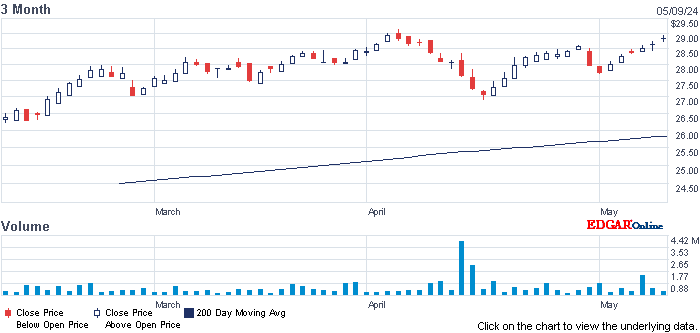
AMJ (Alerian MLP Index tracking fund)


US stocks poised for rebound, Asian stocks rally
Fed’s Bullard says ‘aggressive’ step is needed to align Fed with markets, insure against trade war
The US trade deficit fell almost 3% in Jul owing to higher exports of drugs, oil & autos, but the nation's gap was still running ahead of last year's pace even as the Trump administration adopted tough tactics to reverse the tide. The deficit slipped to $54B from a revised $55.5B in the prior month, the gov said. The forecast called for a $53.4B deficit. Although the deficit with China has fallen after the imposition of US tariffs, the gap has increased with Mexico, the EU & South Korea. The trade gap thru the first 7 months of 2019 totaled $374B vs. $346B in the same span in 2018. US exports rose 0.6% to $207.4B. The US shipped more pharmaceutical drugs, new autos, oil, drilling equipment & soybeans. Soy exports are still running ahead of last year's pace despite disruptions from the trade war with China, a huge customer for the Midwest crop. Farmers have suffered from price swings & interruptions in sales, however. Imports slipped 0.1% to $261.4B. The US saw a big drop in imports of computers & crude oil, offsetting increases in petroleum products, cell phones & furniture. Imports & exports of many goods have gyrated due the trade war with China. In some cases companies have stocked up on products likely to face higher tariffs, reducing orders later in the year. The trade gap in goods with China, meanwhile, fell to $29.6B from $30.2B & it's running below last year's level. Stiff US tariffs have reduce Chinese imports more than the decline in US exports to the Asian nation. Pres Trump raised tariffs again this month. The declining but still high deficit with China, however, has not reduced the overall US deficit. Trade gaps with other large partners such as Mexico, Germany, South Korea & Canada have all grown. The trade deficit in goods with the EU, for instance, hit an all-time high in Jul. The trade deficit isn’t getting any smaller despite Trump's effort to rein it in & part of the reason is a relatively strong economy. The US is growing faster than most other countries, so Americans can afford to buy more foreign goods. The stronger value of the $ & a weaker global economy, on the other hand, have reduced demand for US goods & services. US exports in Jul were about $7B below the record high set in early 2018 before the fight with China intensified. And the surplus in service exports — tourism, travel, financial advice & the like — was the lowest in 3½ years. That's hurting manufacturers in particular & weighing on the US economy more broadly. Higher trade deficits are a drag on GDP.
Buyers are felling better today & supporting stocks. Easing tensions from Hong Kong are a major factor. While it does not have a large population, it is a huge part of China's economic activity as a port for shipments & the banking sector. However, US-China trade talks are going nowhere fast. Buyer excitement may diminish in the PM without additional favorable news stories.
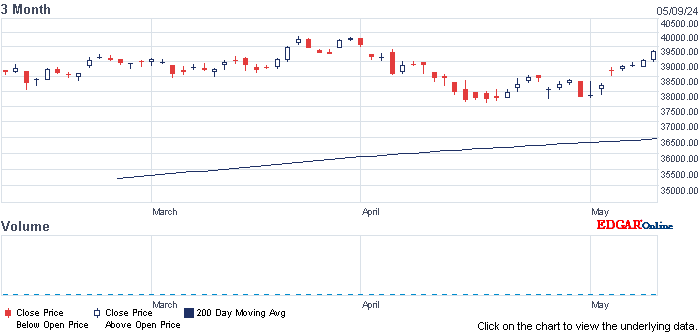
Dow Jones Industrials


AMJ (Alerian MLP Index tracking fund)
| CL=F | Crude Oil | 55.64 | +1.70 | +3.1% |
| GC=F | Gold | 1,555.30 | -0.60 | -0.0% |


Stocks are rebounding after yesterday's selloff sparked by a contraction in US manufactruing. Dow gained 0.8%, S&P 500 also added 0.8% & NAZ is up 1%. This a bounce back compared to the selling that
took over the market, with the Dow down as much as 425 points at one
point after the Institute for Supply Management said its manufacturing
index slid to a 3½-year low of 49.1 last month from Jul's 51.2. A reading under 50 indicates contraction. Techs drove a slide in stocks as markets reopened following a
holiday weekend and the latest round of tariff hikes by Beijing & DC on each other's imports. The benchmark S&P 500 index dropped 0.7%, the Dow lost 1.1% & the NAZ composite fell 1.1%. In
Asian markets, Hong Kong's Hang Seng surged 4% on news the
gov would formally withdraw the proposed extradition bill that
has been among issues sparking months of violent protests. China's Shanghai Composite closed up 0.9% & Japan's Nikkei inched higher. The
news from Hong Kong is giving a boost to European stocks: London's FTSE
rose 0.3%, Germany's DAX was up 1.1% & France's CAC was
also adding 1%. In London, Prime Minister Boris Johnson suffered a setback when
Parliament agreed to allow his opponents to introduce legislation that
would block Britain from leaving the EU without an agreement on terms of
their future trade & other relations. Britain is due to withdraw Oct
31, a deadline the trade bloc's other members would have to agree to
postpone.
US stocks poised for rebound, Asian stocks rally
NY Federal Reserve Pres John Williams said in a speech that sluggish inflation is one of the
central bank's most pressing issues & he promised to use monetary
policy to sustain economic growth in the US. “Low inflation is
indeed the problem of this era. The current outlook of moderate growth,
low unemployment, but stubbornly low inflation is a reflection of the
broader economic picture,” Williams said. “I am carefully monitoring
this nuanced picture and remain vigilant to act as appropriate to
support continuing growth, a strong labor market, and a sustained return
to 2 percent inflation.” The
influential Fed policymaker spoke 2 weeks before the FOMC is expected to cut its benchmark interest rate
during the Sep 17-18 meeting. “Germany, the UK, and China are
all experiencing slowdowns, and the euro area is of particular concern,”
Williams added. “On our own shores, concerns around trade policy with
China are adding to an uncertain picture. My contacts in the business
community have said this is making them more cautious about investment.
The effects of this angst are already showing up in the investment
numbers.” Fed officials are split on whether further cuts to the overnight
lending rate are needed with those in favor of easing citing tepid
inflation data & headwinds from the US-China trade war. The Fed has
pegged the overnight lending rate at 2-2.25%, but well below levels that have prevailed during past
economic expansions. “While there’s not been a dramatic change
seen in the overall numbers yet, the more detailed picture that emerged
by summer of this year pointed to an outlook of slowing growth and
inflation falling short of our goal,” Williams said. “This in turn argued for a somewhat more accommodative monetary policy
stance,” he said, referring to the Fed's Jul rate cut, the first since
2008. Williams did not directly address whether he favors
another cut in Sep, though markets are pricing in a 93% chance of a
qtr-point reduction & a 7% probability that the Fed might cut by a ½ point.
The Federal Reserve should cut interest rates
by ½ a point in 2 weeks to get ahead of
both financial market expectations for a rate cut & a global trade war
that has become a broader “reckoning” over how the world economy is
organized, St Louis Federal Reserve Pres James Bullard said. Global
investors have sent bond yields plummeting in recent weeks to record
lows, leaving the Fed's overnight policy rate seemingly out of line,
Bullard added. Economic
data meanwhile showed the the manufacturing sector had
contracted for the first time in 3 years amid slowing global
economic growth & as China & the US ratchet up tariffs on each
other. Bullard said he felt the situation amounted to a “global
shock” that warranted an “aggressive” step by the Fed at its meeting in 2 weeks. “We are too high,” Bullard said of
Fed interest rates, noting that the central bank’s current target
policy rate of 2-2.25% was higher than the current yield of
all Treasury securities. Typically the Fed's rate should form a
baseline for the determination of other rates, but even the 30- year
bond has dipped below 2%. Stocks slid yesterday &
benchmark Treasury yields hit their lowest in 3 years, as investors
fretted that the drawn-out trade war was taking an increasing toll on
the US & global economy. European stocks also were down while
safe-haven gold rallied. While
central bankers often say they don't let financial markets dictate
policy, “in this situation I would respect the market signal,” Bullard
said. “We should have a robust debate about moving 50 basis points at
this meeting...It’d be better in my mind to go ahead and get realigned
right now,” rather than moving only a qtr point in Sep &
again in Oct. “Why do that? Why not just get to the right point today?” Bullard’s
comments are the bluntest to date by a current voter on Fed policy
endorsing deeper rate cuts in response to the wave of uncertainty
touched off by rising tariffs, the sometimes whipsaw economic policy
developments of recent months & weak US inflation.
Fed’s Bullard says ‘aggressive’ step is needed to align Fed with markets, insure against trade war
The US trade deficit fell almost 3% in Jul owing to higher exports of drugs, oil & autos, but the nation's gap was still running ahead of last year's pace even as the Trump administration adopted tough tactics to reverse the tide. The deficit slipped to $54B from a revised $55.5B in the prior month, the gov said. The forecast called for a $53.4B deficit. Although the deficit with China has fallen after the imposition of US tariffs, the gap has increased with Mexico, the EU & South Korea. The trade gap thru the first 7 months of 2019 totaled $374B vs. $346B in the same span in 2018. US exports rose 0.6% to $207.4B. The US shipped more pharmaceutical drugs, new autos, oil, drilling equipment & soybeans. Soy exports are still running ahead of last year's pace despite disruptions from the trade war with China, a huge customer for the Midwest crop. Farmers have suffered from price swings & interruptions in sales, however. Imports slipped 0.1% to $261.4B. The US saw a big drop in imports of computers & crude oil, offsetting increases in petroleum products, cell phones & furniture. Imports & exports of many goods have gyrated due the trade war with China. In some cases companies have stocked up on products likely to face higher tariffs, reducing orders later in the year. The trade gap in goods with China, meanwhile, fell to $29.6B from $30.2B & it's running below last year's level. Stiff US tariffs have reduce Chinese imports more than the decline in US exports to the Asian nation. Pres Trump raised tariffs again this month. The declining but still high deficit with China, however, has not reduced the overall US deficit. Trade gaps with other large partners such as Mexico, Germany, South Korea & Canada have all grown. The trade deficit in goods with the EU, for instance, hit an all-time high in Jul. The trade deficit isn’t getting any smaller despite Trump's effort to rein it in & part of the reason is a relatively strong economy. The US is growing faster than most other countries, so Americans can afford to buy more foreign goods. The stronger value of the $ & a weaker global economy, on the other hand, have reduced demand for US goods & services. US exports in Jul were about $7B below the record high set in early 2018 before the fight with China intensified. And the surplus in service exports — tourism, travel, financial advice & the like — was the lowest in 3½ years. That's hurting manufacturers in particular & weighing on the US economy more broadly. Higher trade deficits are a drag on GDP.
U.S. trade deficit dips 2.7% in July, but the overall gap is still huge and growing amid China trade war
Buyers are felling better today & supporting stocks. Easing tensions from Hong Kong are a major factor. While it does not have a large population, it is a huge part of China's economic activity as a port for shipments & the banking sector. However, US-China trade talks are going nowhere fast. Buyer excitement may diminish in the PM without additional favorable news stories.
Dow Jones Industrials


![Live 24 hours gold chart [Kitco Inc.]](https://www.kitco.com/images/live/gold.gif?0.2180338269244485)


