


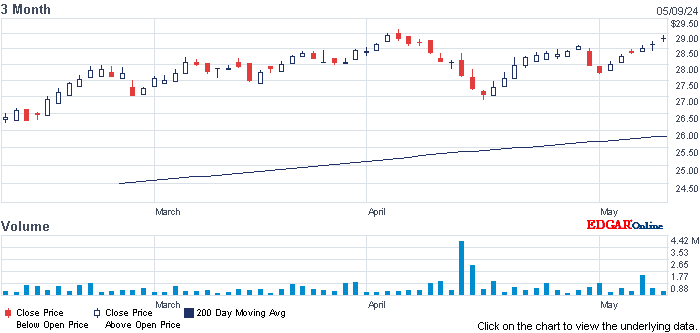
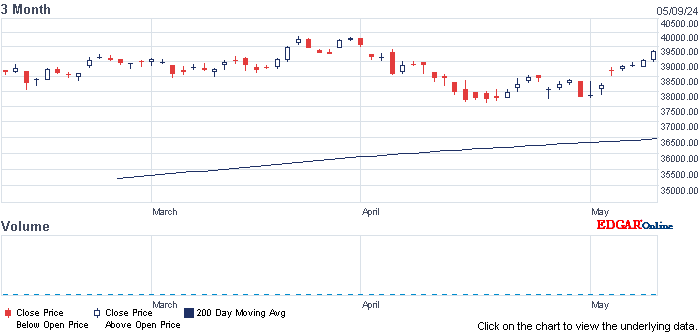
Dow rose 140 to a new record, advancers over decliners about 2-1 & NAZ gained 42 to another record. The MLP index recovered 3+ to 220 & the REIT index gave back 2+ to 410. Junk bond funds did little today & Treasuries were sold. Oil went up 1 to the 57s & gold was steady at 1510.
AMJ (Alerian MLP Index tracking fund)


All of the major averages opened at record highs amid renewed hopes of a phase one trade deal between the US & China. In a Mon press briefing, the Chinese Foreign Ministry said Pres Trump & Chinese Pres Xi Jinping have remained in contact while negotiators craft the final language for the "phase one" of the trade agreement between the 2 economic powers. The major averages all opened higher by about 0.5%. Commodities gained with West Texas Intermediate crude oil up 1% at $56.78 a barrel & gold higher by 0.3% near $1515 an ounce. Treasuries were lower as selling ran the yield on the 10-year note up 2.3 basis points to 1.751%. Global stock markets followed US markets higher after the unexpectedly strong US jobs data helped to soothe investor worries. On Fri, the Labor Dept said American employers added 128K jobs in Oct, better than the 89K forecast. In Europe, Britain's FTSE, France's CAC & Germany's DAX all gained at least 1%. In Asia, the Shanghai Composite Index added 0.6% & Hong Kong's Hang Seng advanced 1.7%. Japan's markets were closed for a holiday.
The clock continues to tick toward the potential signing of a trade deal between the US & China or at least the first phase of one. China's Pres Xi Jinping & Pres Trump have been in touch all along according to the Chinese Foreign Ministry. Ministry spokesman Geng Shuang made the comments today at a daily news briefing in Beijing. It is still being decided when & where the 2 leaders might meet for a potential signing ceremony. Yesterday, Commerce Secretary Wilbur Ross said the deal could be potentially signed anywhere from Iowa, Alaska, Hawaii or somewhere in China. The job right now for US & Chinese negotiators is to put the finishing touches on a 'phase one' agreement for Trump & Xi to sign this month. Coming up Dec 15 is when new US tariffs on Chinese imports such as laptops, toys & electronics are set to kick in. Both sides are interested in avoiding those tariffs.
The US may not put tariffs on imported cars that would especially hurt the EU & Japanese auto industries, Commerce Secretary Wilbur Ross said. "Our hope is that the negotiations we've been having with individual companies about their capital investment plans will bear enough fruit that it may not be necessary to put the 232 fully into effect, may not even be necessary to put it partly in effect," Ross said, referring to a section of US trade law. "We've had very good conversations with our European friends, with our Japanese friends, with our Korean friends, and those are the major auto producing sectors," he added. The White House announced in May that it would delay a decision to impose tariffs on imported cars & parts by 180 days. The delay came ahead of a May 18 deadline in which Pres Trump would have proceeded with tariffs of up to 25% on European made cars & parts. In Feb, the Commerce Dept submitted a report to Trump saying he could justify auto tariffs based on national security concerns. Automakers warned a 25% tariffs would backfire, driving up the cost to US consumers and resulting in job loss for the auto industry. The tariffs could come as the US auto industry faces uncertainty. For example, approximately 49K General Motors (GM) employees were on strike for more than a month until coming to an agreement with the company in Oct. Autoworkers' concerns included GM's production in Mexico.
The Federal Reserve shouldn't raise interest rates again until inflation accelerates, Neel Kashkari, the pres of the central bank’s Minneapolis district, said. While Kashkari also said he wouldn't be looking to cut rates, he added that the Fed can be patient now until there are stronger signs of wage growth and some important economic headwinds such as the trade war & Brexit pass. “Make an announcement today that we will not raise rates until we get core inflation back to our 2% target,” Kashkari said. “That’s not a commitment to cut rates, that’s not a commitment to hold forever, it’s simply saying we’re not going to raise rates prematurely.” The current core inflation level, excluding food & energy according to the Fed's preferred personal consumption expenditures index, is around 1.7%. It hasn’t been at 2% since Dec. Kashkari's suggestion for what the Fed calls “forward guidance” came 5 days after the policymaking FOMC approved a qtr-point rate cut but indicated it likely is done with its easing cycle for a while. He is not an FOMC voter but does get input into policy discussions & will vote in 2020. Fed Chair Jerome Powell's remarks in his post-meeting press conference indicated that he & Kashkari are on the same page. There would need to be a “really significant” rise in inflation before rate hikes would be likely, Powell said. One reason for keeping rates where they are is because the labor market still has room to expand, even with the unemployment rate at 3.6%, near a 50-year low. Kashkari said the measure is not a true gauge of the jobs picture as wage growth continues to be lackluster. “That has now been true for two or three years going forward, and I think Chairman Powell has really embraced the view that there is still slack in the labor market, and that is just resoundingly good news for the American people and I hope it continues,” he said. The Fed raised rates 9 times from Dec 2015 thru 2018 & Kashkari said he disagreed with “all of them.” The FOMC then started cutting rates in Jul, followed by 2 others. Markets pricing points to virtually no chance of a 4th cut at the Dec meeting. “I think as of right now that data looks pretty good. If the economy continues to perform as we expect, I would expect that we’re done for a while,” Kashkari said. “But we need to see. I think things can change pretty quickly.” He added that he thinks current policy is “perhaps slightly accommodative now.”
Fed’s Kashkari calls for no more rate hikes until inflation hits 2%
Investors are feeling great today & bidding up stock price, although market breadth is somewhat limited. The popular averages are at record highs which will get a lot of attention by the news media, bringing out more stock buyers.
Dow Jones Industrials


AMJ (Alerian MLP Index tracking fund)
| CL=F | Crude Oil | 56.98 | +0.78 | +1.4% |
| GC=F | Gold | 1,512.40 | +1.00 | +0.1% |


All of the major averages opened at record highs amid renewed hopes of a phase one trade deal between the US & China. In a Mon press briefing, the Chinese Foreign Ministry said Pres Trump & Chinese Pres Xi Jinping have remained in contact while negotiators craft the final language for the "phase one" of the trade agreement between the 2 economic powers. The major averages all opened higher by about 0.5%. Commodities gained with West Texas Intermediate crude oil up 1% at $56.78 a barrel & gold higher by 0.3% near $1515 an ounce. Treasuries were lower as selling ran the yield on the 10-year note up 2.3 basis points to 1.751%. Global stock markets followed US markets higher after the unexpectedly strong US jobs data helped to soothe investor worries. On Fri, the Labor Dept said American employers added 128K jobs in Oct, better than the 89K forecast. In Europe, Britain's FTSE, France's CAC & Germany's DAX all gained at least 1%. In Asia, the Shanghai Composite Index added 0.6% & Hong Kong's Hang Seng advanced 1.7%. Japan's markets were closed for a holiday.
RECORD HIGHS: Trade optimism sends stock market averages soaring
The clock continues to tick toward the potential signing of a trade deal between the US & China or at least the first phase of one. China's Pres Xi Jinping & Pres Trump have been in touch all along according to the Chinese Foreign Ministry. Ministry spokesman Geng Shuang made the comments today at a daily news briefing in Beijing. It is still being decided when & where the 2 leaders might meet for a potential signing ceremony. Yesterday, Commerce Secretary Wilbur Ross said the deal could be potentially signed anywhere from Iowa, Alaska, Hawaii or somewhere in China. The job right now for US & Chinese negotiators is to put the finishing touches on a 'phase one' agreement for Trump & Xi to sign this month. Coming up Dec 15 is when new US tariffs on Chinese imports such as laptops, toys & electronics are set to kick in. Both sides are interested in avoiding those tariffs.
Xi, Trump have been in touch all along on trade deal
The US may not put tariffs on imported cars that would especially hurt the EU & Japanese auto industries, Commerce Secretary Wilbur Ross said. "Our hope is that the negotiations we've been having with individual companies about their capital investment plans will bear enough fruit that it may not be necessary to put the 232 fully into effect, may not even be necessary to put it partly in effect," Ross said, referring to a section of US trade law. "We've had very good conversations with our European friends, with our Japanese friends, with our Korean friends, and those are the major auto producing sectors," he added. The White House announced in May that it would delay a decision to impose tariffs on imported cars & parts by 180 days. The delay came ahead of a May 18 deadline in which Pres Trump would have proceeded with tariffs of up to 25% on European made cars & parts. In Feb, the Commerce Dept submitted a report to Trump saying he could justify auto tariffs based on national security concerns. Automakers warned a 25% tariffs would backfire, driving up the cost to US consumers and resulting in job loss for the auto industry. The tariffs could come as the US auto industry faces uncertainty. For example, approximately 49K General Motors (GM) employees were on strike for more than a month until coming to an agreement with the company in Oct. Autoworkers' concerns included GM's production in Mexico.
Tariffs on cars from Japan, European Union may not happen after all: Wilbur Ross
The Federal Reserve shouldn't raise interest rates again until inflation accelerates, Neel Kashkari, the pres of the central bank’s Minneapolis district, said. While Kashkari also said he wouldn't be looking to cut rates, he added that the Fed can be patient now until there are stronger signs of wage growth and some important economic headwinds such as the trade war & Brexit pass. “Make an announcement today that we will not raise rates until we get core inflation back to our 2% target,” Kashkari said. “That’s not a commitment to cut rates, that’s not a commitment to hold forever, it’s simply saying we’re not going to raise rates prematurely.” The current core inflation level, excluding food & energy according to the Fed's preferred personal consumption expenditures index, is around 1.7%. It hasn’t been at 2% since Dec. Kashkari's suggestion for what the Fed calls “forward guidance” came 5 days after the policymaking FOMC approved a qtr-point rate cut but indicated it likely is done with its easing cycle for a while. He is not an FOMC voter but does get input into policy discussions & will vote in 2020. Fed Chair Jerome Powell's remarks in his post-meeting press conference indicated that he & Kashkari are on the same page. There would need to be a “really significant” rise in inflation before rate hikes would be likely, Powell said. One reason for keeping rates where they are is because the labor market still has room to expand, even with the unemployment rate at 3.6%, near a 50-year low. Kashkari said the measure is not a true gauge of the jobs picture as wage growth continues to be lackluster. “That has now been true for two or three years going forward, and I think Chairman Powell has really embraced the view that there is still slack in the labor market, and that is just resoundingly good news for the American people and I hope it continues,” he said. The Fed raised rates 9 times from Dec 2015 thru 2018 & Kashkari said he disagreed with “all of them.” The FOMC then started cutting rates in Jul, followed by 2 others. Markets pricing points to virtually no chance of a 4th cut at the Dec meeting. “I think as of right now that data looks pretty good. If the economy continues to perform as we expect, I would expect that we’re done for a while,” Kashkari said. “But we need to see. I think things can change pretty quickly.” He added that he thinks current policy is “perhaps slightly accommodative now.”
Fed’s Kashkari calls for no more rate hikes until inflation hits 2%
Investors are feeling great today & bidding up stock price, although market breadth is somewhat limited. The popular averages are at record highs which will get a lot of attention by the news media, bringing out more stock buyers.
Dow Jones Industrials


![Live 24 hours gold chart [Kitco Inc.]](https://www.kitco.com/images/live/gold.gif?0.2180338269244485)


