


Dow plunged 445 (wallowing below early session lows), decliners over advancers 3-1 (relatively mild all considered) & NAZ declined 108. The MLP index was off 1+ to the 197s (very close to lowest level in more than a decade) & the REIT index recovered 2+ to 402. Junk bond funds drifted lower & Treasuries soared, with the the yield on the 10 year Treasury note dropping a very big 11 basis points to 1.72%. Oil fell in the 55s & gold rallied 13 to 1482 as money from stock sales went into gold.
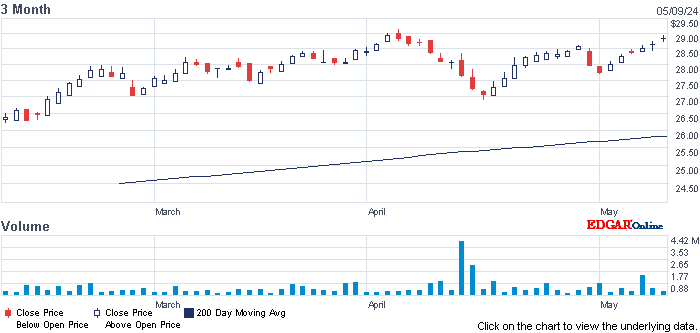
AMJ (Alerian MLP Index tracking fund)


Stocks opened sharply lower after Pres Trump said a US-China trade deal may not happen until after the 2020 election. "In some ways, I like the idea of waiting until after the election for the China deal, but they want to make a deal now and we’ll see whether the deal’s gonna be right -- it's gotta be right," Trump told reporters in London, adding that he has "no deadline" to complete an agreement. Commodities were mixed with West Texas Intermediate crude oil down 0.2% at $55.85 a barrel & gold up 0.9% at $1482 an ounce. Treasuries were rallying, pushing the yield on the 10-year note down 7.2 basis points to 1.76%. In Europe, Britain's FTSE was down 1.8%, France's CAC fell 1.1% while Germany's DAX was little changed. Overnight, Japan's benchmark Nikkei lost 0.6%, Hong Kong's Hang Seng fell 0.2% & China's Shanghai Composite gained 0.3%.
Pres Trump tripled down against France's digital tax during a meeting with NATO leaders in London. France in Jul implemented the 3% tax on companies with more than $834M in revenue globally & more than $27M in revenue in France made thru certain digital services. The Office of the US Trade Representative (USTR) concluded its investigation into the tax yesterday, saying the US would take action against the tax. "I'm not going to let people take advantage of American companies," the pres said of France's digital tax policy. "If anyone is going to take advantage of American companies, it's going to be us. It's not going to be France.” The Trump administration yesterday threatened a 100% tariff on $2.4B of French imports in retaliation of the digital tax. "Statements by French officials responsible for proposing and enacting the French DST show that the law deliberately targets U.S. companies," the Office of the US Trade Representative said, adding that French officials "repeatedly referred to the French DST as the 'GAFA tax,' which stands for Google (GOOG), Apple (AAPL), Facebook (FB) & Amazon (AMZN)." Trump added that the US may implement a tax on the European aerospace company Airbus, which has shares that are traded in France. "If France puts a tax on our companies ... I don't want France taxing American companies," the pres said as a follow-up to the announcement yesterday that it could increase retaliatory tariffs on European goods if the EU continues to provide subsidies to Airbus. The decision came after the World Trade Organization (WTO) rejected the EU's claim that it no longer provides subsidies to Airbus. "Strong action is needed to convince the EU that its interests lie in eliminating these market-distorting subsidies now and in the future so that our industries can compete on a level playing field," Trade Representative Robert Lighthizer said.
France's finance minister is threatening a “strong European riposte” if the Trump administration follows thru on a proposal to hit French cheese, Champagne, handbags & other products with tariffs - of up to 100%. The US Trade Representative proposed he tariffs on $2.4B in goods in retaliation for a French tax on global tech giants including Google, Amazon & Facebook. The move is likely to increase trade tensions between the US & Europe - & set the stage for a likely tense day between Pres Trump & French Pres Macron. “It’s simply unacceptable,” French Finance Minister Bruno Le Maire said on Radio Classique. “It’s not the behavior we expect from the united states toward one of its main allies.” Le Maire said the French tech tax is aimed at “establishing tax justice.” France wants digital companies to pay their fair share of taxes in countries where they make money & is pushing for an intl agreement on the issue. While insisting that a trade war is “not in anyone’s interest,” Le Maire said France talked this week with the European Commission about EU-wide retaliatory measures if the US follows thru with the tariffs next month. The US tariffs could double the price American consumers pay for French imports & would come on top of a 25% tax on French wine imposed last month over a separate dispute over subsidies to Airbus & Boeing (BA), a Dow stock. The Office of the Trade Representative charged that France's new digital services tax discriminates against US companies. Le Maire disputes that, saying it targets European & Chinese businesses, too. The tax imposes a 3% annual levy on French revenues of any digital company with yearly global sales worth more than €750M ($830M) & French revenue exceeding €25M. “What we want is a plan for international tax that is on the table” at the Organization for Economic Cooperation & Development, Le Maire said. The US investigated the French tax under Section 301 of the Trade Act of 1974 — the same provision the Trump administration used last year to probe China's technology policies, leading to tariffs on more than $360M worth of Chinese imports in the biggest trade war since the 1930s.
Pres Trump said it might be better to wait until after the 2020 election to strike a trade deal with China. “In some ways, I like the idea of waiting until after the election for the China deal, but they want to make a deal now and we will see whether or not the deal is going to be right,” Trump said. In reaction to the comments, Dow plunged & turned negative as traders digested the increased likelihood of a delay to any deal. When asked if he had a deadline for the deal, Trump added: “I have no deadline, no.” He did not specify whether he was commenting on a complete trade deal between the 2 large economies or his recently touted “phase one” agreement. DC & Beijing have imposed tariffs on Bs of $s' worth of each other's goods since the start of 2018, battering financial markets & souring business & consumer sentiment. The next tariff deadline is Dec 15. If the 2 sides cannot reach a deal by then, additional US levies on Chinese exports will go into effect. Targeted products include Chinese-made laptops & smartphones. Criticizing previous US administrations, Trump claimed China had been “ripping off the United States for many, many years,” & this had been done to a “lack of leadership.” Trump said the trade deal with China was dependent only on one thing — whether he himself wanted to make it. “We are doing very well with China right now, and we can do even better with the flick of a pen,” Trump added, before claiming that China, in turn, was “having the worst year by far in 57 years.” Trump said after China had targeted US farmers, his administration decided to dole out $28B over a 2-year period to make sure the agriculture sector wasn't hit in the pocket. “That got them whole,” Trump claimed.
Trump says it might be better to wait until after 2020 election for a China trade deal
Never a dull moment with Trump in the White4 House (or even on a foreign trip). The Dow is down a massive 700 in the first 2 days of Dec & the outlook is gloomy. The bears are hoping they can have a repeat of last years' ugly Dec. Not much for investors to do beyond investing in gold or Treasuries & hope for the best..
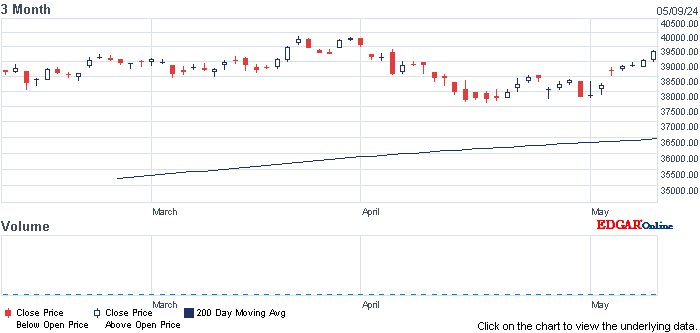
Dow Jones Industrials


AMJ (Alerian MLP Index tracking fund)
| CL=F | Crude Oil | 55.56 | -0.40 | -0.7% |
| GC=F | Gold | 1,484.00 | +14.80 | +1.0% |


Stocks opened sharply lower after Pres Trump said a US-China trade deal may not happen until after the 2020 election. "In some ways, I like the idea of waiting until after the election for the China deal, but they want to make a deal now and we’ll see whether the deal’s gonna be right -- it's gotta be right," Trump told reporters in London, adding that he has "no deadline" to complete an agreement. Commodities were mixed with West Texas Intermediate crude oil down 0.2% at $55.85 a barrel & gold up 0.9% at $1482 an ounce. Treasuries were rallying, pushing the yield on the 10-year note down 7.2 basis points to 1.76%. In Europe, Britain's FTSE was down 1.8%, France's CAC fell 1.1% while Germany's DAX was little changed. Overnight, Japan's benchmark Nikkei lost 0.6%, Hong Kong's Hang Seng fell 0.2% & China's Shanghai Composite gained 0.3%.
Stocks a sea of red after Trump says China trade deal can wait
Pres Trump tripled down against France's digital tax during a meeting with NATO leaders in London. France in Jul implemented the 3% tax on companies with more than $834M in revenue globally & more than $27M in revenue in France made thru certain digital services. The Office of the US Trade Representative (USTR) concluded its investigation into the tax yesterday, saying the US would take action against the tax. "I'm not going to let people take advantage of American companies," the pres said of France's digital tax policy. "If anyone is going to take advantage of American companies, it's going to be us. It's not going to be France.” The Trump administration yesterday threatened a 100% tariff on $2.4B of French imports in retaliation of the digital tax. "Statements by French officials responsible for proposing and enacting the French DST show that the law deliberately targets U.S. companies," the Office of the US Trade Representative said, adding that French officials "repeatedly referred to the French DST as the 'GAFA tax,' which stands for Google (GOOG), Apple (AAPL), Facebook (FB) & Amazon (AMZN)." Trump added that the US may implement a tax on the European aerospace company Airbus, which has shares that are traded in France. "If France puts a tax on our companies ... I don't want France taxing American companies," the pres said as a follow-up to the announcement yesterday that it could increase retaliatory tariffs on European goods if the EU continues to provide subsidies to Airbus. The decision came after the World Trade Organization (WTO) rejected the EU's claim that it no longer provides subsidies to Airbus. "Strong action is needed to convince the EU that its interests lie in eliminating these market-distorting subsidies now and in the future so that our industries can compete on a level playing field," Trade Representative Robert Lighthizer said.
Trump slams France for digital tax on American companies at tense summit
France's finance minister is threatening a “strong European riposte” if the Trump administration follows thru on a proposal to hit French cheese, Champagne, handbags & other products with tariffs - of up to 100%. The US Trade Representative proposed he tariffs on $2.4B in goods in retaliation for a French tax on global tech giants including Google, Amazon & Facebook. The move is likely to increase trade tensions between the US & Europe - & set the stage for a likely tense day between Pres Trump & French Pres Macron. “It’s simply unacceptable,” French Finance Minister Bruno Le Maire said on Radio Classique. “It’s not the behavior we expect from the united states toward one of its main allies.” Le Maire said the French tech tax is aimed at “establishing tax justice.” France wants digital companies to pay their fair share of taxes in countries where they make money & is pushing for an intl agreement on the issue. While insisting that a trade war is “not in anyone’s interest,” Le Maire said France talked this week with the European Commission about EU-wide retaliatory measures if the US follows thru with the tariffs next month. The US tariffs could double the price American consumers pay for French imports & would come on top of a 25% tax on French wine imposed last month over a separate dispute over subsidies to Airbus & Boeing (BA), a Dow stock. The Office of the Trade Representative charged that France's new digital services tax discriminates against US companies. Le Maire disputes that, saying it targets European & Chinese businesses, too. The tax imposes a 3% annual levy on French revenues of any digital company with yearly global sales worth more than €750M ($830M) & French revenue exceeding €25M. “What we want is a plan for international tax that is on the table” at the Organization for Economic Cooperation & Development, Le Maire said. The US investigated the French tax under Section 301 of the Trade Act of 1974 — the same provision the Trump administration used last year to probe China's technology policies, leading to tariffs on more than $360M worth of Chinese imports in the biggest trade war since the 1930s.
France threatens 'strong' response to Trump's tax on its cheese, wines
Pres Trump said it might be better to wait until after the 2020 election to strike a trade deal with China. “In some ways, I like the idea of waiting until after the election for the China deal, but they want to make a deal now and we will see whether or not the deal is going to be right,” Trump said. In reaction to the comments, Dow plunged & turned negative as traders digested the increased likelihood of a delay to any deal. When asked if he had a deadline for the deal, Trump added: “I have no deadline, no.” He did not specify whether he was commenting on a complete trade deal between the 2 large economies or his recently touted “phase one” agreement. DC & Beijing have imposed tariffs on Bs of $s' worth of each other's goods since the start of 2018, battering financial markets & souring business & consumer sentiment. The next tariff deadline is Dec 15. If the 2 sides cannot reach a deal by then, additional US levies on Chinese exports will go into effect. Targeted products include Chinese-made laptops & smartphones. Criticizing previous US administrations, Trump claimed China had been “ripping off the United States for many, many years,” & this had been done to a “lack of leadership.” Trump said the trade deal with China was dependent only on one thing — whether he himself wanted to make it. “We are doing very well with China right now, and we can do even better with the flick of a pen,” Trump added, before claiming that China, in turn, was “having the worst year by far in 57 years.” Trump said after China had targeted US farmers, his administration decided to dole out $28B over a 2-year period to make sure the agriculture sector wasn't hit in the pocket. “That got them whole,” Trump claimed.
Trump says it might be better to wait until after 2020 election for a China trade deal
Never a dull moment with Trump in the White4 House (or even on a foreign trip). The Dow is down a massive 700 in the first 2 days of Dec & the outlook is gloomy. The bears are hoping they can have a repeat of last years' ugly Dec. Not much for investors to do beyond investing in gold or Treasuries & hope for the best..
Dow Jones Industrials


![Live 24 hours gold chart [Kitco Inc.]](https://www.kitco.com/images/live/gold.gif?0.2180338269244485)


