


Dow soared 483 (close to its high), advancers over decliners about 3-1 & NAZ went up 40. The MLP index rose 2+ to the 206s & the REIT index was fractionally lower to the 415s. Junk bond funds were slightly higher & Treasuries continued weak while stocks were being purchased. Oil jumped up 1+ to the 51s (more below) & gold gained 5 to 1560.
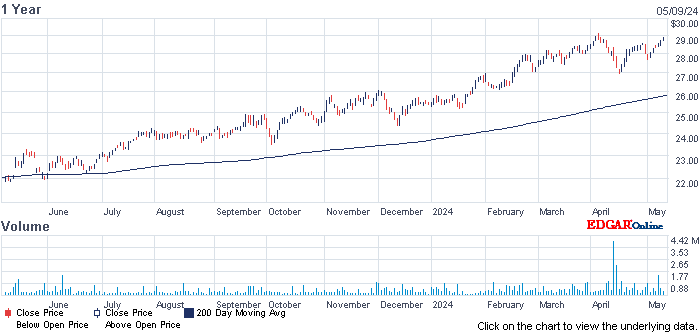
AMJ (Alerian MLP Index tracking fund)
![Live 24 hours gold chart [Kitco Inc.]](https://www.kitco.com/images/live/gold.gif?0.2180338269244485)


The US trade deficit fell for the first time in 6 years in 2019 as Pres Trump hammered China import taxes. The Commerce Dept said that the gap between what the US sells & what it buys abroad fell 1.7% last year to $616.8B. US exports fell 0.1% to $2.5T. But imports fell more, slipping 0.4% to $3.1T. Imports of crude oil plunged 19.3% to $126.6B. The deficit in the trade of goods with China narrowed last year by 17.6% to $346B. Trump has imposed tariffs on $360B worth of Chinese imports in a battle over Beijing's aggressive drive to challenge American technological dominance. The world's 2 biggest economies reached an interim trade deal last month & Trump dropped plans to extend the tariffs to another $160B in Chinese goods. But goods trade gap with Mexico rose 26.2B last year to a record $101.8B. The goods deficit with the EU also hit a record, $177.9B -- up 5.5% from 2018. Overall, the US posted a $866B deficit in the trade of goods such as cars & appliances, down from $887B in 2018. But it ran a $249B surplus in the trade of services such as tourism & banking, down from $260B in 2018. Trump campaigned on a promise to reduce America's massive & persistent trade deficits, which he sees as a sign of economic weakness & the result of lopsided trade deals that put US exporters at a disadvantage. He has negotiated a new trade agreement with Canada & Mexico that he says will bring more balance to trade in North America. Mainstream economists argue that trade deficits are largely the result of a big economic reality that doesn't respond much to changes in trade policy: Americans spend more than they produce, & imports fill the gap. In Dec, the overall trade gap widened 11.9% to $49B as exports rose 0.8% to $209.6B & imports climbed 2.7% to $258.5B.
Maryland-based Novavax (NVAX) is aiming to make a coronavirus vaccine in as little as 3 months, although such vaccines can take years to develop. Its pres of research & development confirmed that the company has the coronavirus gene. "I can confirm we have the gene, and that’s the blueprint for our vaccine," NVAX's Dr Gregory Glenn said. "We’re on the way." The company made an ebola vaccine in 90 days, Glenn said. "I would just say 90 days from the sequence being identified to starting the clinic — that’s the speed of light for vaccines," he added. "We’re hoping to meet something close to that or exceed it if possible." His team is working nearly 24/7. "They see the disaster going on in China and spreading, and it portends a very worrisome scenario for the rest of the world," Glenn said. "That motivates everybody." The virus has infected more than 24K globally, with nearly all cases & deaths concentrated in China. Shares of NVAX shot up in Jan on word that the Food & Drug Administration opted to fast track its recombinant quadrivalent flu vaccine, NanoFlu, for adults aged 65 years & older. It's stock didn't seem to get a boost from its coronavirus news, however. The stock slid back 4¢.
If you would like to learn moire about NVAX, click on this link:
club.ino.com/trend/analysis/stock/NVAX?a_aid=CD3289&a_bid=6ae5b6f7
General Motors (GM) posted a Q4 loss as the United Auto Workers (UAW) strike heavily impacted its business. The automaker's EPS was a loss or 16¢, as net revenue fell 19.7% from a year ago to $30.8B. Adjusted EPS of 5¢ topped the 1¢ that was expected. For the full year, GM earned $6.7B, down 17.4% from the prior year, including the $3.6B hit from the UAW strike. Annual revenue was $137.2B, down 6.7% from the prior year. “GM is positioned for strong, long-term business results with a focus on sustainability, and we are confident that our EV and AV strategies will drive shareholder value while improving the environment,” CEO Mary Barra said, referring to electric & autonomous, or self-driving, vehicles. Chevrolet & GMC full-size pickups remained the backbone of GM's business in 2019. Combined sales of the Chevrolet Silverado & the GMC Sierra totaled 803K vehicles, up almost one percentage point from the prior year. GM continues to set its sights on a fully electric future. Last week, the automaker said it would relaunch the Hummer as an electric vehicle. In Dec, the automaker announced a joint venture with LG Chem to produce battery cells at a Lordstown, Ohio, plant. Looking ahead, GM expects to benefit from new product launches, ongoing cost savings & a lean inventory, but says those gains will be pared by broader industry & economic challenges. New vehicles include a number of full-size SUVs & crossovers. GM sees 2020 full-year EPS of $5.75-6.25, unchanged from the prior year. The stock rose 66¢.
If you would like to learn moire about GM, click on this link:
club.ino.com/trend/analysis/stock/GM?a_aid=CD3289&a_bid=6ae5b6f7
Oil futures finished higher after gov data revealed a drop in both US gasoline & distillate stockpiles, rallying prices for the petroleum products, even though domestic supplies of crude posted a 2nd straight weekly climb. Prices were climbing even before the supply data & US benchmark crude halted a 5-session skid. Unverified claims of progress toward coronavirus vaccines, which could stem the spread of the Asian outbreak that has crushed expectations for demand from China, provided support for oil. Reports that OPEC & its allies were considering deeper production cuts at a technical meeting in Vienna also buoyed oil, though that meeting has reportedly ended with no announcement, but with plans to reconvene for an unscheduled 3rd day tomorrow. West Texas Intermediate crude for Mar delivery rose $1.14 (2.3%) to settle at $50.75 a barrel. The commodity entered a bear market on Mon, usually defined as a decline from a recent peak of at least 20%. Apr Brent crude gained $1.32 (2.5%) to $55.28 a barrel, following its lowest settlement since Dec 31, 2018 yesterday. The intl benchmark also entered a bear market on Mon.
Oil futures end higher as U.S. gasoline and distillate stockpiles decline and coronavirus concerns ebb
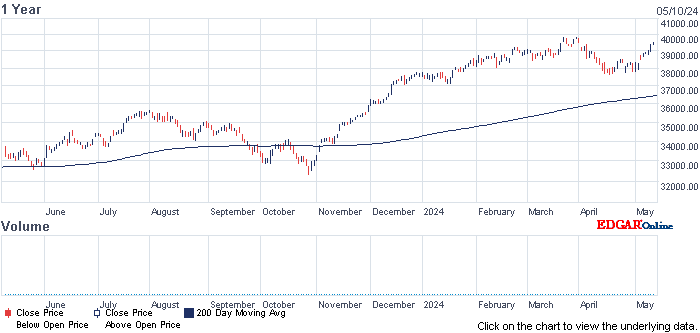
This was a curious day. The stock market rose on hopes for a new vaccine for coronavirus, but the the manufacturer's stock was a little lower. That's curious! The Dow was strong all day, closing pretty much at its high & within 100 of setting a new record. The bulls are anxious.
Dow Jones Industrials


AMJ (Alerian MLP Index tracking fund)


The US trade deficit fell for the first time in 6 years in 2019 as Pres Trump hammered China import taxes. The Commerce Dept said that the gap between what the US sells & what it buys abroad fell 1.7% last year to $616.8B. US exports fell 0.1% to $2.5T. But imports fell more, slipping 0.4% to $3.1T. Imports of crude oil plunged 19.3% to $126.6B. The deficit in the trade of goods with China narrowed last year by 17.6% to $346B. Trump has imposed tariffs on $360B worth of Chinese imports in a battle over Beijing's aggressive drive to challenge American technological dominance. The world's 2 biggest economies reached an interim trade deal last month & Trump dropped plans to extend the tariffs to another $160B in Chinese goods. But goods trade gap with Mexico rose 26.2B last year to a record $101.8B. The goods deficit with the EU also hit a record, $177.9B -- up 5.5% from 2018. Overall, the US posted a $866B deficit in the trade of goods such as cars & appliances, down from $887B in 2018. But it ran a $249B surplus in the trade of services such as tourism & banking, down from $260B in 2018. Trump campaigned on a promise to reduce America's massive & persistent trade deficits, which he sees as a sign of economic weakness & the result of lopsided trade deals that put US exporters at a disadvantage. He has negotiated a new trade agreement with Canada & Mexico that he says will bring more balance to trade in North America. Mainstream economists argue that trade deficits are largely the result of a big economic reality that doesn't respond much to changes in trade policy: Americans spend more than they produce, & imports fill the gap. In Dec, the overall trade gap widened 11.9% to $49B as exports rose 0.8% to $209.6B & imports climbed 2.7% to $258.5B.
US trade deficit drops for first time in 6 years as Trump hammers China with taxes
Maryland-based Novavax (NVAX) is aiming to make a coronavirus vaccine in as little as 3 months, although such vaccines can take years to develop. Its pres of research & development confirmed that the company has the coronavirus gene. "I can confirm we have the gene, and that’s the blueprint for our vaccine," NVAX's Dr Gregory Glenn said. "We’re on the way." The company made an ebola vaccine in 90 days, Glenn said. "I would just say 90 days from the sequence being identified to starting the clinic — that’s the speed of light for vaccines," he added. "We’re hoping to meet something close to that or exceed it if possible." His team is working nearly 24/7. "They see the disaster going on in China and spreading, and it portends a very worrisome scenario for the rest of the world," Glenn said. "That motivates everybody." The virus has infected more than 24K globally, with nearly all cases & deaths concentrated in China. Shares of NVAX shot up in Jan on word that the Food & Drug Administration opted to fast track its recombinant quadrivalent flu vaccine, NanoFlu, for adults aged 65 years & older. It's stock didn't seem to get a boost from its coronavirus news, however. The stock slid back 4¢.
If you would like to learn moire about NVAX, click on this link:
club.ino.com/trend/analysis/stock/NVAX?a_aid=CD3289&a_bid=6ae5b6f7
US biotech firm using coronavirus gene to make vaccine, could have in monthsf
General Motors (GM) posted a Q4 loss as the United Auto Workers (UAW) strike heavily impacted its business. The automaker's EPS was a loss or 16¢, as net revenue fell 19.7% from a year ago to $30.8B. Adjusted EPS of 5¢ topped the 1¢ that was expected. For the full year, GM earned $6.7B, down 17.4% from the prior year, including the $3.6B hit from the UAW strike. Annual revenue was $137.2B, down 6.7% from the prior year. “GM is positioned for strong, long-term business results with a focus on sustainability, and we are confident that our EV and AV strategies will drive shareholder value while improving the environment,” CEO Mary Barra said, referring to electric & autonomous, or self-driving, vehicles. Chevrolet & GMC full-size pickups remained the backbone of GM's business in 2019. Combined sales of the Chevrolet Silverado & the GMC Sierra totaled 803K vehicles, up almost one percentage point from the prior year. GM continues to set its sights on a fully electric future. Last week, the automaker said it would relaunch the Hummer as an electric vehicle. In Dec, the automaker announced a joint venture with LG Chem to produce battery cells at a Lordstown, Ohio, plant. Looking ahead, GM expects to benefit from new product launches, ongoing cost savings & a lean inventory, but says those gains will be pared by broader industry & economic challenges. New vehicles include a number of full-size SUVs & crossovers. GM sees 2020 full-year EPS of $5.75-6.25, unchanged from the prior year. The stock rose 66¢.
If you would like to learn moire about GM, click on this link:
club.ino.com/trend/analysis/stock/GM?a_aid=CD3289&a_bid=6ae5b6f7
GM reveals massive hit it took from UAW strike
Oil futures finished higher after gov data revealed a drop in both US gasoline & distillate stockpiles, rallying prices for the petroleum products, even though domestic supplies of crude posted a 2nd straight weekly climb. Prices were climbing even before the supply data & US benchmark crude halted a 5-session skid. Unverified claims of progress toward coronavirus vaccines, which could stem the spread of the Asian outbreak that has crushed expectations for demand from China, provided support for oil. Reports that OPEC & its allies were considering deeper production cuts at a technical meeting in Vienna also buoyed oil, though that meeting has reportedly ended with no announcement, but with plans to reconvene for an unscheduled 3rd day tomorrow. West Texas Intermediate crude for Mar delivery rose $1.14 (2.3%) to settle at $50.75 a barrel. The commodity entered a bear market on Mon, usually defined as a decline from a recent peak of at least 20%. Apr Brent crude gained $1.32 (2.5%) to $55.28 a barrel, following its lowest settlement since Dec 31, 2018 yesterday. The intl benchmark also entered a bear market on Mon.
Oil futures end higher as U.S. gasoline and distillate stockpiles decline and coronavirus concerns ebb
This was a curious day. The stock market rose on hopes for a new vaccine for coronavirus, but the the manufacturer's stock was a little lower. That's curious! The Dow was strong all day, closing pretty much at its high & within 100 of setting a new record. The bulls are anxious.
Dow Jones Industrials


