


Dow soared 1293 (at session high), advancers over decliners better than 3-1 & NAZ shot up 384. The MLP index rose 4+ to the 177s & the REIT index rebounded a very big 12 to 393. Junk bond funds recovered some of last week's losses & Treasuries continued in heavy demand with many yields setting record lows (more below). Oil jumped up 2+ to the 47s & gold surged 29 to 1595 (more on both below).
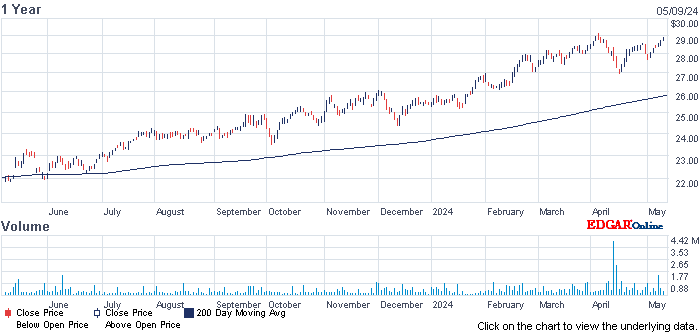
AMJ (Alerian MLP Index tracking fund)
![Live 24 hours gold chart [Kitco Inc.]](https://www.kitco.com/images/live/gold.gif?0.2180338269244485)


CDC says US coronavirus cases jump to 91
The 10-year Treasury yield dropped to another record low as the historic decline in US rates continued amid the coronavirus outbreak & traders call for Federal Reserve stimulus. The 10-year yields hit a record low of 1.03% at one point overnight before bouncing & was last at 1.06%. The 2-year Treasury yields fell to 0.71%, threatening to break its low in Nov. The 30-year yields dropped to 1.623%, a record low. Investors are betting the Federal Reserve will now act aggressively in response to a coming economic slowdown due to the coronavirus outbreak. The fed funds futures market has already priced in a 50 basis point cut at the Fed's meeting this month. Pres Trump increased pressure on the Fed to cut interest rates, tweeting that the central bank is “slow to act” & falling behind its global peers. Investors have fled stocks & rushed into bonds, pushing yields to historic lows, as fears of a coronavirus outbreak gripped the globe. The benchmark 10-year rate, which moves inversely with prices, tumbled about 37 basis points in Feb alone. Stocks had their worst week since the financial crisis last week. Senior White House officials have attempted to calm market panic over the potential of the virus to trigger a global recession, as the US reported its 2nd death in Washington state & a first case in New York City was confirmed. Still, some are warning about an economic downturn. Yields remains near record low levels after showed a slowdown last month. The ISM manufacturing index fell to 50.1 in Feb, the lowest level since the end of 2019. It also came below an estimate of 50.8. Adding to the slew of bad news is China’s official Purchasing Managers' Index (PMI), a gauge for its manufacturing sector, which plunged to a record low of just 35.7 in Feb. Any reading below 50 signals a contraction. The somber reading provides the first official snapshot of the state of the Chinese economy since the outbreak of the coronavirus that has killed almost 3K in mainland China & infected about 80K.
10-year Treasury yield drops to another record low of 1.03% as historic fall in US rates continues
Gold futures rebounded, tacking on nearly 2% after suffering the sharpest drop since 2013 in the previous session, finding support as central banks promise to act appropriately to mitigate the effect of a viral outbreak that is expected to hurt global economies & supply chains. Bank of Japan Gov Haruhiko Kuroda said the central bank would take steps to steady markets & bolster liquidity through short-term lending operations & asset purchases. On Fri, Federal Reserve Chair Jerome Powell issued a rare, unscheduled statement, emphasizing the central bank's intention to act appropriately to address the risks posed by the coronavirus. A 2nd death from the virus in the US, has raised fears of a wider spread of the disease domestically & investors are starting to believe that the Fed & other central banks will act to tamp down expected economic shocks from COVID-19, the infectious disease that originated in Wuhan, China late last year & has rapidly spread across the globe. The global death toll from the illness stands at more than 3K & deaths in China stand at 2900. Gold for Apr rose $28.10 (1.8%) to settle at $1594 an ounce. It fell nearly 5% on Fri—the biggest one-day percentage loss since the week ended Jun 20, 2013. The metal last week also booked a weekly slide of about 5%. Still, gold is up more than 4% so far this year. Providing an added boost to haven demand for the precious metals, the Institute for Supply Management said its US manufacturing index dipped to 50.1% last month from 50.9% as most US manufacturers said business began
Oil futures settled with a gain of more than 4%—the biggest daily percentage climb of the year—boosted by optimism that OPEC & its allies will soon announce additional production cuts. Prices also found support from expectations that global central banks are ready to support economies amid the coronavirus outbreak. That’s on the heels of the biggest weekly percentage loss in over a decade for West Texas Intermediate crude driven by investor fears the spread of COVID-19 would significantly hurt crude demand. Apr WTI crude futures climbed $1.99 (4.5%) to settle at $46.75 a barrel, after tumbling 5% on Fri to settle at $44.76 a barrel. For the week, the contract fell over 16%, the biggest weekly drop since 2008. The global benchmark, May Brent crude tacked on $2.23 (4.5%) to finish at $51.90 a barrel. It fell 14% last week, which was the biggest weekly decline since Jan 2016. The front-month contracts for both WTI & Brent posted their largest one-day percentage gains since Sep 16, 2019. Oil markets will be closely watching a Mar 5-6 meeting of OPEC & its allies in Vienna to discuss the possibility of additional production cuts in a bid to balance supply & demand.
Bargain hunters returned, encouraged on thoughts on rate cuts by the Fed. Of course, rates have already seen a sharp decline in Treasuries. Those interest rates are used to set rates on many loans (starting with mortgages). From its early AM lows, the Dow climbed 1300 to close at its highs (after a 350 retreat in the early PM). Sudden, rapid moves in either direction by investments should be viewed with skepticism. These are not comfortable times for investors feint of heart. They are flocking to gold & Treasuries with meager yields. More economic data is coming this week & will probably be dreary, testing whose who purchased stocks today. In the meantime, enjoy today's gains.
Dow Jones Industrials


AMJ (Alerian MLP Index tracking fund)


The Centers for Disease Control & Prevention
said there are currently 91 cases of COVID-19 in the US, up from just over 60 cases a day ago. At least 48 of those
cases are repatriates from Wuhan, China, the epicenter of the outbreak, & the Diamond Princess cruise ship, according to an update on the
agency's website. The CDC is now adding “presumptive” positive cases to
its daily tally. Those are patients who have tested positive at a state
or local lab & are awaiting confirmation from the CDC. At
least 17 cases — 12 confirmed & 5 presumptive positive — are
travel-related infections. 26 cases — 4 confirmed & 22
presumptive positive— are from human-to-human interaction, according to
the CDC. The update comes after the World Health Organization said
the number of new coronavirus cases outside China was almost 9 times
higher than that inside the country over the last 24 hours. Outside
China, the total number of cases now tops 8739 across 61 countries,
including 127 deaths, according to WHO. About 81% of cases outside
China are from 4 countries. Over the weekend, the US reported its first 2 deaths related to the virus — 2 men from Washington state. NY officials also confirmed the state's first coronavirus case, a
woman who recently traveled to Iran & is currently isolated in her
Manhattan home.
CDC says US coronavirus cases jump to 91
The 10-year Treasury yield dropped to another record low as the historic decline in US rates continued amid the coronavirus outbreak & traders call for Federal Reserve stimulus. The 10-year yields hit a record low of 1.03% at one point overnight before bouncing & was last at 1.06%. The 2-year Treasury yields fell to 0.71%, threatening to break its low in Nov. The 30-year yields dropped to 1.623%, a record low. Investors are betting the Federal Reserve will now act aggressively in response to a coming economic slowdown due to the coronavirus outbreak. The fed funds futures market has already priced in a 50 basis point cut at the Fed's meeting this month. Pres Trump increased pressure on the Fed to cut interest rates, tweeting that the central bank is “slow to act” & falling behind its global peers. Investors have fled stocks & rushed into bonds, pushing yields to historic lows, as fears of a coronavirus outbreak gripped the globe. The benchmark 10-year rate, which moves inversely with prices, tumbled about 37 basis points in Feb alone. Stocks had their worst week since the financial crisis last week. Senior White House officials have attempted to calm market panic over the potential of the virus to trigger a global recession, as the US reported its 2nd death in Washington state & a first case in New York City was confirmed. Still, some are warning about an economic downturn. Yields remains near record low levels after showed a slowdown last month. The ISM manufacturing index fell to 50.1 in Feb, the lowest level since the end of 2019. It also came below an estimate of 50.8. Adding to the slew of bad news is China’s official Purchasing Managers' Index (PMI), a gauge for its manufacturing sector, which plunged to a record low of just 35.7 in Feb. Any reading below 50 signals a contraction. The somber reading provides the first official snapshot of the state of the Chinese economy since the outbreak of the coronavirus that has killed almost 3K in mainland China & infected about 80K.
10-year Treasury yield drops to another record low of 1.03% as historic fall in US rates continues
Gold futures rebounded, tacking on nearly 2% after suffering the sharpest drop since 2013 in the previous session, finding support as central banks promise to act appropriately to mitigate the effect of a viral outbreak that is expected to hurt global economies & supply chains. Bank of Japan Gov Haruhiko Kuroda said the central bank would take steps to steady markets & bolster liquidity through short-term lending operations & asset purchases. On Fri, Federal Reserve Chair Jerome Powell issued a rare, unscheduled statement, emphasizing the central bank's intention to act appropriately to address the risks posed by the coronavirus. A 2nd death from the virus in the US, has raised fears of a wider spread of the disease domestically & investors are starting to believe that the Fed & other central banks will act to tamp down expected economic shocks from COVID-19, the infectious disease that originated in Wuhan, China late last year & has rapidly spread across the globe. The global death toll from the illness stands at more than 3K & deaths in China stand at 2900. Gold for Apr rose $28.10 (1.8%) to settle at $1594 an ounce. It fell nearly 5% on Fri—the biggest one-day percentage loss since the week ended Jun 20, 2013. The metal last week also booked a weekly slide of about 5%. Still, gold is up more than 4% so far this year. Providing an added boost to haven demand for the precious metals, the Institute for Supply Management said its US manufacturing index dipped to 50.1% last month from 50.9% as most US manufacturers said business began
Gold ends sharply higher after biggest daily drop in nearly 7 years
Oil futures settled with a gain of more than 4%—the biggest daily percentage climb of the year—boosted by optimism that OPEC & its allies will soon announce additional production cuts. Prices also found support from expectations that global central banks are ready to support economies amid the coronavirus outbreak. That’s on the heels of the biggest weekly percentage loss in over a decade for West Texas Intermediate crude driven by investor fears the spread of COVID-19 would significantly hurt crude demand. Apr WTI crude futures climbed $1.99 (4.5%) to settle at $46.75 a barrel, after tumbling 5% on Fri to settle at $44.76 a barrel. For the week, the contract fell over 16%, the biggest weekly drop since 2008. The global benchmark, May Brent crude tacked on $2.23 (4.5%) to finish at $51.90 a barrel. It fell 14% last week, which was the biggest weekly decline since Jan 2016. The front-month contracts for both WTI & Brent posted their largest one-day percentage gains since Sep 16, 2019. Oil markets will be closely watching a Mar 5-6 meeting of OPEC & its allies in Vienna to discuss the possibility of additional production cuts in a bid to balance supply & demand.
Oil sees biggest daily gain of 2020 as traders hope for OPEC cuts this week
Bargain hunters returned, encouraged on thoughts on rate cuts by the Fed. Of course, rates have already seen a sharp decline in Treasuries. Those interest rates are used to set rates on many loans (starting with mortgages). From its early AM lows, the Dow climbed 1300 to close at its highs (after a 350 retreat in the early PM). Sudden, rapid moves in either direction by investments should be viewed with skepticism. These are not comfortable times for investors feint of heart. They are flocking to gold & Treasuries with meager yields. More economic data is coming this week & will probably be dreary, testing whose who purchased stocks today. In the meantime, enjoy today's gains.
Dow Jones Industrials


