


Dow jumped up 524 (off early highs), advancers over decliners better than 6-1 & NAZ gained 82. The MLP index jumped up 5+ to 100 (the starting point 25 years ago) & the REIT index rose 11 to 317. Junk bond funds found more buyers attracted by high yields & Treasuries were sold as stocks were bid higher. Oil rose to the 26s on renewed hopes for production cut & gold slid back 2 to 1691.
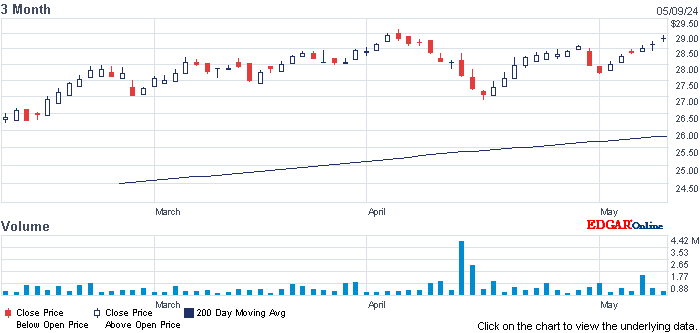
AMJ (Alerian MLP Index tracking fund)


Treasury Secretary Steve Mnuchin said that President Trump is looking at how to reopen parts of the US economy as the coronavirus pandemic forces an unprecedented shutdown of business throughout the country. "The president is very much looking at how we can reopen parts of the economy," Mnuchin said. "There are parts of the country, like New York, where obviously this is very, very concerning. There are other parts of the country where it’s not." Restaurants, bars, hotels, gyms, beauty salons, entertainment venues & other businesses deemed nonessential have been ordered to close, while 41 states have enacted strict stay-at-home policies, bringing American life to a grinding halt. The result has been an economic free-fall that experts warn will be worse than the 2008 financial crisis. In the final 2 weeks of Mar, a record-shattering 10M Americans filed for unemployment benefits, a stunning sign of the depth of the downturn. Estimates vary drastically for how high unemployment will climb, but economists broadly agree that it will be grim. An analysis published by the Federal Reserve Bank of St Louis last week projected that unemployment could hit 32% in Q2 as more than 47M workers are laid off because of the pandemic. That would exceed the 25% peak during the Great Depression. To prop up the economy, Congress passed a $2.2T stimulus package that includes a one-time cash check of up to $1200 for adults who earn less than $99K; $350B in forgivable loans for small businesses to maintain their payrolls & a $500B fund for bigger companies. Mnuchin said the direct payments are slated to be sent by the end of next week. The $349B Payroll Protection Program, meanwhile, is designed to get cash in the hands of struggling small businesses & incentivize them to keep staff on payroll, or re-hire workers who have already been laid off. To receive the aid, businesses must have been operational by at least Feb 15. The $349B Payroll Protection Program, meanwhile, is designed to get cash in the hands of struggling small businesses and incentivize them to keep staff on payroll, or re-hire workers who have already been laid off.
As the coronavirus pandemic clobbers the US economy, more voters in pivotal 2020 election states are worrying about losing their jobs or wages, a poll found. More than 1/3 of respondents in the 6 key states who have already lost income or employment said they could afford food, housing & other essential costs for less than a month, according to States of Play, a joint CNBC/Change Research survey of swing states. Even so, the likely voters polled in Arizona, Florida, Michigan, North Carolina, Pennsylvania & Wisconsin overwhelmingly said they are more worried about their health than their finances. The COVID-19 outbreak has ripped thru the US, infecting more than 368K & leading to 11K deaths, according to data compiled by Johns Hopkins University. Business shutdowns across the countrycaused the economy to shed 701K jobs in early March — though a tally of roughly 10M new jobless claims over 2 weeks indicates the economic destruction is much worse than the employment report showed. While respondents’ worries about losing income have jumped since the first iteration of the swing state poll taken in mid-Mar, voters now fear for their health most.
More Americans worry about losing wages, covering costs as coronavirus spreads, poll finds
The Federal Reserve announced it would take new action to support America's small businesses as
coronavirus-related prevention measures have led to mass closures all around the country. The
central bank will pump up lending to small businesses by encouraging
banks to make more loans thru the newly implemented Paycheck
Protection Program (PPP). It said that it will set
up a facility to provide term financing backed by PPP loans, which
would potentially free up room on lenders' balance sheets so they could
make more loans. The Small Business Administration launched the Paycheck Protection Program on Fri – a measure implemented as part of Congress multitrillion-$ stimulus package. The program provides forgivable
loans of up to $10M to small businesses, so long as they keep
their staffing levels & salaries constant. According
to the administration, more than $40B worth of loans to small
businesses had been processed. That equates to
more than 130K loans. There are concerns that the $350B set aside for the program would not be enough. Pres Trump tweeted that he would request additional funds for the program from Congress if the initial round is depleted.
The Dow surged 800 in opening trades, then dropped over 500 & is bouncing back with buying. As has become routine in recent weeks, there is high volatility making it difficult to understand what is truly going on in the stock market. However, there are some simple truths. Q2 will be dreadful for US GDP. There will be a significant contraction, probably the largest in history. Quibbling about numbers is meaningless. It will be dreadful. Managing the recovery will be done carefully because so much damage has been done already to the economy & understanding how to defeat the virus will take take time. At least many investors are generally optimistic about the future but negative ones keep buying gold.
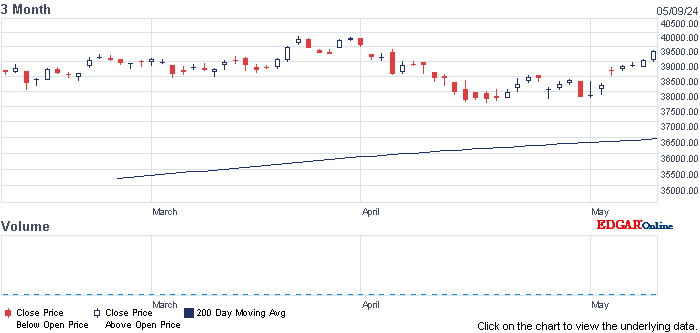
Dow Jones Industrials


AMJ (Alerian MLP Index tracking fund)
| CL=F | Crude Oil | 26.57 | +0.49 | +1.9% |
| GC=F | Gold | 1,690.40 | -3.50 | -0.1% |


Treasury Secretary Steve Mnuchin said that President Trump is looking at how to reopen parts of the US economy as the coronavirus pandemic forces an unprecedented shutdown of business throughout the country. "The president is very much looking at how we can reopen parts of the economy," Mnuchin said. "There are parts of the country, like New York, where obviously this is very, very concerning. There are other parts of the country where it’s not." Restaurants, bars, hotels, gyms, beauty salons, entertainment venues & other businesses deemed nonessential have been ordered to close, while 41 states have enacted strict stay-at-home policies, bringing American life to a grinding halt. The result has been an economic free-fall that experts warn will be worse than the 2008 financial crisis. In the final 2 weeks of Mar, a record-shattering 10M Americans filed for unemployment benefits, a stunning sign of the depth of the downturn. Estimates vary drastically for how high unemployment will climb, but economists broadly agree that it will be grim. An analysis published by the Federal Reserve Bank of St Louis last week projected that unemployment could hit 32% in Q2 as more than 47M workers are laid off because of the pandemic. That would exceed the 25% peak during the Great Depression. To prop up the economy, Congress passed a $2.2T stimulus package that includes a one-time cash check of up to $1200 for adults who earn less than $99K; $350B in forgivable loans for small businesses to maintain their payrolls & a $500B fund for bigger companies. Mnuchin said the direct payments are slated to be sent by the end of next week. The $349B Payroll Protection Program, meanwhile, is designed to get cash in the hands of struggling small businesses & incentivize them to keep staff on payroll, or re-hire workers who have already been laid off. To receive the aid, businesses must have been operational by at least Feb 15. The $349B Payroll Protection Program, meanwhile, is designed to get cash in the hands of struggling small businesses and incentivize them to keep staff on payroll, or re-hire workers who have already been laid off.
Mnuchin: Trump now 'looking at' how to reopen parts of US economy
As the coronavirus pandemic clobbers the US economy, more voters in pivotal 2020 election states are worrying about losing their jobs or wages, a poll found. More than 1/3 of respondents in the 6 key states who have already lost income or employment said they could afford food, housing & other essential costs for less than a month, according to States of Play, a joint CNBC/Change Research survey of swing states. Even so, the likely voters polled in Arizona, Florida, Michigan, North Carolina, Pennsylvania & Wisconsin overwhelmingly said they are more worried about their health than their finances. The COVID-19 outbreak has ripped thru the US, infecting more than 368K & leading to 11K deaths, according to data compiled by Johns Hopkins University. Business shutdowns across the countrycaused the economy to shed 701K jobs in early March — though a tally of roughly 10M new jobless claims over 2 weeks indicates the economic destruction is much worse than the employment report showed. While respondents’ worries about losing income have jumped since the first iteration of the swing state poll taken in mid-Mar, voters now fear for their health most.
- 84% of respondents in Apr said they have “very” or “somewhat” serious concerns about themselves or a family member getting sick, up from 51% in Mar.
- 82% of likely swing-state voters said they were more worried about about their family's health & safety than their family's financial situation, while 18% said the opposite.
- 81% said they had significant concerns about a recession, a jump from 57% last month.
- Fears about lost wages spiked, with 65% now seeing it as a very or somewhat serious concern in Apr, versus 35% in Mar.
- 39% said the same about losing a job, an increase from 16% last month.
- Only 35% of respondents said the US economy is good or excellent, versus 65% who called it poor or not so good. It marks a major shift from Mar, when 57% of respondents rated it as good or excellent.
More Americans worry about losing wages, covering costs as coronavirus spreads, poll finds
The Federal Reserve announced it would take new action to support America's small businesses as
How the Fed plans to save America's struggling small businesses
The Dow surged 800 in opening trades, then dropped over 500 & is bouncing back with buying. As has become routine in recent weeks, there is high volatility making it difficult to understand what is truly going on in the stock market. However, there are some simple truths. Q2 will be dreadful for US GDP. There will be a significant contraction, probably the largest in history. Quibbling about numbers is meaningless. It will be dreadful. Managing the recovery will be done carefully because so much damage has been done already to the economy & understanding how to defeat the virus will take take time. At least many investors are generally optimistic about the future but negative ones keep buying gold.
Dow Jones Industrials


![Live 24 hours gold chart [Kitco Inc.]](https://www.kitco.com/images/live/gold.gif?0.2180338269244485)


