Tuesday, June 2, 2020

Markets struggle with kid gloves for gains amid civil unrest

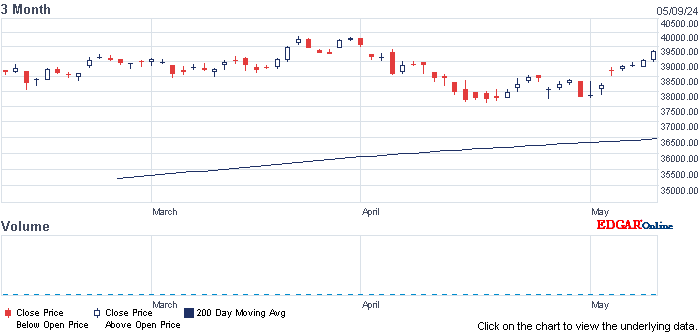
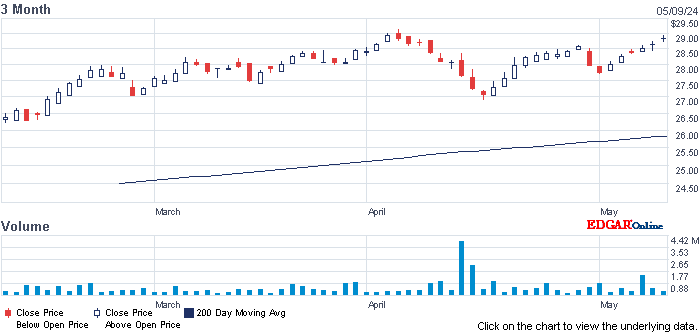
Dow went up 81, advancers over decliners 5-2 & NAZ fell 74.  The MLP index gained 2+ to the 146s & the REIT index added 2 to the 349s.  Junk bond funds continued in demand & Treasuries wee off a tad.  Oil rose to 36 & gold crawled up 1 to 1751.

AMJ (Alerian MLP Index tracking fund)
stock chart

CL=FCrude Oil36.18
+0.74+2.1%

GC=FGold   1,755.00+4.70+0.3%


3 Stocks You Should Own Right Now - Click Here!


Adidas (ADDYY) will close all of its US stores after looting throughout the country hit retailers trying to recover from coronavirus' impact on sales.  The German company had shared an anti-racism message on its social media over the weekend.  "Together is how we move forward," Adidas wrote on its Instagram.  "Together we have the power to make a change. Together we must fight what is wrong and try to make it right."  Looters cleaned out Adidas stores in Los Angeles, Chicago & New York City over the weekend.  The news comes after ADDYY reported a rough Q1 in Apr.  "Our results for the first quarter speak to the serious challenges that the global outbreak of the coronavirus poses even for healthy companies,"  CEO Kasper Rorsted said at the time.  It's unclear when some of these businesses will reopen.  Community members in cities from Long Beach, California, to Philadelphia came together yesterday to clean up the aftermath.  The stock dropped 2.07.
If you would like to learn more about ADDYY, cllick on this link:
club.ino.com/trend/analysis/stock/ADDYY?a_aid=CD3289&a_bid=6ae5b6f7

Adidas closes all US stores after looting: report


Pres Trump has threatened to deploy the US military to "restore safety and civility in America" if governors refuse to deploy the National Guard to put an end to riots across the country sparked by the death of George Floyd.  "I am mobilizing all available federal resources, civilian and military, to stop the rioting and looting, to end the destruction and arson, and to protect the rights of law-abiding Americans," Trump said.  "Today I have strongly recommended to every governor to deploy the National Guard in sufficient numbers that we dominate the streets. Mayors and governors must establish an overwhelming law enforcement presence until the violence has been quelled. If a city or state refuses to take the actions that are necessary to defend the life and property of their residents, then I will deploy the United States military and quickly solve the problem for them."  The move would require Trump to invoke the Insurrection Act, a 213-year old law established in 1807 giving the pres the authority to deploy US troops on active duty.  Trump vowed that justice will be served for George Floyd & his family but said we "cannot allow the righteous cries and peaceful protesters to be drowned out by an angry mob."  Trump specifically targeted the protests in DC from Sun night calling them a "total disgrace."  He warned that the gov will strictly enforce a 7PM. curfew for the city & that those inciting violence will be held accountable.  "Those who threaten innocent life and property will be arrested, detained and prosecuted to the fullest extent of the law," Trump said.  "I want the organizers of this terror to be on notice that you will face severe criminal penalties and lengthy sentences in jail"  The news comes following an announcement from the White House yesterday that the White House would establish a command center to help state & local govs put an end to violent protests.

Trump threatens this action to 'restore safety and civility in America'


Economic activity in Q2 has been cut by more than ½, according to a tracker employed by the Atlanta Federal Reserve.  The GDPNow outlook is now showing a 52.8% tumble, following data yesterday that US manufacturing remains firmly in decline & will weigh on investment and consumption.  That data from the Institute for Supply Manufacturing showed just 43% of firms seeing expansion in May.  Extrapolating from that data, the Atlanta Fed anticipates personal consumption expenditures, which make up 68% of the nation’s GDP, to fall 58% in Q2.  Gross private domestic investment, which accounts for 17% of GDP, is now projected to slide 63%.  The GDPNow reading undergoes regular revisions & generally is more accurate as it gets closer to the end of the qtr (Jun 30).  The New York Fed's GDP Nowcast, which was last updated before the ISM release, estimates a 35% Q2 drop, while CNBC's Rapid Update survey of leading economists has a median 38% decline.  The blow to the economy comes as most states have begun to relax stay-at-home restrictions stemming from the coronavirus pandemic.  Even with the reopenings, the economic data for the period is expected to be among the worst the US has ever seen.  Fri's nonfarm payrolls report is expected to show that another 8.3M Americans lost their jobs in Apr, bringing the unemployment rate to 19.5%.  That's on top of the 20.5M payrolls drop in Mar & a 14.7% jobless level.  The current slide in activity has been unique in that it has been led by services sector, rather than manufacturing or construction as is common in recessions.  Of the jobs lost in Apr, 17.2M came from the services side, including nearly 7.7M in leisure & hospitality.

GDP now projected to fall nearly 53% in second quarter, according to Fed gauge

These are trying times for economy between recovering from an economic depression & civil unrest.  At least investors are have been able to hold up by keeping their optimistic outlook for the economy.

Dow Jones Industrials


Monday, June 1, 2020

Markets rise on early signs of US economic recovery

Dow gained 91, advancers over decliners better than 3-1 & NAZ climbed 62.  The MLP index slid to the 14es & the REIT index jumped 9+ to the 349s.  Junk bond funds were purchased all day & Treasuries went up in price.  Oil finished higher in the 35s & gold was flattish at 1751 (more on both below).

AMJ (Alerian MLP Index tracking fund)

stock chart

Live 24 hours gold chart [Kitco Inc.]


3 Stocks You Should Own Right Now - Click Here!


China has ordered major Chinese buyers to halt purchases of some US agriculture products amid heightened tensions with the US over Hong Kong.  State-owned agricultural buyers Cofco & Sinograin were told to stop buying US soybeans, pork & other goods.  Private companies have not been told to pause their buys.  The move comes after Pres Trump announced Fri his administration would take action to punish Beijing for passing a national security bill that bypassed Hong Kong's legislature, effectively ending the “one country, two systems” governing principle that was guaranteed for the 50 years following Great Britain's 1997 handover to China.  Trump directed his administration to “begin the process of eliminating policy exemptions that give Hong Kong different and special treatment” including agreements with Hong Kong on extradition, export controls on dual-use technologies & more.  The pres also instructed his working group on financial markets to “study the differing practices of Chinese companies listed on the US financial markets with the goal of protecting American investors.”  Firms from China, & elsewhere, listed on US exchanges do not have to follow the same accounting standards as American companies.  Beijing's agriculture purchases, which must total $50B under the partial trade deal, have gotten off to a slow start due to the COVID-19 pandemic, which originated in Wuhan, China.  US customs data showed Beijing had purchased $3.1B of US agricultural products in the 3 months thru Mar.  China's data showed those purchases totaled $5B.  The phase one trade deal signed in Jan calls for Beijing to buy an additional $200B of US goods over the next 2 years, including $50B of agricultural products.  The deal also says China must halt intellectual property theft, refrain from currency manipulation & cooperate in financial services.  The US, for its part, reduced tariffs on some Chinese goods, but kept duties on $375B worth of products.

China to halt some US purchases, putting trade deal in jeopardy


Eli Lilly (LLY) said it began the world’s first human trial of a potential antibody treatment for the novel coronavirus.  LLY said its early-stage study is designed to determine the treatment's effectiveness on patients hospitalized with COVID-19.  The experimental drug is derived from a blood sample taken from one of the first American patients who recovered from COVID-19.  The initial study will have about 40 patients, CEO David Ricks said.  Results are expected by the end of Jun.  “We take the very best one or two antibodies, and we scale them up and make them into a medicine,” Rick said.  “A very potent medicine. We’ve already initiated the process to begin production. We could have 100,000 or more doses available this fall.”  “We also want to study the medicine before people get to the hospital,” he added.  “And perhaps even a bigger study in what we would call prophylactics, prevention for those patients who are most at risk with compromised immune systems, maybe cancer therapy, or the elderly. This is an important bridge therapy until a vaccination could arrive.”  The treatment, LY-CoV555, has been developed through LLY's collaboration with AbCellera Biologics, a privately held company that LLY partnered with in Mar.  Globally, there are about a dozen vaccine candidates in the first stages of testing or about to begin.   The stock lost 46¢.
If you would like to learn more about LLY, click on this link:
club.ino.com/trend/analysis/stock/LLY?a_aid=CD3289&a_bid=6ae5b6f7

Eli Lilly begins human test of potential coronavirus antibody treatment


Las Vegas is getting ready to launch a “Welcome Back” ad campaign to encourage visitors to come.  But now guests will have to weigh not only the risks of coronavirus but also of civil unrest.  Thurs is the scheduled reopening for Nevada's casinos, but over the weekend, the National Guard was called up to respond to riots in Reno, & the mayor declared a citywide emergency.  In Las Vegas, squads of police shot rubber bullets at protestors & released tear gas on the Strip.  The protests & unrest have the potential to disrupt what had been a surprisingly strong response to the scheduled reopening.  Last week, Caesars Entertainment (CZR) said demand for reservations was so strong, the company decided to reopen a 3rd property, adding Harrah’s to Caesars Palace & the Flamingo. MGM also added MGM Grand to its planned reopening list that already included Bellagio & New York New York.  The same is true in Missouri, where the planned reopening of casinos is continuing today.  Eldorado Resorts (ERI) is opening 5 casinos today in Missouri & Iowa, including Lumiere Place Casino & Hotels near the iconic St Louis Arch.  Over the weekend in & around that city, protests turned violent, with a man killed after being dragged by a Fedex (FDX) truck.  The same is true in Missouri, where the planned reopening of casinos is continuing today.  ERI is opening 5 casinos today in Missouri & Iowa, including Lumiere Place Casino & Hotels near the iconic St Louis Arch.

Protests may derail what was expected to be a strong reopening for Las Vegas casinos

A private survey showed manufacturing activity in China expanded for the month of May.  The Caixin/Markit Manufacturing Purchasing Manager's Index came in at 50.7 for May.  PMI readings above 50 indicate expansion, while those below that level signal contraction.  The forecast expected the May PMI number to come in at 49.6 compared to the Apr reading of 49.4.  Data suggested that production recovered faster than demand & the rate of expansion for output was at its fastest since 2011.  Meanwhile, demand was subdued with total new work falling in May.  “May data signalled a further increase in output following February’s record decline, with firms widely mentioning the resumption of works due to an easing of COVID-19 related measures,” Caixin & IHS Markit said.  “Data indicated that the fall was largely driven by weaker external demand, as many nations faced strict measures to stop the spread of the pandemic including company closures, leading new export orders to contract at a historically sharp rate,” they continued.  Yesterday China posted the official manufacturing Purchasing Manager's Index which came in at 50.6, according to the National Bureau of Statistics.  This was compared to 50.8 in Apr.  The Caixin/Markit survey features a bigger mix of small- & medium-sized firms.  In comparison, the official PMI survey typically polls a large proportion of big businesses & state-owned companies.   It's not just external demand that is dragging on China's economy.  Weak labor market conditions are likely to hold back recovery in Chinese consumer spending.

A private survey shows China’s manufacturing activity unexpectedly expanded in May

Gold prices settled with a modest loss as investors weighed demand for the precious metal against a backdrop of nationwide protests following the death of a black man in Minneapolis police custody, the latest developments tied to US-China tensions over Hong Kong & some data that point to an improvement in the economy.  Gold for Aug fell $1 to settle at $1750 an ounce.  The most-active contract traded between a low of $1737 & a high of $1761.  Civil unrest erupted across major cities from Los Angeles to New York as anger over the death in police custody of George Floyd last Mon sparked demonstrations.  A Minneapolis police officer, Derek Chauvin, was captured on video driving his knee onto Floyd's neck until the handcuffed man lost consciousness & later died.  For now, the US economy, however, has shown some signs of recovery as COVID-19 lockdowns in the country because to ease.  The Institute for Supply Management said its manufacturing index climbed to 43.1 last month from an 11-year low of 41.5 in Apr, while the Commerce Dept reported that spending for US construction projects dropped a smaller than expected 2.9% in Apr.

Gold prices end slightly lower as investors eye U.S. unrest and tensions with China

US benchmark oil futures settled lower, as Beijing-DC tensions raised concerns over the prospects for crude demand.  Global benchmark oil prices, however, finished higher on the heels of a report that major oil producers may meet earlier than previously planned & discuss an extension to current crude output cuts.  Russia & members of OPEC & allies (OPEC) were moving toward an agreement to extend current output cuts by one or 2 months, accordion to leakers.  The report comes ahead of a meeting of OPEC and its allies, which could occur Thurs, instead of a previously scheduled Jun 9-10.  West Texas Intermediate crude for Jul lost 5¢ to settle at $35.44 a barrel.  Front-month US benchmark WTI futures rose 88.4% for May, for its best month on record, based on data going back to 1983.  Global benchmark Brent saw its Aug contract edge up 48¢ (1.3%) to $38.32 a barrel.  The Jul contract expired on May 31.  Front-month prices for Brent rose 39.8% for the month, which was the strongest monthly rise since 1999.  Back in Apr, OPEC & its allies forged a historic pact to reduce global output by 9.7M barrels per day, but those cuts, which began in May, are scheduled to terminate at the end of Jun.  A combination of world-wide output cuts and some brewing optimism about demand for crude have helped boost crude prices from lows as business lockdowns caused by measures to curb the spread of the novel strain of coronavirus recede.  However, investors continue to watch strained relations between the US & China.  A report said that Beijing has halted some imports of US soybeans, potentially adding to Sino-American friction, which could add pressure on crude prices if it results in an erosion of the hard-won, phase-one trade agreement.  Tensions between the 2 nations have climbed again in recent weeks with US officials expressing anger over how China handled the coronavirus outbreak & Pres Trump on Fri saying he would end the special status of Hong Kong, due to China's imposition of national-security laws.  Meanwhile, violent unrest among major cities in the US, sparked by the death of George Floyd in police custody, has added to uncertainty in the financial markets.

U.S. oil prices end lower on U.S.-China tensions, but global prices gain on talk of extension to OPEC+ output cuts

This was a very tough day for the country, but the stock market held up well.  Dark clouds from civil unrest & faltering US-China economic relations are extremely disturbing.  But investors are more impressed by early signs of a recovering economy.

Dow Jones Industrials


Markets edge higher on encouraging manufacturing data

Dow went up 12 after a lower market opening, advancers over decliners 5-2 & NAZ rose 25.  The MLP index added 1+ to the 145s & the REIT index gained 6+ to the 346s.  Junk  bond funds continued climbing & Treasuries were bid higher.  Oil dropped to the 34s & gold was off 1 to 1750.

AMJ (Alerian MLP Index tracking fund)

stock chart

CL=FCrude Oil34.89
-0.60-1.7%

GC=FGold   1,745.50
-6.20-0.4%


3 Stocks You Should Own Right Now - Click Here!


As the US erupted in protest over the weekend in response to the police killing of George Floyd, an unarmed black man, health officials are warning that mass gatherings will likely exacerbate the coronavirus outbreak in the most vulnerable communities.  The protests come as schools & businesses across the country have been closed for months in a bid to keep people home & curb the spread of the virus.  The coronavirus has now infected more than 1.7M across the US & killed 105K, according to Johns Hopkins University data.  While some states, including those hardest hit by Covid-19 such as New York & New Jersey, have managed to drive the outbreak into decline,  Minnesota is expanding with hospitalizations on the rise.  City & state officials across the country called for protesters to get tested & continue to practice social distancing.  Maryland Gov Larry Hogan said that there’s “no question” the protests will lead to spread of the virus, but that's the “next step” for officials after quelling the protests & violence.  “If you were out protesting last night, you probably need to go get a Covid test this week,”  Atlanta Mayor Keisha Lance Bottoms said.  “There is still a pandemic in America that’s killing black and brown people at higher numbers.”  States have moved in recent weeks to ease restrictions meant to limit the spread of the virus.  Officials have shown particular willingness to reopen beaches, parks & other outdoor sites and businesses as some research indicates that the virus does not spread as easily outdoors.

Protests across U.S. prompt concerns over exacerbating coronavirus outbreak

Nearly ½ (48.8%) of leading CFOs surveyed in the latest CNBC Global CFO Council Survey say the Covid-19 pandemic will have a “negative” impact on their companies in 2020, while another 39% say it will have a “very negative” impact.  The CFOs who responded to this qtr's survey have grown more certain about the negative outlook for their businesses, & more downbeat about the outlook for the global economy, in the 3 months since last surveyed them.  The CNBC Global CFO Council represents some of the largest public & private companies in the world, collectively managing more than $5T in market value across a wide variety of sectors.  In the Q1 survey, conducted in Mar, 30% of CFOs said it was “too early to know” the impact the pandemic would have on their companies this year.  Now only one of the 41 CFOs surveyed says it’s too early to know, & just 2 think the impact will be positive for their companies, leaving the overwhelming majority facing down a very tough 2020.  41 of the 130 members of the council responded to the survey, which was conducted from May 14–28 (15 from North America, 10 EMEA & 16 APAC).  CFOs' outlook for the global economy has worsened since Mar as well.  On average, CFOs rated the GDP outlook for every region of the world as “declining,” with the exception of Brazil & Latin America, which are viewed as “strongly declining.”  Both regions are currently global hot spots for new infections.  Brazilian Pres Jair Bolsonaro has been criticized for his response to the pandemic. That is the first time since  the survey began that any region has been given the worst possible rating.  The “declining” outlook for the US economy is its worst ever.  Fueling the downbeat view, a majority of CFOs report significant declines in demand for their companies' products or services.  54% of CFOs say their companies have seen a decrease in demand in the US since Apr 1, with most of them calling it a “major decrease.”

 CFOs more negative on economy, expect big coronavirus hit in 2020: Survey

US manufacturing activity eased off an 11-year low in May, the strongest sign yet that the worst of the economic downturn was behind as businesses reopen, though the recovery from the Covid-19 crisis could take years because of high unemployment.  The Institute for Supply Management (ISM) said its index of national factory activity rose to a reading of 43.1 last month from 41.5 in Apr, which was the lowest level since 2009.  A reading below 50 indicates contraction in manufacturing, which accounts for 11% of the US economy.  The forecast called for the index rising to 43.0 in May.  The first increase in the ISM index since Jan mirrored improvements in regional manufacturing surveys in May & suggested Apr was the nadir for economic activity.  At least 21.4M jobs were lost been Mar & Apr.  The economy contracted at a 5% annualized rate in Q1, the worst performance since the 2007-09 recession.  GDP is expected to decline at a rate as sharp as 40% in Q2, which would the biggest contraction in output since the depression on the 1930s.  The ISM's forward-looking new orders sub-index increased to a reading of 31.8 in May from 27.1 in Apr, which was the lowest since 2008.  The survey's measure of order backlogs at factories rose to 38.2 last month after plummeting to a reading of 37.8 in Apr.  There was also a slight improvement in the ISM's measure of factory employment, which advanced to a reading of 32.1 in May after plunging to 27.5 in the prior month, which was the lowest since 1949.

U.S. manufacturing activity pulls off 11-year low

Selling dragged the Dow lower at the opening, but cautious buying lifted it modestly into the black.  Current news events are getting the headlines, but economic news & US-China relations get more attention by the traders.  So far, the Dow was able to remain close to its 2+ month highs. & the bulls like to see that.

Dow Jones Industrials

stock chart