Dow sank 210 (closing near the lows), decliners over advancers 2-1 & NAZ dropped 57. The MLP index pulled back 1+ to the 294s following a recent run shown in the chart below & the REIT index added 5+ to the 336s. Junk bond funds were mixed to lower in a very good year for them & Treasuries were bid higher. Commodities rallied on a weak $. Oil is back over 46 & gold had a big gain (shown in its chart).
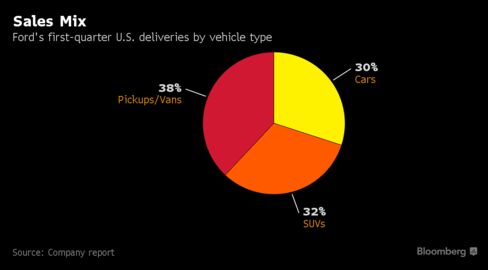
Ford reaped the benefits of Americans' love of SUVs & pickups in Q1, posting record net
income of $2.5 billion that exceeded estimates on the back of
those popular models. EPS excluding one-time costs was 68¢, beating the 48¢ estimate. Ford gained
market share in North America, bolstered by sales of F-Series pickups & SUVs like the Explorer & the Flex.
Ford
posted quarterly pretax earnings of $3.8B, a record for any
quarter, aided by an all-time high North American margin of 12.9%. Solid profits in Europe & growth in China also contributed. EPS rose to 61¢ from 29¢
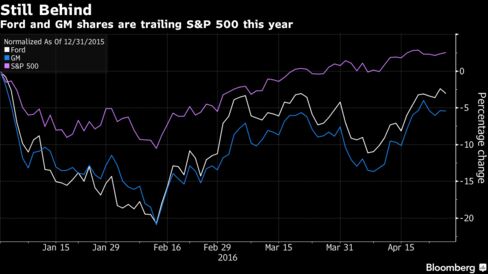
a year earlier (when F-150 pickup production was limited). The shares also rose after CEO Mark Fields said that Ford is working on a long-range electric vehicle that would go 200 miles or more on a charge. CFO Bob Shanks rejected the view that the US auto market has peaked. “I
don’t buy into that,” he said. “I know that’s what the
market is pricing in; they’re also pricing in a recession. There’s
nothing that we see in the leading economic indicators to suggest that
anything like that is on the horizon.”
“I don’t know if it’s as good as it gets,” Shanks said. “We expect the first half to be the more favorable half of the year.” The stock went up 43¢. If you would like to learn more about Ford, click on this link: club.ino.com/trend/analysis/stock/F?a_aid=CD3289&a_bid=6ae5b6f
MasterCard
reported a slightly better-than-expected quarterly profit as customers
spent more using its cards. However, net income fell 6% as operating costs jumped 25%. EPS fell to 86¢ from 89¢ a year earlier. Analysts expected 85¢. Gross dollar volumes, the total value of transactions made by
customers, rose 13% to $1.1T on a local currency basis. Cross-border volumes, the value of transactions made by card holders outside the card-issuer's country, jumped 12%. Total operating costs rose to $1.1B from $879M & net revenue rose 9.7% to $2.45B. The stock lost 1.20. If you would like to learn more about MA, click on this link: club.ino.com/trend/analysis/stock/MA?a_aid=CD3289&a_bid=6ae5b6f
United Parcel Service reported a higher quarterly net
profit, citing a rise in ecommerce packages in its crucial US domestic
business & improved margins on the back of cost cutting. The company posted EPS of $1.27, up from $1.12 a year earlier. Analysts had expected EPS of $1.22. The stock lost 1.55. If you would like to learn more about UPS, click on this link: club.ino.com/trend/analysis/stock/UPS?a_aid=CD3289&a_bid=6ae5b6f
The overbought stock market finally ran into selling. The weak dollar was bullish for commodities & stocks were sold to fuel rising commodity prices. The stock market remains vastly overbought & more such weakness can be expected. However, yield sensitive issues, such as REITs & junk bond funds, are trading near highs for 2016.
Dow dropped 31, advancers & decliners were even & NAZ recovered 21. The MLP index lost a tad to the 295s & the REIT index is still in the 337s. Junk bond funds hardly budged & Treasuries fluctuated. Oil & gold each had modest gains.
The US economy expanded in Q1 at the slowest pace in 2 years as American consumers reined in spending & companies
tightened their belts in response to weak global financial conditions & a plunge in oil prices. GDP rose at a 0.5% annualized rate after a 1.4% Q4 advance,
according to the Commerce Dept. The increase was less than the
0.7% projection & marked the
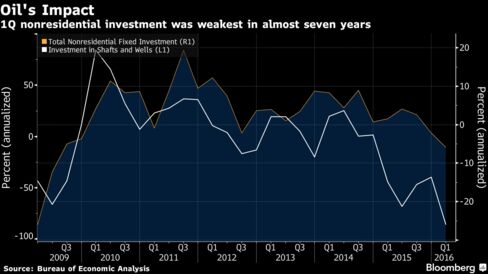
third straight disappointing start to a year. Shaky global markets & oil's tumble resulted in the biggest business-investment slump in
almost 7 years, & household purchases climbed the least since
early 2015. While Fed yesterday acknowledged the softness, they also indicated strong hiring & income gains have the potential to reignite consumer spending &
propel economic growth. Household
purchases, almost 70% of the economy, rose at a
1.9% annual pace, compared with 2.4% in Q4. Spending, while slightly better
than the 1.7% forecast, was a disappointment in light of
the consumer-friendly fundamentals including low gasoline prices, cheap
borrowing costs, increased hiring & warmer-than-usual winter weather. Disposable income adjusted for inflation climbed 2.9%, an improvement from the 2.3% gain in Q4 & the saving rate ticked up to 5.2% from 5%. The biggest factor weighing on the economy came from companies. Nonresidential fixed investment, or spending on
equipment, structures & intellectual property, dropped at a 5.9% annualized pace, the biggest decline since Q2-2009. Last year’s slump in oil prices that extended into early
2016 led to an 86% annualized plunge in capital spending on wells & shafts, the most in records back to 1958.
Investment
is also languishing as corps struggle to boost profits against a
backdrop of weak overseas demand & restrained domestic purchases. Customers
in the US also limited orders as companies trim stockpiles to bring
them more in line with sales. Inventories subtracted 0.33 percentage
point from growth after a 0.22 percentage-point drag in Q4. A
dearth of eager overseas customers led to a drop in exports, trade subtracted 0.34 percentage point from overall
growth, the most in a year.
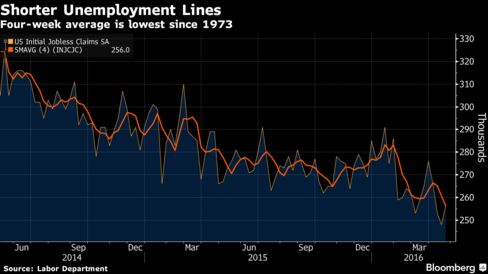
Jobless claims last week hovered around 4-decade lows, showing the
labor market remains the strongest part of the US economy. Initial
applications for unemployment benefits climbed 9K to 257K, according to the Labor Dept. The low level of layoffs indicates companies
are optimistic about prospects for demand after a soft Q1.
Continued progress in the labor market that's accompanied by
accelerating wage growth will be needed to help prop up consumer
spending.
The 4-week moving average of claims decreased to 256K, the lowest since 1973,
from 261K. The number continuing to receive jobless
benefits fell 5K to 2.13M, the
fewest since 2000. The unemployment rate among people eligible
for benefits held at 1.6%.
ConocoPhillips, the largest US independent oil company, posted a Q1 loss, compared with a year-earlier profit, & cut its
spending budget for the 2nd time this year as the slump in crude
prices sapped profitability. The 2016 capital expenditure forecast was cut to $5.7B from $6.4B, driven by reduced deepwater exploration
activity. It had cut its capital budget forecast in Feb. COP, which cut its div 25% in
Feb to save cash, reduced Q1 operating costs 21% to $1.69B. Production fell to 1.578M barrels of oil equivalent per day (mboe/d) from 1.610M. The loss per share was $1.18,
compared with EPS of 22¢ a year
earlier. Excluding special items, the loss was 95¢ per share, compared with the estimate for a loss of $1.05. Total revenue & other income fell 37% to $5.02B. The stock rose 65¢. If you would like to learn more about COP, click on this link: club.ino.com/trend/analysis/stock/COP?a_aid=CD3289&a_bid=6ae5b6f7
Drab economic data & mixed earnings reports were accepted by the stock market with little excitement. Modest economic growth is welcome to many traders who see that as another excuse to postpone interest rate hikes. More earnings reports are coming from biggie oil companies & they will not be pretty. Low oil prices have not brought a boost to the economy while they hurt the energy segment badly (with more pain to come). The Dow continues in the black YTD.


![Live 24 hours gold chart [Kitco Inc.]](https://lh3.googleusercontent.com/blogger_img_proxy/AEn0k_uslZflI22ygzl0K7xag7SH3Bm89DsxKNt90E_TeiNhZGZaiK1nA8LAEg40VGYZhaSZCT0noO2C4ZBQkUxkWCbfHB5GEDNVjajw11Fc2HwuU_mW_9EyjSUR7UKpXVUl=s0-d)



 ...0.70