


Dow was off 9 in another wild day for stocks, advancers a little ahead of decliners & NAZ declined 59 (more below). The MLP index was about even in the 236s & the REIT index continued fractionally higher to the 322s. Junk bond funds were mixed & Treasuries crawled higher. Oil is back in the 64s (more below) & gold tumbled 18 to 1329.
AMJ (Alerian MLP Index tracking fund)
![Live 24 hours gold chart [Kitco Inc.]](https://lh3.googleusercontent.com/blogger_img_proxy/AEn0k_tOe6gP1qigzt8bBMeIn0-zDpfFKLBiItw9wgAe8_R_M_6uJ_cFbFr6Lw4-vW9E4AOQnFWK9bYpZP9bWOmaUJFDCLd4kRUInAieNVRTRDltua-ZqnlQlBPjhEydzeJbNhQ=s0-d)


Stocks fluctuated as megacap tech shares struggled to recover from a sharp selloff yesterday in the PM. The $ rose while Treasury yields held below 2.8% as data showed American economic growth beat estimates. Volatility measures spiked as the NAZ 100 Index swung from losses of as much as 1.8% to gains that reached 0.5%. Netflix (NFLX) & Amazon (AMZN) were each off more than 3.5%, helping leave the gauge poised for its worst month in 2 years. The S&P 500 Index was little changed, hovering just above its average price for the past 200 days, a level that’s set a line in the sand in the selloffs last week & in early Feb. The 10-year yield rose slightly after dipping below 2.75% for the first time since early Feb. Gold retreated with the ¥. Crude slumped below $65 a barrel. European equities advanced after Asian stocks posted broad declines. Technology shares have suffered the most from investor jitters this month after leading much of the bull-market charge in global equities during the past few years. Pressure is growing on the stocks amid speculation about a regulatory crackdown related to data privacy & antitrust concerns, US threats to forbid Chinese investments in the sector & a move by traders to lock in their gains after the NAZ 100 soared more than 60% in the 2 years through mid-Mar.
Tech Swings Spur Spike in Volatility; Dollar Gains: Markets Wrap
Walgreens (WBA) quarterly profit & sales beat estimates, as the drugstore chain's partnerships with pharmacy benefit managers over the past year helped it fill more prescriptions & mail orders. The company, which has been focusing on its pharmacy business in the face of falling retail sales, added more than 20M members through its partnership with pharmacy benefit managers such Prime Therapeutics. This helped fill 9.1% more prescriptions in the qtr and drive a 5.1% rise in pharmacy same-store sales. The higher number of prescriptions also comes as the US faced its harshest flu season in decades, with flu-related doctor visits reaching a 20-year high. Same-store sales at its retail business fell 2.7%. WBA lifted its full-year adjusted EPS forecast to $5.85-6.05 from $5.45-$5.70. Analysts were estimating $5.78 for the year. The lift in forecast reflects a $350M tax benefit for fiscal year 2018, an increase of about $150M from the company's previous estimate. EPS attributable to the company rose to $1.36 from 98¢ a year earlier. Excluding items, EPS was $1.73. Net sales rose 12% to $33.02B, helped in part by the ongoing takeover of nearly 2K Rite Aid (RAD) stores. Analysts were expecting EPS of $1.55 on revenue of $32.19B. The stock rose 1.63.
If you would like to learn more about WAG, click on this link:
club.ino.com/trend/analysis/stock/WBA?a_aid=CD3289&a_bid=6ae5b6f
Before this week, oil had recovered from Feb's losses after Pres Trump named hawkish officials to his gov, signaling the nation may pursue a more hard-line approach toward OPEC member Iran. Still, fears remain that surging American shale production could thwart efforts by OPEC to reduce a global oversupply. West Texas Intermediate crude for May delivery lost as much as $1.36 to $63.89 a barrel & Brent for May settlement dropped $1.04 to $69.07. The global benchmark traded at a $5.06 premium to WTI. The stockpile increase was the 4th in 5 weeks. Inventories at the Cushing, Oklahoma, storage hub jumped 1.8M barrels, the most since a year ago. Meanwhile gasoline supplies fell 3.47M barrels, according to the EIA.
Pres Trump called for continued pressure against Kim Jong Un, after China said the North Korean leader expressed an openness to disarmament talks during a surprise visit to Beijing. Trump struck an optimistic tone after the unexpected summit with Chinese President Xi Jinping, saying in a pair of early AM tweets that Kim might “do what is right for his people and for humanity” & give up his nuclear weapons. “In the meantime, and unfortunately, maximum sanctions and pressure must be maintained at all cost!” Trump added. Trump's tweets followed Chinese & North Korean statements confirming Kim's secretive 4-day swing thru China, his first foreign trip since taking power in 2011. China's official Xinhua News Agency said Kim expressed an openness to discussing his weapons program during a planned May summit with Trump, while North Korean reports made no mention of denuclearization. “North Korea sees an opportunity with these summits to message to the world that it’s not isolated and that it has diplomatic options,” Mintaro Oba, a former State Dept official who worked on North Korean issues, said. “The Kim-Xi summit is the latest step in that game.” Kim's clandestine visit -- Chinese officials refused for 2 days to confirm reports of his motorcade & train movements -- shakes up the diplomatic landscape ahead of the potential Trump meeting. Chinese media reports included Kim's first public remarks indicating he would discuss his nuclear arsenal with Trump, who has upended decades of US policy by agreeing to meet the North Korean leader without a clear disarmament plan. The confirmation of Kim’s talks in Beijing helped reduce demand for haven assets, weakening the ¥. The news had little impact on Asian equity markets, which fell after a selloff in technology shares spooked investors. Kim also shored up his alliance with China, which has been strained since he came to power & executed his uncle, who was a key communications channel with Beijing. His missile & nuclear tests have exasperated China, which has supported Trump’s “maximum pressure” campaign against Kim's weapons program.
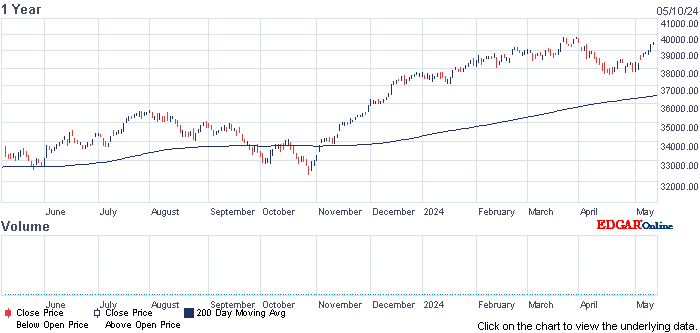
Tariff issues are taking a back seat to problems in tech, especially the high profile guys. Facebook (FB) is facing its first major test regarding data breaches with a young leader has not been tested in difficult times. Others are also getting hit with complaints from many directions which has brought on substantial selling, not common for them. For example, AMZN is down 10% in the last couple of weeks. Tariff problems have not gone away & they could affect the tech sector. After going sideways near 25K for a couple of weeks, the Dow is currently drifting sideways around 24K. The Dow is down 600 this week & in the red YTD. Not good going forward.
Dow Jones Industrials


AMJ (Alerian MLP Index tracking fund)


Stocks fluctuated as megacap tech shares struggled to recover from a sharp selloff yesterday in the PM. The $ rose while Treasury yields held below 2.8% as data showed American economic growth beat estimates. Volatility measures spiked as the NAZ 100 Index swung from losses of as much as 1.8% to gains that reached 0.5%. Netflix (NFLX) & Amazon (AMZN) were each off more than 3.5%, helping leave the gauge poised for its worst month in 2 years. The S&P 500 Index was little changed, hovering just above its average price for the past 200 days, a level that’s set a line in the sand in the selloffs last week & in early Feb. The 10-year yield rose slightly after dipping below 2.75% for the first time since early Feb. Gold retreated with the ¥. Crude slumped below $65 a barrel. European equities advanced after Asian stocks posted broad declines. Technology shares have suffered the most from investor jitters this month after leading much of the bull-market charge in global equities during the past few years. Pressure is growing on the stocks amid speculation about a regulatory crackdown related to data privacy & antitrust concerns, US threats to forbid Chinese investments in the sector & a move by traders to lock in their gains after the NAZ 100 soared more than 60% in the 2 years through mid-Mar.
Tech Swings Spur Spike in Volatility; Dollar Gains: Markets Wrap
Walgreens (WBA) quarterly profit & sales beat estimates, as the drugstore chain's partnerships with pharmacy benefit managers over the past year helped it fill more prescriptions & mail orders. The company, which has been focusing on its pharmacy business in the face of falling retail sales, added more than 20M members through its partnership with pharmacy benefit managers such Prime Therapeutics. This helped fill 9.1% more prescriptions in the qtr and drive a 5.1% rise in pharmacy same-store sales. The higher number of prescriptions also comes as the US faced its harshest flu season in decades, with flu-related doctor visits reaching a 20-year high. Same-store sales at its retail business fell 2.7%. WBA lifted its full-year adjusted EPS forecast to $5.85-6.05 from $5.45-$5.70. Analysts were estimating $5.78 for the year. The lift in forecast reflects a $350M tax benefit for fiscal year 2018, an increase of about $150M from the company's previous estimate. EPS attributable to the company rose to $1.36 from 98¢ a year earlier. Excluding items, EPS was $1.73. Net sales rose 12% to $33.02B, helped in part by the ongoing takeover of nearly 2K Rite Aid (RAD) stores. Analysts were expecting EPS of $1.55 on revenue of $32.19B. The stock rose 1.63.
If you would like to learn more about WAG, click on this link:
club.ino.com/trend/analysis/stock/WBA?a_aid=CD3289&a_bid=6ae5b6f
Walgreens pharmacy business drives profit, sales beat
Before this week, oil had recovered from Feb's losses after Pres Trump named hawkish officials to his gov, signaling the nation may pursue a more hard-line approach toward OPEC member Iran. Still, fears remain that surging American shale production could thwart efforts by OPEC to reduce a global oversupply. West Texas Intermediate crude for May delivery lost as much as $1.36 to $63.89 a barrel & Brent for May settlement dropped $1.04 to $69.07. The global benchmark traded at a $5.06 premium to WTI. The stockpile increase was the 4th in 5 weeks. Inventories at the Cushing, Oklahoma, storage hub jumped 1.8M barrels, the most since a year ago. Meanwhile gasoline supplies fell 3.47M barrels, according to the EIA.
Pres Trump called for continued pressure against Kim Jong Un, after China said the North Korean leader expressed an openness to disarmament talks during a surprise visit to Beijing. Trump struck an optimistic tone after the unexpected summit with Chinese President Xi Jinping, saying in a pair of early AM tweets that Kim might “do what is right for his people and for humanity” & give up his nuclear weapons. “In the meantime, and unfortunately, maximum sanctions and pressure must be maintained at all cost!” Trump added. Trump's tweets followed Chinese & North Korean statements confirming Kim's secretive 4-day swing thru China, his first foreign trip since taking power in 2011. China's official Xinhua News Agency said Kim expressed an openness to discussing his weapons program during a planned May summit with Trump, while North Korean reports made no mention of denuclearization. “North Korea sees an opportunity with these summits to message to the world that it’s not isolated and that it has diplomatic options,” Mintaro Oba, a former State Dept official who worked on North Korean issues, said. “The Kim-Xi summit is the latest step in that game.” Kim's clandestine visit -- Chinese officials refused for 2 days to confirm reports of his motorcade & train movements -- shakes up the diplomatic landscape ahead of the potential Trump meeting. Chinese media reports included Kim's first public remarks indicating he would discuss his nuclear arsenal with Trump, who has upended decades of US policy by agreeing to meet the North Korean leader without a clear disarmament plan. The confirmation of Kim’s talks in Beijing helped reduce demand for haven assets, weakening the ¥. The news had little impact on Asian equity markets, which fell after a selloff in technology shares spooked investors. Kim also shored up his alliance with China, which has been strained since he came to power & executed his uncle, who was a key communications channel with Beijing. His missile & nuclear tests have exasperated China, which has supported Trump’s “maximum pressure” campaign against Kim's weapons program.
Trump Urges Pressure Against North Korea After Kim’s China Trip
Tariff issues are taking a back seat to problems in tech, especially the high profile guys. Facebook (FB) is facing its first major test regarding data breaches with a young leader has not been tested in difficult times. Others are also getting hit with complaints from many directions which has brought on substantial selling, not common for them. For example, AMZN is down 10% in the last couple of weeks. Tariff problems have not gone away & they could affect the tech sector. After going sideways near 25K for a couple of weeks, the Dow is currently drifting sideways around 24K. The Dow is down 600 this week & in the red YTD. Not good going forward.
Dow Jones Industrials


