


Dow soared 306, advancers over decliners better than 4-1 & NAZ gained 65. The MLP index rose 4+ to the 267s & the REIT index also advanced. Junk bond funds continued slightly higher & Treasuries were sold, taking the yield on the 10 year Treasury up 7 basis points to 2.84%. Oil shot up to the 68s on word that OPEC quotas will continue thru Dec (more below) & gold went up 2 to 1306.
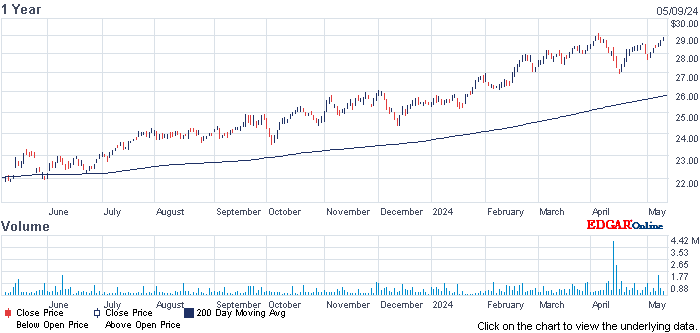
AMJ (Alerian MLP Index tracking fund)
![Live 24 hours gold chart [Kitco Inc.]](https://lh3.googleusercontent.com/blogger_img_proxy/AEn0k_tiNyIKlLPFN4KOWIUXeVS5agUrotkdVsWLvc3yaVtF0_eP2qPoK66ia2YZp4KY0VMq4fBpY4JT_pK4odPVi2B-IZSSmTg8phls8RFuJvwjKcpZd_nvxq3TuCXnzGbKgCg=s0-d)


Top European officials are holding last-ditch talks with the US commerce & trade chiefs just 2 days before the Trump administration decides whether to hit Europe with punishing new tariffs. Potential US tariffs on European steel or quotas on foreign cars have raised threats of retaliation & fears of a global trade war, a prospect that is already weighing on investor confidence & could hinder the global economic upturn. Commerce Sec Wilbur Ross & Trade Representative Robert Lighthizer are holding meetings today & tomorrow in Paris with EU, French & German officials. A final decision on Trump's threatened steel & aluminum tariffs is expected by Fri. The administration is also investigating possible limits on foreign cars in the name of US national security. EU Trade Commissioner Cecilia Malmstrom, ahead of her meetings with Ross & Lighthizer, tweeted today "the EU wants to be fully excluded from these tariffs and rather engage in a positive transatlantic trade agenda." Sec Ross criticized the EU for its tough negotiating position. "There can be negotiations with or without tariffs in place. There are plenty of tariffs the EU has on us. It's not that we can't talk just because there's tariffs," he said & noted that "China has not used that as an excuse not to negotiate." Speaking on a panel on cooperation between countries, Ross expressed concern that the Geneva-based World Trade Organization & other intl organizations are too rigid & slow to adapt to changes in business. "We would operate within (multilateral) frameworks if we were convinced that people would move quickly," he said. The EU is seeking exemptions on the steel & aluminum tariffs, which Trump hopes will revive domestic US industry but which could hurt American business activity abroad. The EU has notably threatened to impose tariffs on US orange juice, peanut butter & other goods in return.
China reportedly lining up countries against US in pending trade war
US crude surges 2.2%, settling at $68.21, on signs OPEC's output caps may survive
These are not good times for timid investors. Today, caution was thrown to wind & buyers returned. But the Italian crisis has to be watched closely. More importantly are trade negotiations with China, the EU & NAFTA which need a lot of work before agreements can be signed. The Dow remains unable to break away from sideways trading in the recent months.
Dow Jones Industrials


AMJ (Alerian MLP Index tracking fund)


Office of Trade & Manufacturing Policy Director Peter Navarro said Pres Trump is reigniting the trade war with China to protect national security. The Trump administration yesterday announced its plans to impose 25% tariff on $50B of Chinese imports. The statement came more than a week
after Treasury Sec Steve Mnuchin said that the trade war was
being put “on hold.” “This is a trade dispute
that we are having with China,” Navarro said. “As President Trump said we lost the trade war
long ago… President Trump has the courage and vision to turn that
around.” A final list of imports will be announced by Jun 15 & will be implemented soon thereafter. Commerce Sec Wilbur Ross is expected to return to Beijing on Sat for continued discussions. Navarro added the US is prepared for retaliation from China.
Trump ready for China trade war revenge, trade director says
Top European officials are holding last-ditch talks with the US commerce & trade chiefs just 2 days before the Trump administration decides whether to hit Europe with punishing new tariffs. Potential US tariffs on European steel or quotas on foreign cars have raised threats of retaliation & fears of a global trade war, a prospect that is already weighing on investor confidence & could hinder the global economic upturn. Commerce Sec Wilbur Ross & Trade Representative Robert Lighthizer are holding meetings today & tomorrow in Paris with EU, French & German officials. A final decision on Trump's threatened steel & aluminum tariffs is expected by Fri. The administration is also investigating possible limits on foreign cars in the name of US national security. EU Trade Commissioner Cecilia Malmstrom, ahead of her meetings with Ross & Lighthizer, tweeted today "the EU wants to be fully excluded from these tariffs and rather engage in a positive transatlantic trade agenda." Sec Ross criticized the EU for its tough negotiating position. "There can be negotiations with or without tariffs in place. There are plenty of tariffs the EU has on us. It's not that we can't talk just because there's tariffs," he said & noted that "China has not used that as an excuse not to negotiate." Speaking on a panel on cooperation between countries, Ross expressed concern that the Geneva-based World Trade Organization & other intl organizations are too rigid & slow to adapt to changes in business. "We would operate within (multilateral) frameworks if we were convinced that people would move quickly," he said. The EU is seeking exemptions on the steel & aluminum tariffs, which Trump hopes will revive domestic US industry but which could hurt American business activity abroad. The EU has notably threatened to impose tariffs on US orange juice, peanut butter & other goods in return.
US, Europe trade chiefs meet ahead of tariffs deadline
US factories ramped up production in late Apr & early May despite the risk of a global trade war, but soft consumer
spending kept the economy growing at a moderate rate, the Federal
Reserve reported. In its periodic "Beige Book" summary of
contacts with businesses in its 12 regional districts, the central
bank pointed to strong output in fabricated metals, heavy machinery &
electronics equipment. The assessment of growth
across the economy represented a slight upgrade from the Fed's prior
Beige Book report, which said economic activity was expanding at a
"modest to moderate pace." "Manufacturing shifted into higher gear," the Fed said in its latest report. More than ½ of the
Fed's districts reported a pickup in industrial activity, & 1/3 of
them reported the activity as "strong." Still, manufacturers worried that tensions between the US & its trading partners, notably China, could lead to higher tariffs
across the world. "The major concern
manufacturers expressed was trade policy," the Fed said, referring to
comments from business contacts in its Boston district, where a maker of
testing equipment said it might move some production to Europe to avoid
Chinese retaliation for increases in US tariffs. The Minneapolis Fed's
contacts said they were worried about how recent tariff announcements on
steel & aluminum could affect supply chains. The Trump administration
has announced tariffs on steel imports from many countries including
China while Beijing has targeted US aluminum & other goods. Only the Dallas Fed found
overall economic activity had "sped up to a solid pace." Across the country, growth in auto sales was flat & retail
sales excluding autos eased. The Fed's districts reported modest-to-moderate growth in employment
while contacts said the labor market remained tight. Wage increases,
however, were reported to be modest.
China is reportedly looking to line up other
countries against the US in a pending trade war after the White House
took an unexpected move forward on tariffs a day earlier, according to Chinese officials. Yesterday, the White House announced it would have a final list of $50B in imports that would be
subject to 25% tariffs by Jun 15 & 2 weeks later would
announce investment restrictions on Chinese acquisitions of US
technology. In response, China is
reportedly looking to line up countries against the US. The countries in question are mostly in Europe & Asia, where
companies could benefit from China's plans to give foreign companies
more open access to its markets. Yesterday's announcement came just days after the 2 countries announced a tentative solution. Treasury Sec Steve Mnuchin had said any trade war would be put on ice while negotiators worked out the
details. As part of that deal, China would reduce its trade advantage by
buying more US goods such as agricultural & energy commodities. Commerce Sec Wilbur Ross is set to arrive in Beijing Sat but the surprise move from DC could be an impediment to those talks & is "casting doubt"
over whether they can advance to the next level.
China reportedly lining up countries against US in pending trade war
Oil prices rebounded sharply,
supported by a report that Saudi Arabia, other OPEC states & non-OPEC
allies aim to stick to a global pact on cutting oil supplies until the
end of 2018. The producers are ready to make gradual
adjustments to offset any supply shortage, according to a leaker. The oil producers participating in the output
reduction deal are satisfied with the result of their agreement, which
was due to end at the end of 2018. US crude ended the session $1.48 (2.2%) higher at $68.21. The contract
fell about $5.50 a barrel (7.6%) over the last 5 trading
sessions. Brent rose $1.94 (2.6%) to $77.33 a barrel after trading as low as $74.81 earlier.
US crude surges 2.2%, settling at $68.21, on signs OPEC's output caps may survive
These are not good times for timid investors. Today, caution was thrown to wind & buyers returned. But the Italian crisis has to be watched closely. More importantly are trade negotiations with China, the EU & NAFTA which need a lot of work before agreements can be signed. The Dow remains unable to break away from sideways trading in the recent months.
Dow Jones Industrials


