


Dow lost 7, decliners slightly ahead of advancers & NAZ crawled up 14 after yesterday's steep decline. The MLP index fell 1+ to the 259s & the REIT index was off 1 to the 348s. Junk bond funds drifted lower & Treasuries fluctuated. Oil advanced well into the 73s & gold fell another 4 to 1252.
AMJ (Alerian MLP Index tracking fund)
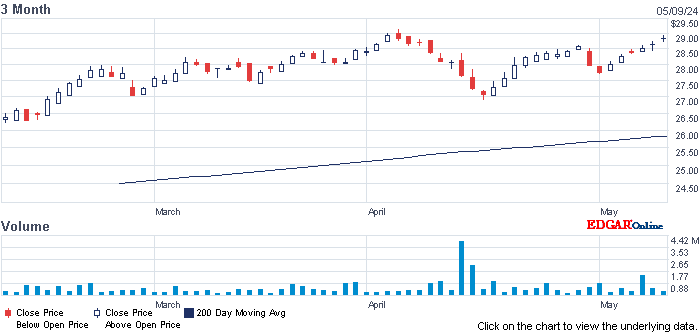


Stocks bounce between gains and losses
Energy Secretary Rick Perry confirmed he met with Russia's oil minister this week & laid out US concerns about a number of issues, including Moscow's annexation of the Crimean peninsula from Ukraine in 2014. "We shared with them our concerns about some of the activities they've been involved with, whether it's Crimea, Ukraine [or] the continual development of the Nord Stream 2 [natural gas pipeline]. All of those are on the table," Perry said. "They're obviously not unilateral for the Department of Energy to be making decisions. But we can send a message," he added. Perry's meeting with his Russian counterpart came ahead of a summit between Pres Trump & Russian Pres Putin, set for Jul 16 in Helsinki, Finland. Russia will be a "major player in the European market" for natural gas, Perry said, recognizing to the competitive edge of the Nord Stream 2 pipeline, under the Baltic Sea, that will directly connect Russia & Germany. Critics are concerned about the $11B project boosting Europe's dependence on Russian gas. "Competition is a good thing was basically our message," Perry said. "[However] , we're going to put our shoulders to task and try to get as much American LNG [liquefied natural gas] into the [European] community as we can." On oil prices, which have soared more than 12% in recent weeks, Perry refused to predict the future path for crude. But he said $65-70 per barrel "seems to be a place where most of the producers are comfortable."
Energy Secretary Rick Perry meets with Russia's oil minister and airs US concerns about their foreign aggression
The number of Americans filing for unemployment benefits increased more than expected last week, but the trend in claims remained consistent with a tightening labor market. Initial claims for state unemployment benefits rose 9K to a seasonally adjusted 227K for the latest week, the Labor Dept said. Filings had dropped for 4 straight weeks prior to the latest data. The forecast called for claims rising to 220K (there is probably limited scope for claims to post significant declines). The labor market is viewed as being near or at full employment, with the jobless rate at an 18-year low of 3.8&. The unemployment rate has dropped by three-tenths of a percentage point this year & is near the Fed's forecast of 3.6% by the end of this year. The 4-week moving average of initial claims, viewed as a better measure of labor market trends as it irons out week-to-week volatility, edged up 1K to 222K last week. The claims report also showed the number of people receiving benefits after an initial week of aid fell 21K to 1.71M in the latest week. The 4-week moving average of continuing claims dropped 3K to 1.72M, the lowest level since 1973. The continuing claims data covered the week of the household survey from which the Jun unemployment rate will be derived. The 4-week average of continuing claims decreased 32K between the May & Jun survey periods, suggesting a further decline in the jobless rate this month was likely.
US weekly jobless claims rose more than expected last week
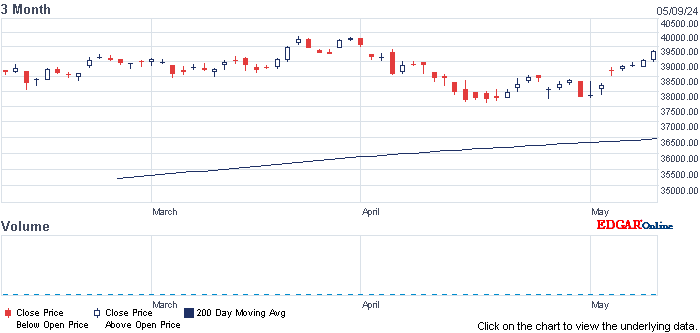
The stock market is doing little, waiting for new developments on the trade front. Yesterday was packed with an unusually large number of significant new stories & traders are attempting to digest it all today. The Dow is holding above 24K (shown below), but its hold is fragile. The bulls are mainly on the sidelines.
Dow Jones Industrials


AMJ (Alerian MLP Index tracking fund)
| CL=F | Crude Oil | 73.80 | +1.04 | +1.4% |
| GC=F | Gold | 1,253.50 | -2.60 | -0.2% |


The major US stock market indexes were flat to lower, having trimmed their early AM gains after the final read
on Q1 GDP came in at 2.0% slightly below the 2.2%
forecast. The volatility in US & global markets
may continue after investors digest updates on the economy & take in
moves from the Trump Administration that will impact business here in
the US. Other economic data released
included weekly jobless claims. Applications for jobless claims
came in above expectations, with 227K filing for
benefits in the prior week versus the 220K estimate. In trading around the globe, China's Shanghai Composite
closed the day down 0.9%, falling deeper into a bear market, down more
than 20% from its high, & Hong Kong's Hang Seng closed up 0.50%. Japan's Nikkei ended the day little changed, but near a one-month low. European shares succumbed once again to trade tensions & political concerns. London's FTSE slipped back, Germany's DAX fell 0.8% & France's CAC was off 0.4%. Stocks retreated yesterday, with all 3 major U.S. indices turning negative after what was a fairly upbeat session. The tech-heavy NAZ led the selloff. The
Dow lost 165 (0.7%) to
24,117 & the S&P 500 fell 23 (0.8%) to 2699.
The NAZ dropped 116 (1.5%) to 7445. Commodities were mostly lower but oil was higher again, touching its highest price in 3-1/2 years today.
Stocks bounce between gains and losses
The US economy slowed more than expected in Q1. The
final reading on GDP was revised lower
to an annualized pace of 2.0%, according to the Commerce Dept. The prior reading showed growth at 2.2%, which was what was expected in the final reading. Growth in Q4 was 2.9%. Growth in consumer spending, which accounts for
more than 2/3 of economic activity, slowed to a 0.9%
rate in Q1 instead of the previously reported 1.0%
pace, the slowest pace since Q2-2013 & reflected downward revisions to healthcare
spending by nonprofits & outlays on finance & insurance services. Consumer spending grew at a 4.0% rate in Q4.
1Q GDP sits at 2.0% with optimism for 2H bounce
Energy Secretary Rick Perry confirmed he met with Russia's oil minister this week & laid out US concerns about a number of issues, including Moscow's annexation of the Crimean peninsula from Ukraine in 2014. "We shared with them our concerns about some of the activities they've been involved with, whether it's Crimea, Ukraine [or] the continual development of the Nord Stream 2 [natural gas pipeline]. All of those are on the table," Perry said. "They're obviously not unilateral for the Department of Energy to be making decisions. But we can send a message," he added. Perry's meeting with his Russian counterpart came ahead of a summit between Pres Trump & Russian Pres Putin, set for Jul 16 in Helsinki, Finland. Russia will be a "major player in the European market" for natural gas, Perry said, recognizing to the competitive edge of the Nord Stream 2 pipeline, under the Baltic Sea, that will directly connect Russia & Germany. Critics are concerned about the $11B project boosting Europe's dependence on Russian gas. "Competition is a good thing was basically our message," Perry said. "[However] , we're going to put our shoulders to task and try to get as much American LNG [liquefied natural gas] into the [European] community as we can." On oil prices, which have soared more than 12% in recent weeks, Perry refused to predict the future path for crude. But he said $65-70 per barrel "seems to be a place where most of the producers are comfortable."
Energy Secretary Rick Perry meets with Russia's oil minister and airs US concerns about their foreign aggression
The number of Americans filing for unemployment benefits increased more than expected last week, but the trend in claims remained consistent with a tightening labor market. Initial claims for state unemployment benefits rose 9K to a seasonally adjusted 227K for the latest week, the Labor Dept said. Filings had dropped for 4 straight weeks prior to the latest data. The forecast called for claims rising to 220K (there is probably limited scope for claims to post significant declines). The labor market is viewed as being near or at full employment, with the jobless rate at an 18-year low of 3.8&. The unemployment rate has dropped by three-tenths of a percentage point this year & is near the Fed's forecast of 3.6% by the end of this year. The 4-week moving average of initial claims, viewed as a better measure of labor market trends as it irons out week-to-week volatility, edged up 1K to 222K last week. The claims report also showed the number of people receiving benefits after an initial week of aid fell 21K to 1.71M in the latest week. The 4-week moving average of continuing claims dropped 3K to 1.72M, the lowest level since 1973. The continuing claims data covered the week of the household survey from which the Jun unemployment rate will be derived. The 4-week average of continuing claims decreased 32K between the May & Jun survey periods, suggesting a further decline in the jobless rate this month was likely.
US weekly jobless claims rose more than expected last week
The stock market is doing little, waiting for new developments on the trade front. Yesterday was packed with an unusually large number of significant new stories & traders are attempting to digest it all today. The Dow is holding above 24K (shown below), but its hold is fragile. The bulls are mainly on the sidelines.
Dow Jones Industrials


![Live 24 hours gold chart [Kitco Inc.]](https://www.kitco.com/images/live/gold.gif?0.8116015171332475)


