


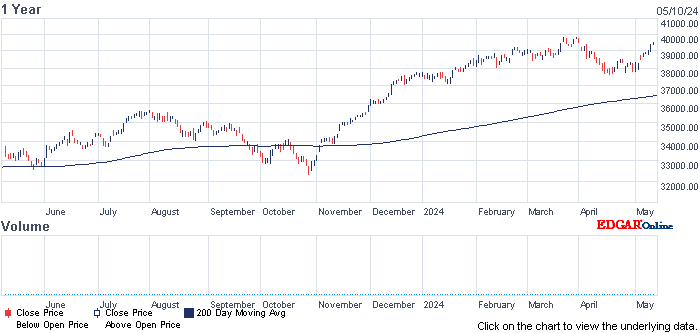
Dow sank 137 (going below 26K), decliners over advancers 2-1 & NAZ dropped 21. The MLP index lost 1+ to 281 & the REIT index fluctuated. Junk bond funds inched higher & Treasuries rose in price. Oil climbed to over 70 (more below) & gold pulled back 5 to 1206.
AMJ (Alerian MLP Index tracking fund)
![Live 24 hours gold chart [Kitco Inc.]](https://www.kitco.com/images/live/gold.gif?0.2180338269244485)


Canada's top trade negotiator says she's "encouraged" by urgent discussions that are intended to overhaul the North American Free Trade Agreement. Leaving a morning session with US Trade Rep Robert Lighthizer, Foreign Affairs Minister Chrystia Freeland told reporters, "We continue to be encouraged by the constructive atmosphere that I think both countries are bringing to the table." On Mon, the US & Mexico reached an agreement to replace NAFTA, a 24-year-old pact involving those 2 countries & Canada. But the new deal excluded Canada. Freeland hurried to DC to try to repair the damage. She's seeking to forge a 3-country deal by tomorrow, starting a 90-day countdown that would let Mexican Pres Enrique Pena Nieto sign the pact before leaving office Dec 1. "We're working very intensively," Freeland said.
Stocks accelerated losses in the PM following a report that Trump wants to move ahead with $200B in China tariffs. Sources said that Trump told aides he wants to move ahead with a plan to impose tariffs on $200B in Chinese imports as soon as the public-comment period concludes next week. Meanwhile, roday Canadian & US officials were meeting to renegotiate a NAFTA deal, after the US & Mexico announced a preliminary trade deal between the 2 nations on Mon. Tomorrow is seen as a deadline for the 3 countries to come to some agreement. Earlier today Trump touted the strength of the stock market, tweeting that more good news is coming. Yesterday, shares rose on unexpectedly robust economic news: The gov said that Q2 GDP was revised to 4.2% versus the initial 4.1% estimate. Analysts had expected no change. Tech-heavy NAZ & the broader S&P 500 index closed at record highs, for the 4th day in a row.
Campbell Soup (CPB) reported better-than-expected quarterly profit, but sales fell short of expectations. The company also announced plans to shed 2 intl units & its fresh foods business. Reported results versus the forecasts are shown:
If you would like to learn more about CPB, click on this link:
club.ino.com/trend/analysis/stock/CPB?a_aid=CD3289&a_bid=6ae5b6f7
Campbell Soup beats Wall Street earnings estimates, misses on revenue
US crude rises 1.1% to 6-week high, settling at $70.25, on supply concerns
Nothing like the threat of higher tariffs, especially on Chinese trade, along with uncertainty on Canada trade to dampen a rise in the stock market. For what it's worth Amazon (AMZN) finished above $2K. Once again, this is supposed to be a quiet time in the stock market. However plenty of excitement keeps coming from DC & tomorrow could be a busy day for the stock market.
Dow Jones Industrials


AMJ (Alerian MLP Index tracking fund)


Although EU officials have said they
are supportive of lowering tariffs on automobiles to zero if the US
reciprocates, Pres Trump believes this is not a stand-alone issue
or trade deal, according to a senior diplomatic official. After
months of back-&-forth, retaliatory tariffs between the US & the
European bloc, Trump wants to see all tariffs removed on all industries,
including agriculture, steel aluminum & medical equipment. "We are willing to bring down
even our car tariffs to zero, all tariffs to zero, if the U.S. does the
same," European Trade Commissioner Cecilia Malmstrom told members of
the European Parliament today. But
according to Politico, Malmstrom has said that agriculture would not be
included in this deal, &, because of this, the White House is not
celebrating the comments made today by Malmstrom. US
Ambassador to Germany Richard Grenell began a successful push in
Germany to get their auto industry on board with lowering tariffs. At
the time, one of the outstanding questions was whether other major
European auto players would join the call for zero tariffs. But the Italians & the French are
now supportive of lowering the tax.
Trump believes EU trade deal needs to go beyond zero tariffs on autos: Official
Canada's top trade negotiator says she's "encouraged" by urgent discussions that are intended to overhaul the North American Free Trade Agreement. Leaving a morning session with US Trade Rep Robert Lighthizer, Foreign Affairs Minister Chrystia Freeland told reporters, "We continue to be encouraged by the constructive atmosphere that I think both countries are bringing to the table." On Mon, the US & Mexico reached an agreement to replace NAFTA, a 24-year-old pact involving those 2 countries & Canada. But the new deal excluded Canada. Freeland hurried to DC to try to repair the damage. She's seeking to forge a 3-country deal by tomorrow, starting a 90-day countdown that would let Mexican Pres Enrique Pena Nieto sign the pact before leaving office Dec 1. "We're working very intensively," Freeland said.
Canadian envoy says she is 'encouraged' by NAFTA talks
Stocks accelerated losses in the PM following a report that Trump wants to move ahead with $200B in China tariffs. Sources said that Trump told aides he wants to move ahead with a plan to impose tariffs on $200B in Chinese imports as soon as the public-comment period concludes next week. Meanwhile, roday Canadian & US officials were meeting to renegotiate a NAFTA deal, after the US & Mexico announced a preliminary trade deal between the 2 nations on Mon. Tomorrow is seen as a deadline for the 3 countries to come to some agreement. Earlier today Trump touted the strength of the stock market, tweeting that more good news is coming. Yesterday, shares rose on unexpectedly robust economic news: The gov said that Q2 GDP was revised to 4.2% versus the initial 4.1% estimate. Analysts had expected no change. Tech-heavy NAZ & the broader S&P 500 index closed at record highs, for the 4th day in a row.
US stocks take a dive on Trump tariff threat against China
Campbell Soup (CPB) reported better-than-expected quarterly profit, but sales fell short of expectations. The company also announced plans to shed 2 intl units & its fresh foods business. Reported results versus the forecasts are shown:
- Adjusted EPS of 25¢ versus 24¢ expected
- Revenue of $2.22B versus $2.24B expected.
If you would like to learn more about CPB, click on this link:
club.ino.com/trend/analysis/stock/CPB?a_aid=CD3289&a_bid=6ae5b6f7
Campbell Soup beats Wall Street earnings estimates, misses on revenue
Oil prices rose, extending gains on
growing evidence of disruptions to crude supply from Iran & Venezuela & after a fall in US crude inventories. Brent has risen by almost 10%
over the past 2 weeks on widespread perceptions that the global oil
market is tightening & could run short in the next few months as US
sanctions restrict crude exports from Iran. Benchmark Brent crude oil was up 56¢ a barrel at $77.70 & US light crude ended the session up 74¢ (1.1%) at $70.25, the highest closing price in 6 weeks. Iranian crude exports will likely drop to just over
2M barrels per day (bpd) in Aug, versus a peak of 3.1M
bpd in Apr, as importers bow to American pressure to cut orders. OPEC, in which Iran is the 3rd-biggest
producer, will discuss in Dec whether it can compensate for a
sudden drop in Iranian supply after sanctions start in Nov, the
head of Iraq's state oil marketer SOMO said on yesterday. Crude exports from
crisis-struck OPEC member Venezuela have also fallen sharply, halving in
recent years to around 1M bpd. Official US oil inventory data yesterday also helped the bullish trend. US commercial crude
inventories fell 2.6M barrels in the latest week, to
406M barrels, more than forecast, the Energy Information
Administration said. US production was flat from the previous week's record of 11M bpd. The market pared gains
slightly in morning trade after information provider Genscape said
inventories at the delivery hub at Cushing, Oklahoma had risen 101K
barrels since Aug 24. The Intl Energy
Agency (IEA) has warned of a tightening market towards the end of the
year, due to a combination of falling supply in countries such as Iran & Venezuela, & strong demand especially in Asia. "Definitely there are
some worries that oil markets can tighten towards the end of this year,"
IEA Exec Director Fatih Birol said yesterday.
US crude rises 1.1% to 6-week high, settling at $70.25, on supply concerns
Nothing like the threat of higher tariffs, especially on Chinese trade, along with uncertainty on Canada trade to dampen a rise in the stock market. For what it's worth Amazon (AMZN) finished above $2K. Once again, this is supposed to be a quiet time in the stock market. However plenty of excitement keeps coming from DC & tomorrow could be a busy day for the stock market.
Dow Jones Industrials


