


Dow rose 91, advancers over decliners 2-1 & NAZ went up 25. The MLP index went up a fraction to the 253s & the REIT index fell 1+ to the 377s. Junk bond funds fluctuated & Treasuries declined slightly in price, but yields remain near recent lows. Oil was off pennies in the 58s & gold sank 20 to 1290 (more on both below).
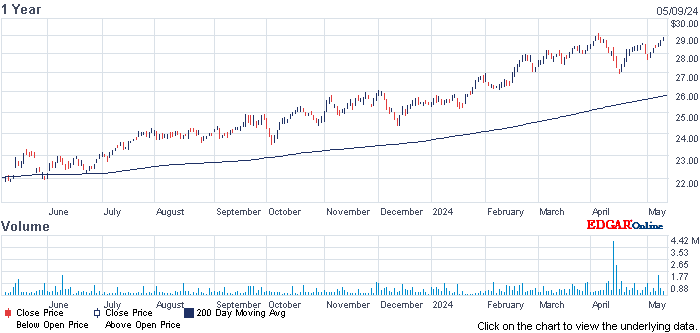
AMJ (Alerian MLP Index tracking fund)
![Live 24 hours gold chart [Kitco Inc.]](https://www.kitco.com/images/live/gold.gif?0.2180338269244485)


The number of people who applied for unemployment benefits in late Mar fell for the 2nd week in a row to match the lowest level of 2019, a sign the sturdy labor market remains a source of strength for a US economy struggling to gain traction. Jobless claims, a rough measure of layoffs, declined to 211K from a revised 216K in the prior week, the gov said. The forecast called for a 222K reading last week. The 4-week average of new jobless claims, meanwhile, slipped by 3K to 217K. The monthly average is viewed as more stable since it smooths out weekly gyrations. The number of people already collecting unemployment benefits, known as continuing claims, rose by 13K to 1.76M. The number of Americans losing their jobs fell last year to the lowest levels since the late 1960s, when the working population was much smaller. Jobless claims have bounced up & down since last fall, but they remain extremely low. Hiring appeared to slow dramatically in Feb after big gains in Jan & Dec, but it's hard to know if it’s merely a blip or the start of a long-predicted slowdown in hiring. Investors anxiously awaits the employment report for Mar, due next week, for more clues. A raft of evidence suggests the US economy has weakened, but the labor market has been one of the bright spots.
Gold prices suffered the largest single-session percentage decline since Aug, to settle below the key $1300 mark for the first time in 2 weeks. A firmer $ helped to undercut demand. Apr gold shed $20.60 (1.6%) to end at $1289 an ounce. Jun, which is now the most active contract, lost $21.60 (1.6%) to end at $1295 an ounce. Negative sentiment sparked by worry about sluggish growth has weighed on global stocks this week & pushed bond yields lower across the globe; however, that dynamic also has propelled demand for $s. A stronger buck weighs on commodities priced in the monetary unit, making them comparatively more expensive for buyers using other currencies. Meanwhile, the 10-year Treasury note yield was up at 2.378%, but holding near a 15-month low. Yields move inversely to prices. Demand for gov debt amid mounting concerns about growth internationally has helped to check losses for precious metals.
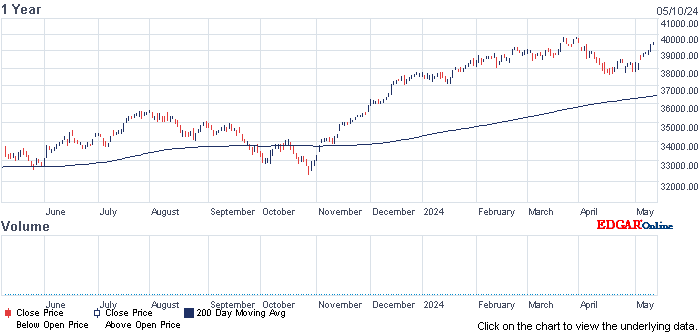
Hopes are riding high on trade talks which have completed their first day. Today the Dow began trading sharply higher, dropped into the red at midday & bounced back, finishing near session highs. Current market gyrations on perceptions of their progress demonstrate there is a lot riding on their success. Until there is an announcement, all investors can do is keep their fingers crossed. Today's market advance may have more to do with gold investors switching to stocks.
Dow Jones Industrials


AMJ (Alerian MLP Index tracking fund)


US mortgage rates posted their biggest weekly drop in more than a decade amid concerns about a slowing economy, according to Freddie Mac's Primary Mortgage Market Survey. The
average 30-year fixed-rate mortgage dropped by 22 basis points, down to
4.06% with an average 0.5 point from 4.28%, for the latest week, according to survey results. The average
15-year fixed-rate mortgage dropped to 3.57% from 3.71%. “The Federal Reserve’s concern about the prospects
for slowing economic growth caused investor jitters to drive down
mortgage rates by the largest amount in over ten years,” Freddie Mac
chief economist Sam Khater said. “Despite negative outlooks by some, the
economy continues to churn out jobs, which is great for housing demand.
We have recently seen home sales start to recover and with this week’s
rate drop we expect a continued rise in purchase demand.” The
average 5-year Treasury indexed hybrid adjustable-rate mortgage was
3.75% with an average 0.3 point, down from an average of 3.84% one week ago. The
Federal Reserve said last month it would be “patient” about interest
rate hikes in 2019 amid signs of a slowing US economy.
US mortgage rates post biggest weekly drop in decade
Pres Trump called on OPEC to increase the flow of oil in a bid to curb rising prices. West
Texas Intermediate crude prices fell more than $1 to about $58.39 per
barrel today & Brent crude prices fell about $1.14 to $66.69
per barrel. Brent crude prices hit their 2019 high earlier
this month and have risen more than 25% so far this year. Crude oil accounts for
more than ½ of the retail price of regular gasoline, meaning
consumers are starting to pay more at the pump. However, even if Trump gets his wish, gas prices are still likely to rise this spring. There are a number of seasonal factors that are
contributing to the increase – while massive flooding across parts of
the Midwest was expected to contribute to short-term pain at the pump
for some people on the coastal regions. As today, gas prices were hovering near $2.68, up more than 20¢ when compared with last month & about 4¢ when compared with last year. OPEC is no stranger to criticism from
the US pres. Last month he told the organization to “please relax
and take it easy,” saying oil prices were getting “too high.” At
their Dec meeting, OPEC members agreed to curb output by 1.2M barrels per day for H1, an effort aimed at
boosting prices. Production among the group has been on the decline amid
US sanctions on both Iran & Venezuela. While Trump has hit out at OPEC for rising oil prices, he took credit when gas prices began to decline at the end of last year: The highest prices consumers have paid while Trump has been in office
was in May, when the average price hit $2.97 per gallon. The lowest
prices were seen earlier this year, when they clocked in at $2.23 per
gallon on Jan 9.
Trump calls on OPEC to hike output as US gas prices poised to rise
The number of people who applied for unemployment benefits in late Mar fell for the 2nd week in a row to match the lowest level of 2019, a sign the sturdy labor market remains a source of strength for a US economy struggling to gain traction. Jobless claims, a rough measure of layoffs, declined to 211K from a revised 216K in the prior week, the gov said. The forecast called for a 222K reading last week. The 4-week average of new jobless claims, meanwhile, slipped by 3K to 217K. The monthly average is viewed as more stable since it smooths out weekly gyrations. The number of people already collecting unemployment benefits, known as continuing claims, rose by 13K to 1.76M. The number of Americans losing their jobs fell last year to the lowest levels since the late 1960s, when the working population was much smaller. Jobless claims have bounced up & down since last fall, but they remain extremely low. Hiring appeared to slow dramatically in Feb after big gains in Jan & Dec, but it's hard to know if it’s merely a blip or the start of a long-predicted slowdown in hiring. Investors anxiously awaits the employment report for Mar, due next week, for more clues. A raft of evidence suggests the US economy has weakened, but the labor market has been one of the bright spots.
Jobless claims fall to 211,000 in late March to match 2019 low
Gold prices suffered the largest single-session percentage decline since Aug, to settle below the key $1300 mark for the first time in 2 weeks. A firmer $ helped to undercut demand. Apr gold shed $20.60 (1.6%) to end at $1289 an ounce. Jun, which is now the most active contract, lost $21.60 (1.6%) to end at $1295 an ounce. Negative sentiment sparked by worry about sluggish growth has weighed on global stocks this week & pushed bond yields lower across the globe; however, that dynamic also has propelled demand for $s. A stronger buck weighs on commodities priced in the monetary unit, making them comparatively more expensive for buyers using other currencies. Meanwhile, the 10-year Treasury note yield was up at 2.378%, but holding near a 15-month low. Yields move inversely to prices. Demand for gov debt amid mounting concerns about growth internationally has helped to check losses for precious metals.
Gold’s biggest percentage decline since August leaves it firmly below key $1,300
Hopes are riding high on trade talks which have completed their first day. Today the Dow began trading sharply higher, dropped into the red at midday & bounced back, finishing near session highs. Current market gyrations on perceptions of their progress demonstrate there is a lot riding on their success. Until there is an announcement, all investors can do is keep their fingers crossed. Today's market advance may have more to do with gold investors switching to stocks.
Dow Jones Industrials


