Wednesday, August 28, 2019

Markets rise, led by energy shares

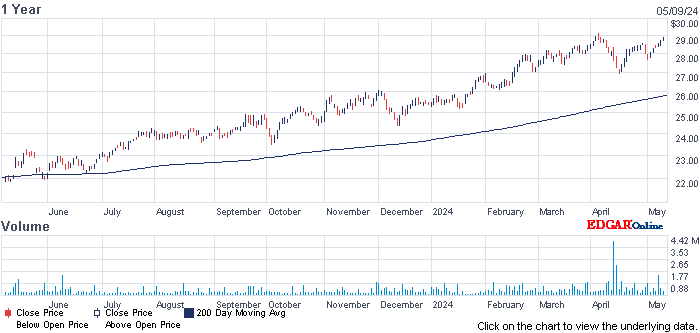
Dow jumped up 258 (session highs), advancers over decliners 5-2 & NAZ gained 29.  The MLP index advanced 5+ to the 228s & the REIT index went up 1+ to 400 (record territory).  Junk bond funds were little changed & Treasuries remained strong.  Oil rose to the 55s while gold slid back 1 to 1550 (more on both below).

AMJ (Alerian MLP Index tracking fund)

Live 24 hours gold chart [Kitco Inc.]


3 Stocks You Should Own Right Now - Click Here!


The Trade Representative's office confirmed that the US will levy an additional 5% tariff on $300B worth of Chinese goods starting Sep 1. The tax, originally set at 10%, will now take effect at 15%.  The decision comes after Pres Trump wrote on Twitter last week that the US would ratchet up tariffs after China's "politically motivated" decision to raise taxes on US goods.  The 2 countries have engaged in a back-&-forth tariff battle for more than a year.  The tariffs on Chinese goods will be implemented incrementally.  Officials will slap tariffs onto one batch of goods on Sep 1 & another on Dec 15.  However, Trump declared that his negotiators were encouraged by recent communications from China yesterday  The Chinese foreign ministry denied knowledge of any such communications, but stocks still received a boost early Mon after Trump's announcement.  American consumers felt slightly less confident in Aug compared to Jul as the trade battle continued. 

US-China trade war: Beijing will face additional tariffs Trump threatened to enact

Federal Reserve Bank of Richmond Pres Tom Barkin said that while the US economy looks strong, intl growth has weakened and trade-related uncertainty is high.  "If you look at the data, the national economy appears great," he said in remarks prepared for delivery today, noting that US economic growth is solid, while consumers are confident & spending.  "International economies are weaker, though, and uncertainty -- particularly around trade -- is elevated. Business investment dropped in the second quarter."  Barkin said the Federal Reserve is monitoring the impact of its ¼-percentage-point interest rate cut implemented after its policy meeting on Jul 30-31.  But he gave no clues about the future path of rates.  Bond-market futures are pricing in a 95% probability of another qtr-point rate cut at the Fed's next meeting on Sep 18, lower the Fed's benchmark federal-funds rate to a range 1.75-2%.  The probability of a ½-percentage-point cut are estimated at 5%.  Pres Trump has ratcheted up the trade war with China since the Fed's last meeting, announcing plans to impose 10% tariffs on a range of imported consumer goods & to raise tariffs on another swath of goods to 30% from 25%.

Fed's Barkin Says U.S. Economy Looks Strong, but ..


Gold futures turned lower, after the sharp rally in the past month to the highest levels since 2013, discouraged some potential buyers who are now waiting for a dip or some consolidation in prices in order to invest, analysts said.  Gold for Dec fell $2.70 (0.2%) to settle at $1549 an ounce after settling at $1551 yesterday, the highest finish for a most-active contract since Apr 2013.

Gold ends lower, in retreat from their highest levels since 2013


Oil futures posted a gain, after gov data reported a weekly drop in US crude supplies, the largest in 5 weeks, along with declines in petroleum products, which helped to ease concerns about a slowdown in demand.  West Texas Intermediate crude for Oct, the US benchmark, rose 85¢ (1.6%) to settle at $55.78 a barrel.  Prices settled at their highest in just over a week, but off the session's high of $56.75.  Oct Brent crude, the global benchmark, added 98¢ (1.7%) at $60.49 a barrel.  The Energy Information Administration reported that US crude supplies fell by 10M barrels last week.  That was the biggest one-week decline reported by the gov agency since the 10.8M-barrel fall for Jul 19.  The forecast called for a decline of 4.7M barrels, while the American Petroleum Institute yesterday reported an 11.1M-barrel decrease.  This rise in crude-oil prices followed a rally yesterday that saw the US benchmark up more than 2%, buoyed in part by data that showed compliance with production curbs agreed to by members of OPEC & their non-OPEC allies hit 159% in Jul, its highest so far this year.

Oil prices post a gain as EIA reports biggest U.S. crude supply decline in 5 weeks


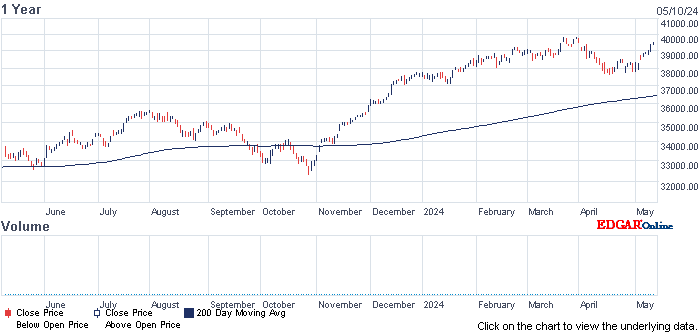
Buyers came out today without any dramatic news.  It's the end of summer trading, so it's difficult to make sense out of market changes.  However, the chart for the Dow below shows this has been a tough month.  And some of the money from stocks has been invested in gold & Treasuries.  Negative thinking investors are putting that money into gov bonds that yield a measly 2% for 30 years.  Meanwhile trade talks drone on, going nowhere.  More trouble may like ahead for stocks.

Dow Jones Industrials


Markets edge higher as 20 year Treasury falls to record low

Dow rose 107, advancers over decliners better than 3-2 & NAZ crawled up 4.  The MLP index gained 3+ to the 226s & the REIT index was fractionally higher to the 399s.  Junk bond funds fluctuated & Treasuries remained in demand.  Oil added 1+ to the 56s & gold retreated 4 to 1547 on profit taking.

AMJ (Alerian MLP Index tracking fund)


CL=FCrude Oil56.31
+1.38+2.5%

GC=FGold   1,546.80
 -5.00 -0.3%


3 Stocks You Should Own Right Now - Click Here!


Despite pockets of global weakness, the Trump economy will remain strong thru 2020 & beyond.  The economy continues to be lifted by corp tax cuts that are inducing investment, deregulation & cheap energy.  These positive developments are enhancing global competitiveness & tough trade reforms that are leveling the playing field for American workers & manufacturers.  On the wings of such growth-inducing policies, the Trump economy has created over 6M jobs, including about 500K in manufacturing.  Unemployment rates for blacks, Hispanics, women & veterans hover near historic lows.  Wages are rising, particularly for blue-collar workers.  Over 1M prime-age workers have returned to the labor force & strong consumer spending above expectations points to solid Q3 growth.  This bullish performance notwithstanding, the difference between a good Trump economy & a great one thru 2020 will ultimately hinge on a set of actors outside direct White House control.  Key among them are Congress, the Federal Reserve Board, the ECB & the govs of Britain, Germany & China.  According to the independent US Intl Trade Commission, Congress can increase GDP growth by as much as 1.2%  by swiftly passing the US-Mexico-Canada trade agreement.  USMCA would create over 100K jobs while helping to reshore the US manufacturing base thru tough rules of origin, strong labor & environmental protections, & clear enforcement provisions.  Pres Trump has kept his promise to renegotiate one of the worst trade deals in American history.  We are confident that Congress will rise above partisan politics & do what’s right for America's farmers, ranchers, manufacturers & workers & approve the trade agreement.  The Federal Reserve can contribute as much as a point of additional GDP growth in 2020 by promptly & aggressively lowering interest rates.  This is necessary not because the Trump economy is weak, but rather because it has plenty of room to grow without triggering inflation.  With an initial 25 basis point cut in Jul, an early end to balance sheet normalization & the likelihood of more rate cuts to come, the Fed seems to have reconsidered its growth message.  The ECB likewise seems to have gotten the message that the European economy is underperforming. Finland's Olli Rehn, who sits on the ECB's rate-setting committee, has clearly signaled an aggressive monetary stimulus package for Sep.  As this new ECB stimulus bolsters economic activity in Europe, it should ripple thru to the Trump economy by fueling demand for US exports – but only if the Federal Reserve matches any ECB cuts.  Otherwise, upward pressure on the $ from the ECB rate cuts will dampen demand for American exports.  In summary, the Trump economy is strong. It will be even stronger if Congress, the Fed, the ECB, Britain, & Germany all implement commonsense policies.

Peter Navarro: Trump economy will stay strong – New trade pact and interest rate cut would make it stronger


The rate on the benchmark 30-year Treasury bond sank to a new all-time low while the US yield curve inverted even further as fixed-income traders continue to bet on tepid inflation & slower growth around the world.  The 30-year bond yield dropped to as low as 1.907%, breaking its prior all-time low of 1.916% clinched earlier in Aug.   The 30-year rate later moved off those lows to trade at 1.916%, still below yields on US debt of far shorter duration such as 3-month & 1-month bills.  The yield curve inversion, meanwhile, continued to worsen.  The yield on the benchmark 10-year Treasury slumped further below that of the 2-year note — at 1.454% & 1.5%, respectively — after closing inverted for the 2nd day in a row yesterday.  Yields fall as prices rise.  Bond traders consider a 10-year rate below the 2-year yield an notable recession signal, marking an unusual phenomenon as bondholders receive better compensation in the short term.  Before Aug, the last inversion of this part of the yield curve began in 2005, 2 years before the financial crisis & subsequent recession.  The spread between the 3-month Treasury yield & that of the 10-year note, the Federal Reserve's preferred inversion metric, sank to -54.5 basis points, its lowest level since before the financial crisis.  Traders across the board have pointed to a deterioration in US-China trade relations as the catalyst for Aug's dramatic stock & bond moves, including a 60-basis-point drop in the 10-year Treasury rate.   But notwithstanding the latest barbs between the 2 largest economies, Treasury demand remains strong & likely symptomatic of traders' belief in a larger, more malignant downturn in the global economy & a secular decline in inflation.  Lukewarm inflation expectations & the Fed's perceived inability to goose prices higher have sparked a rash of Treasury buying as traders try to lock in rates they believe will exceed inflation in the long term.  Investors tend to sell Treasuries when inflation is high because it erodes the purchasing power of bonds' fixed payments.  The Fed tries to keep inflation around its 2% target, a pace it feels is both healthy & sustainable for the US economy.  But despite historically low interest rates, price gains have remained tame.  The bond market's inflation expectations are perhaps most evident in the yields on Treasury inflation-protected securities, or TIPS.

US 30-year bond yield falls to record low under 2% as global recession fears grow

Tiffany (TIF) reported quarterly earnings that easily topped  expectations, but revenue fell short as protests in Hong Kong disrupted the luxury jeweler's sales & tourists spent less across the US.  It also maintained its previously lowered outlook for the full year.  “With the tough comparison to last year’s strong performance in the first half behind us, and in spite of the headwinds of weak demand from foreign tourists, currency exchange rate pressures and continuing business disruptions in Hong Kong, we are actively managing what is in our control and positioning our brand to win,” CEO Alessandro Bogliolo said.  Bogliolo said that TIF lost 6 selling days in Hong Kong, its 4th largest market, during Q2 because of the protests.  Management also said that if the situation worsens, full-year sales results could fall closer to the lower end of its current forecast.  EPS was $1.12, compared with $1.17 a year earlier.  That was beat expectations for $1.04.  Sales fell to $1.05 B from $1.08B a year ago, short of expectations for $1.06B.  Sales at stores worldwide operating for at least 12 months were down 4%.  Excluding the impacts from currency exchange rates, they were down 3% during the qtr.  That was worse than an expected drop of 1.3%.  Same-store sales in the US were down 4% on a constant-currency basis, while analysts had been calling for a drop of 1.7%.  In the Asia-Pacific region, same-stores sales were up 1%, better than an expected drop of 0.2%.  TIF said it had “strong growth” in mainland China but “softness” in Hong Kong.  Earlier this year, TIF trimmed its full-year outlook, citing the impact it will face due to increased tariffs.  It also has blamed a strong $ & lower spending by tourists as hampering recent results.  For its fiscal year ending Jan 31, 2020, TIF is still calling for net sales globally to increase by a low-single-digit percentage, & for EPS to increase by a low-to-mid-single-digit percentage.  The stock rose 2.92.
If you would like to learn more about TIF, click on this link:
club.ino.com/trend/analysis/stock/TIF?a_aid=CD3289&a_bid=6ae5b6f7

Tiffany revenue falls, hurt by Hong Kong unrest, and sales could be hit harder if protests continue

Stocks are back to meandering with a slight bias to the upside.  Until there is dramatic new news, this could put the pattern for the rest of this week.

Dow Jones Industrials


Tuesday, August 27, 2019

Markets reverse early gains as hopes for trade talks fade

Dow dropped 120 (near session lows), decliners over advancers 2-1 & NAZ fell 26.  The MLP index lost 1+, falling to 223 (10 year low) & the REIT index gave back 1 to the 399s.  Junk bond funds slid lower & Treasuries rose with heavy buying, taking the yield on the 10 year down to 1.49%.  The yield on the 30 Treasury dropped under 3%.  Oil jumped up 1+ to 55 & gold surged 13 to 1550 (more on both below).

AMJ (Alerian MLP Index tracking fund)


Manufacturing activity in 5 states & DC remains stagnant, despite a small improvement in Aug, the latest data point to illustrate the sector remains under pressure, according to the Richmond Fed monthly Survey of Manufacturing Activity.  The results were modestly positive, compared to Jul's weak manufacturing activity yet not enough to illustrate a recovery in the sector which is likely being impacted by the ongoing trade war with China.  "The composite index rose from -12 in July to 1 in August, buoyed by increases in the indexes for shipments and new orders," the survey found.  "However, the third component, employment, fell. Firms reported increasing capital expenditures and inventories, but the measure of local business conditions was slightly negative. Manufacturers were, however, optimistic that conditions would improve in the next six months.”  The survey indicated that while wage growth continues, firms were having difficulty finding employees with the necessary skills for open positions --- & it anticipates that both of these trends will continue.  Also, “many firms saw employment decline while the average workweek increased in Aug,” according to the survey.

Manufacturing activity remains stale


Iran’s Pres Hassan Rouhani rejected the possibility of meeting with Pres Trump as long as the US sanctioned his country, a day after both leaders appeared to be opening up to possible talks following months of heightened tensions.  The Iranian leader's return to his default position illustrates the pressure he faces at home from hard-line factions opposed to talking to the Trump administration & the challenges of resolving the crisis between the US & Iran.

Iran’s President Won’t Meet Trump Unless the U.S. Lifts Sanctions


Gold futures climbed to their highest finish since 2013 & silver rallied to a more than 2-year high, with losses in stocks & a drop in Treasury yields providing a boost to the precious metals as investors hopes for progress on US-China trade talks faded.  Gold for Dec rose $14.60 (1%) to settle at $1551 an ounce.  That was the highest finish for a most-active contract since Apr 2013.  Additionally, the 10-year Treasury note yield was down by 6.8 basis points at 1.481%, contributing to haven appeal in gold & silver.  Last week, gold also closed at more than 6-year highs, boosted by safe haven bids as the US-China intl trade battle escalated.  Gold pulled back modestly yesterday as both the US & Beijing struck a more conciliatory tone, though analysts remained wary of the potential for further deterioration & expressed concern that elevated tariffs announced so far will add to global economic weakness.

Gold ends at highest since 2013, silver climbs to 2-year high

Oil futures rose, with US prices up by more than 2%, buoyed by a report showing strong compliance with OPEC production cuts & expectations for a sizable weekly decline in US crude supplies.  OPEC's Joint Ministerial Monitoring Committee pegged Jul compliance with pledged output cuts at 159%, the highest monthly compliance rate so far this year.  Meanwhile, a survey of analysts shows expectations for a 4.7M-barrel decline in last week's US crude stocks, ahead of gov supply data due tomorrow.  Prospects for a deal to lift US sanctions on Iran, which would add more barrels of oil to the market, also faded, contributing to oil's rise.  Oct West Texas Intermediate oil rose $1.29 (2.4%) to settle at $54.93 a barrel.

U.S. oil futures settle more than 2% higher


There has been an abundance of confusion about the status of China trade talks.  That brought out stock sellers in the PM.  The Dow has fallen 1500 from its record set in mid Jul & the outlook is gloomy.  Consumer data remains good, but the trade talks are clearly stuck in the mid, as they have been for many months.  As a result, stock buyers will just wait for developments in trade talks..

Dow Jones Industrials