


Dow went up 55, advancers modestly ahead of decliners & NAZ added 15. The MLP index dropped 3+ to the 202s & the REIT index advanced 4+ to the 405s. Junk bond funds crawled higher & Treasuries continued in demand. Oil was higher in the 58s (more below) & gold rose 4 to 1461.
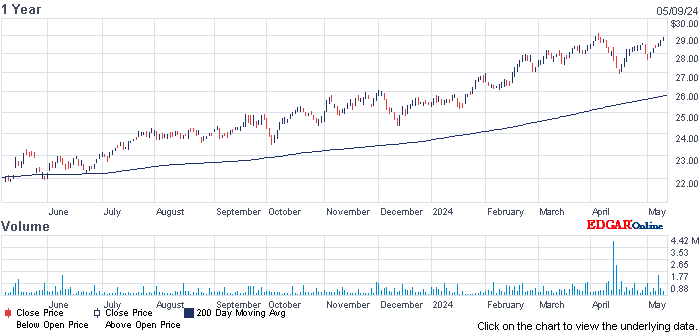
AMJ (Alerian MLP Index tracking fund)
![Live 24 hours gold chart [Kitco Inc.]](https://www.kitco.com/images/live/gold.gif?0.2180338269244485)


Dallas Federal Reserve Pres Robert Kaplan expects US economic growth to slow substantially in Q4 because businesses worried about the trade war are cutting their inventories. “We think the fourth quarter is going to be weak,” Kaplan said. He attributed the anemic growth level to “deglobalization” in the form of tariffs the US & China have levied against each other in their trade war. While Kaplan did not put a specific level where he thinks GDP gains will fall, gauges from the NY & Atlanta Fed are estimating rises of 0.7% & 0.4% respectively & CNBC's Rapid Update measure of economist expectations puts the number closer to 1.5%. Kaplan said the inventory reduction is probably cutting ½ a point off GDP. Uncertainty over future conditions is at the center of the low expectations. “This means people have been destocking and probably the reason they were destocking is there was a lot of pessimism over the last number of months over future growth prospects,” Kaplan said. “We think things will stabilize. We’ve got a good chance to grow at 2% next year.” Over the long run, he sees the US growing at a 1.75%-2% range, though he said even that slowed pace could come under pressure. “It gets worse if we don’t make some policy changes. We think over the next five or 10 years it’s going to slowly decline,” he aidded. Those policy changes have to come on the fiscal side in terms of infrastructure spending & immigration reform. As for the Fed's only monetary policy, he said interest rates are where they should be. The central bank in Oct approved its 3rd qtr-point reduction this year, taking the overnight borrowing rate of 1.5%-1.75%. “I think policy is in the right place now,” Kaplan said, adding that he believes the “midcycle adjustment” that Fed Chair Jerome Powell had alluded to this summer is over “for the time being.” Despite a generally positive outlook on the US, he & other policymakers continue to warn that future risks are skewed to the downside. The Fed repeatedly has cautioned about the state of the global economy as well as persistently low inflation & uncertainty over trade & its impact on business investment & consumer spending. “I think weak manufacturing, weak global growth, weak business investment all relate to uncertainty regarding trade,” he said. “If that got stabilized, I think we’d have a chance to see those measures improved.”
Dallas Fed President Robert Kaplan says the fourth-quarter economy is ‘weak’
Fed’s Brainard argues for capping interest rate levels during the next downturn
The US & China are in the "final throes" of finalizing a phase one trade deal, Pres Trump said at the White House, while again declining to say if he would sign a Hong Kong human rights bill that was approved by Congress. Trump reiterated that he has a "very good relationship" with Chinese Pres Xi Jinping & that the 2 sides are close on the deal, which was agreed upon last month. The 2 nations have been working to put it in writing since then & had hoped to sign it in mid-Nov. "It's going very well, but at the same time, we want to see it go well in Hong Kong," he said. "I think it will. I think President Xi can make that happen. I know him, and I know he'd like to make it happen." He confirmed that he has been watching the results of the weekend Hong Kong elections, where pro-democracy candidates won big. His message to Hong Kong voters: "we are with them." Stock averages hit new record highs yesterday following Beijing's announcement of new guidelines for the protection of patents & copyrights. China has vowed to retaliate if Trump signs a bill that would penalize Chinese & Hong Kong officials for human rights abuses in the semi-autonomous Chinese territory, & Trump has suggested that the bill could hurt trade negotiations. "I stand with Hong Kong, I stand with freedom, I stand with all of the things that we want to do," Trump said last Fri. "But we also are in the process of making the largest trade deal in history and if we could do that, that would be great."
Sales of newly-constructed homes in the US decreased 0.7% on a monthly basis in Oct to a seasonally-adjusted annual rate of 733K, gov data showed. However, the figure for Sep was revised up to 738K from 701K. As a result, Sep's new-home sales surpassed Jun's figure, which had broken a 12-year record at the time. The estimate for Oct was 705K. This was the first time since 2007 that the annual pace of single-family home sales remained above 700K for 3 consecutive months. New-home sales were nearly 32% higher on an annual basis in Oct. The median sales price for new homes was $316K in Oct. The gov estimated there was a 5.3-month supply of new homes available for sale, down from Sep's 5.5-month supply. The supply of homes peaked around 7 months back in Dec 2018. The small sample size of the new-home sales report from the Census Bureau lends itself to wide swings & significant revisions, as were seen in the Oct release. As with other indicators of the US housing market, new-home sales have improved as mortgage rates decreased toward the end of summer & then remained at those low levels. New-home sales were also hampered at the beginning of the year by changes to the US tax code that capped the federal tax deductions for state & local taxes. Home-building activity has continued to improve, a sign that new-home sales should remain strong in the months ahead. However, weather will become a factor as winter approaches.
Oil prices edged higher, gaining in 4 of the past 5 sessions, amid hopes that trade talks between China & the US will ultimately result in a deal that sustains global economic growth & energy demand, especially if OPEC restrains production. The market got a slight nudge higher after a report from Russian news agency TASS said the cartel & its major partners, including Russia, are mulling extending a oil production-cut deal for 3-6 months after its Mar 2020 expiration. West Texas Intermediate crude futures for Jan delivery closed up 40¢ (0.6%) at $58.41 a barrel. Jan Brent crude, the global benchmark, gained 62¢ (0.9%) at $64.27 a barrel. Expectations that 2 reports on US inventories will show a decline in crude oil when they're released during a holiday-abbreviated US trading week added to the bullish tone & will be watched ahead of the early-Dec OPEC meeting. The American Petroleum Institute releases its snapshot shortly& the forecast is for a 600K-barrel draw. The last outright drawdown was in mid-Oct & official gov data is due tomorrow. US markets will be closed Thurs. Meanwhile, top US & Chinese trade negotiators held a phone call today, China's Commerce Ministry said. The 2 sides are trying to reach agreement on a Phase 1 deal in a trade war that has dragged on for 16 months, but progress has been stymied lately by China's frustration with passage in the US of the Hong Kong Human Rights & Democracy Act. The Chinese gov over the weekend released a document calling for more protection of intellectual property rights, which soothed the US side, although questions persist. Oil futures had hit a 2-month high as recently as last Thurs before choppy trading action took over at week's end when China's Pres Xi Jinping said Beijing wants to work with the US for a trade deal but was not afraid to “fight back” to protect its own interests.
Oil gains on trade-talk optimism, hopes for OPEC extension and forecasts for lower U.S. production
The Dow was in the black all day, but remained only modestly higher. Trading tomorrow & on Fri's shortened day should be quiet unless there is exciting news on a US-China trade deal. Meanwhile popular stock indices are at or essentially at record highs.
Dow Jones Industrials


AMJ (Alerian MLP Index tracking fund)


Dallas Federal Reserve Pres Robert Kaplan expects US economic growth to slow substantially in Q4 because businesses worried about the trade war are cutting their inventories. “We think the fourth quarter is going to be weak,” Kaplan said. He attributed the anemic growth level to “deglobalization” in the form of tariffs the US & China have levied against each other in their trade war. While Kaplan did not put a specific level where he thinks GDP gains will fall, gauges from the NY & Atlanta Fed are estimating rises of 0.7% & 0.4% respectively & CNBC's Rapid Update measure of economist expectations puts the number closer to 1.5%. Kaplan said the inventory reduction is probably cutting ½ a point off GDP. Uncertainty over future conditions is at the center of the low expectations. “This means people have been destocking and probably the reason they were destocking is there was a lot of pessimism over the last number of months over future growth prospects,” Kaplan said. “We think things will stabilize. We’ve got a good chance to grow at 2% next year.” Over the long run, he sees the US growing at a 1.75%-2% range, though he said even that slowed pace could come under pressure. “It gets worse if we don’t make some policy changes. We think over the next five or 10 years it’s going to slowly decline,” he aidded. Those policy changes have to come on the fiscal side in terms of infrastructure spending & immigration reform. As for the Fed's only monetary policy, he said interest rates are where they should be. The central bank in Oct approved its 3rd qtr-point reduction this year, taking the overnight borrowing rate of 1.5%-1.75%. “I think policy is in the right place now,” Kaplan said, adding that he believes the “midcycle adjustment” that Fed Chair Jerome Powell had alluded to this summer is over “for the time being.” Despite a generally positive outlook on the US, he & other policymakers continue to warn that future risks are skewed to the downside. The Fed repeatedly has cautioned about the state of the global economy as well as persistently low inflation & uncertainty over trade & its impact on business investment & consumer spending. “I think weak manufacturing, weak global growth, weak business investment all relate to uncertainty regarding trade,” he said. “If that got stabilized, I think we’d have a chance to see those measures improved.”
Dallas Fed President Robert Kaplan says the fourth-quarter economy is ‘weak’
The Federal Reserve should consider capping the
level of interest rates the next time it is confronted with future
economic downturns, Fed Governor Lael Brainard said. As
part of a continuing look the central bank is taking at what potential
responses it can come up with when very short-term rates go to zero,
Brainard suggested using Treasury purchases to limit how high short &
medium-term gov bond yields can rise. She said tools such as quantitative easing showed limits that yield caps might not. “The combination of a commitment to condition
liftoff on the sustained achievement of our employment and inflation
objectives with yield curve caps targeted at the same horizon has the
potential to work well in many circumstances,” Brainard added. She also touched on a variety of other topics, saying
the Fed's 3 rate cuts this year amounted to “significant action” to
help support the economy against the headwinds of slow global growth &
tariffs, though she noted it will still take time for the effects to
filter through the system.
Fed’s Brainard argues for capping interest rate levels during the next downturn
The US & China are in the "final throes" of finalizing a phase one trade deal, Pres Trump said at the White House, while again declining to say if he would sign a Hong Kong human rights bill that was approved by Congress. Trump reiterated that he has a "very good relationship" with Chinese Pres Xi Jinping & that the 2 sides are close on the deal, which was agreed upon last month. The 2 nations have been working to put it in writing since then & had hoped to sign it in mid-Nov. "It's going very well, but at the same time, we want to see it go well in Hong Kong," he said. "I think it will. I think President Xi can make that happen. I know him, and I know he'd like to make it happen." He confirmed that he has been watching the results of the weekend Hong Kong elections, where pro-democracy candidates won big. His message to Hong Kong voters: "we are with them." Stock averages hit new record highs yesterday following Beijing's announcement of new guidelines for the protection of patents & copyrights. China has vowed to retaliate if Trump signs a bill that would penalize Chinese & Hong Kong officials for human rights abuses in the semi-autonomous Chinese territory, & Trump has suggested that the bill could hurt trade negotiations. "I stand with Hong Kong, I stand with freedom, I stand with all of the things that we want to do," Trump said last Fri. "But we also are in the process of making the largest trade deal in history and if we could do that, that would be great."
Trump: US, China in 'final throes' of 'phase one' trade deal
Sales of newly-constructed homes in the US decreased 0.7% on a monthly basis in Oct to a seasonally-adjusted annual rate of 733K, gov data showed. However, the figure for Sep was revised up to 738K from 701K. As a result, Sep's new-home sales surpassed Jun's figure, which had broken a 12-year record at the time. The estimate for Oct was 705K. This was the first time since 2007 that the annual pace of single-family home sales remained above 700K for 3 consecutive months. New-home sales were nearly 32% higher on an annual basis in Oct. The median sales price for new homes was $316K in Oct. The gov estimated there was a 5.3-month supply of new homes available for sale, down from Sep's 5.5-month supply. The supply of homes peaked around 7 months back in Dec 2018. The small sample size of the new-home sales report from the Census Bureau lends itself to wide swings & significant revisions, as were seen in the Oct release. As with other indicators of the US housing market, new-home sales have improved as mortgage rates decreased toward the end of summer & then remained at those low levels. New-home sales were also hampered at the beginning of the year by changes to the US tax code that capped the federal tax deductions for state & local taxes. Home-building activity has continued to improve, a sign that new-home sales should remain strong in the months ahead. However, weather will become a factor as winter approaches.
New-home sales fell in October, but the housing market’s trajectory remains positive
Oil prices edged higher, gaining in 4 of the past 5 sessions, amid hopes that trade talks between China & the US will ultimately result in a deal that sustains global economic growth & energy demand, especially if OPEC restrains production. The market got a slight nudge higher after a report from Russian news agency TASS said the cartel & its major partners, including Russia, are mulling extending a oil production-cut deal for 3-6 months after its Mar 2020 expiration. West Texas Intermediate crude futures for Jan delivery closed up 40¢ (0.6%) at $58.41 a barrel. Jan Brent crude, the global benchmark, gained 62¢ (0.9%) at $64.27 a barrel. Expectations that 2 reports on US inventories will show a decline in crude oil when they're released during a holiday-abbreviated US trading week added to the bullish tone & will be watched ahead of the early-Dec OPEC meeting. The American Petroleum Institute releases its snapshot shortly& the forecast is for a 600K-barrel draw. The last outright drawdown was in mid-Oct & official gov data is due tomorrow. US markets will be closed Thurs. Meanwhile, top US & Chinese trade negotiators held a phone call today, China's Commerce Ministry said. The 2 sides are trying to reach agreement on a Phase 1 deal in a trade war that has dragged on for 16 months, but progress has been stymied lately by China's frustration with passage in the US of the Hong Kong Human Rights & Democracy Act. The Chinese gov over the weekend released a document calling for more protection of intellectual property rights, which soothed the US side, although questions persist. Oil futures had hit a 2-month high as recently as last Thurs before choppy trading action took over at week's end when China's Pres Xi Jinping said Beijing wants to work with the US for a trade deal but was not afraid to “fight back” to protect its own interests.
Oil gains on trade-talk optimism, hopes for OPEC extension and forecasts for lower U.S. production
The Dow was in the black all day, but remained only modestly higher. Trading tomorrow & on Fri's shortened day should be quiet unless there is exciting news on a US-China trade deal. Meanwhile popular stock indices are at or essentially at record highs.
Dow Jones Industrials


