


Dow dropped 185, decliners over advancers 2-1 & NAZwas off 71. The MLP index lost 1 to the 218s & the REIT index fell 2 to the 401s. Junk bond funds did little & Treasuries were sold. Oil went up pennies in the 61s (more below) & gold was steady at 1518 following its recent rise.
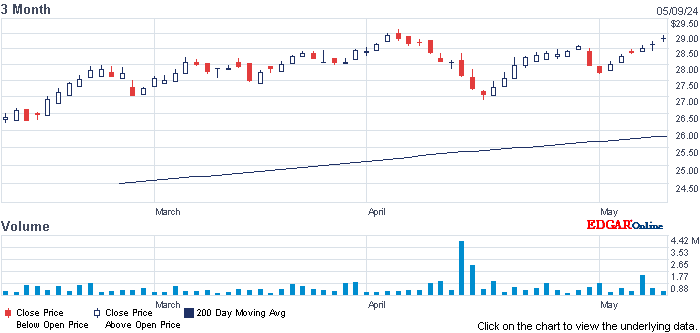
AMJ (Alerian MLP Index tracking fund)


Stocks lost ground from their record highs, with the Dow dropping more than 100 points, as markets kicked off their final trading week of the year, in what is expected to be a quiet session. All 3 of the major averages were in the red, but are looking to extend their Santa Claus rallies. The term is used to refer to gains made on the last 5 trading days of the year & the first 2 of the following year. So far, the S&P 500 has added 0.5% during the period while the Dow & NAZ have climbed 0.3% & 0.7%, respectively. These gains topped off the record highs for the averages. Looking at commodities, oil prices climbed after the US launched airstrikes in Iraq & Syria against an Iran-backed militia group. Brent crude oil, the intl benchmark, was up 0.9% at $68.80 a barrel & West Texas Intermediate crude oil, the US benchmark, was higher by 0.8% at $62.23. Gold was down 0.2% at $1515 an ounce. Treasuries were under pressure with the yield on the 10-year note up 6.5 basis points to 1.94%. In Europe, Germany's DAX lost 0.7%, the CAC 40 in Paris shed 0.2% & Britain's FTSE edged lower by 0.3%.
The partial trade deal between the US & CHina could be signed within the week, according to Peter Navarro, White House assistant for trade & manufacturing policy. "We'll probably have a signing on that within the next week or so," he said. "We're just waiting for the translation." Navarro's comments come after a China newspaper reported, citing a leaker, that Liu He, China’s chief trade negotiator, is leading a delegation to the US on Sat with the directive to sign the phase one trade agreement. As part of the trade agreement, Beijing agreed to buy $200B of US products over the next & years from the manufacturing, energy, agriculture & services sectors, in addition to protecting against intellectual property theft & technology transfer. In return, the US will reduce tariffs on Chinese goods. About $380B of Chinese goods will still be taxed in an effort to force Beijing to negotiate a broad trade agreement. The skinny trade deal further deescalates the nearly &-year-long trade war that has hurt growth in the world's 2 largest economies. China's economy grew at a 6% rate in Q3, its weakest since record keeping began in 1993. Economic expansion in the US slowed to 2.1% in the Jul-Sep period, down from 3.1% at the beginning of the year. Pres Trump has said a comprehensive trade deal could occur in 2 or 3 phases.
US pending home sales rise in November
Oil prices held on to 3-month highs, underpinned by optimism over an expected China_US trade deal & upbeat industrial data, while there was a close watch on the Middle East following a US air strike. Investors remained cautious despite news of the US strikes in Iraq & Syria against an Iran-backed militia group, even as US officials warned "additional actions" may be taken. West Texas Intermediate (WTI) crude futures rose 4¢ to $61.76 a barrel in early trading. The US benchmark is up about 36% so far this year. Brent crude futures were at $68.33 a barrel, up 17¢ (0.3%). The intl benchmark has risen around 27% in 2019. Tensions in the Middle East have flared up as the US carried out air strikes on Sun in Iraq & Syria against the Kataib Hezbollah militia group, while protesters in Iraq on Sat forced the closure of its southern Nassiriya oilfield. US officials said the air strikes were in response to the killing of a US civilian contractor in a rocket attack on an Iraqi military base were successful, but warned that "additional actions" may still be taken. Iraq's oil ministry said the production halt at the Nassiriya oilfield will not affect the country's exports as it will use additional output from southern oilfields in Basra. Elsewhere, Libyan state oil firm NOC said it is considering the closure of its western Zawiya port & evacuating staff from the refinery located there due to clashes nearby. Oil prices were also supported by declining US crude stocks, which fell by 5.5M barrels last week, far exceeding a 1.7M barrel drop forecast. As for China, its factory activity had likely expanded again in Dec on stronger external demand & an infrastructure push at home although the pace of growth is set to ease as markets await more certainty on a US-China trade truce.
Because of light trading, today's selloff may not be meaningful. The US-China trade deal keeps chugging forward, even if it's at a snail's pace. Stocks continue to be turning in an outstanding year & the last 2 days should not disturb that record.
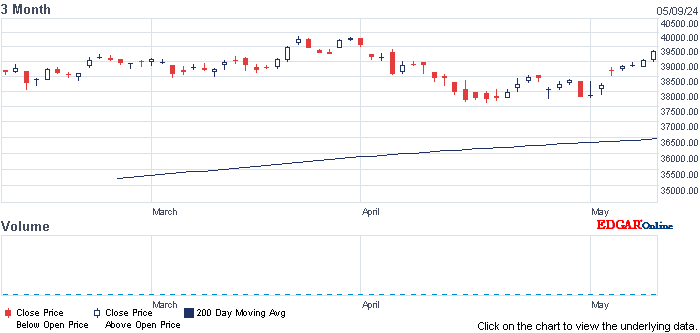
Dow Jones Industrials


AMJ (Alerian MLP Index tracking fund)
| CL=F | Crude Oil | 61.90 | +0.18 | +0.3% |
| GC=F | Gold | 1,517.50 | - 0.60 | -0.0% |


Stocks lost ground from their record highs, with the Dow dropping more than 100 points, as markets kicked off their final trading week of the year, in what is expected to be a quiet session. All 3 of the major averages were in the red, but are looking to extend their Santa Claus rallies. The term is used to refer to gains made on the last 5 trading days of the year & the first 2 of the following year. So far, the S&P 500 has added 0.5% during the period while the Dow & NAZ have climbed 0.3% & 0.7%, respectively. These gains topped off the record highs for the averages. Looking at commodities, oil prices climbed after the US launched airstrikes in Iraq & Syria against an Iran-backed militia group. Brent crude oil, the intl benchmark, was up 0.9% at $68.80 a barrel & West Texas Intermediate crude oil, the US benchmark, was higher by 0.8% at $62.23. Gold was down 0.2% at $1515 an ounce. Treasuries were under pressure with the yield on the 10-year note up 6.5 basis points to 1.94%. In Europe, Germany's DAX lost 0.7%, the CAC 40 in Paris shed 0.2% & Britain's FTSE edged lower by 0.3%.
Dow drops a quick 100 as stocks unexpectedly suffer
The partial trade deal between the US & CHina could be signed within the week, according to Peter Navarro, White House assistant for trade & manufacturing policy. "We'll probably have a signing on that within the next week or so," he said. "We're just waiting for the translation." Navarro's comments come after a China newspaper reported, citing a leaker, that Liu He, China’s chief trade negotiator, is leading a delegation to the US on Sat with the directive to sign the phase one trade agreement. As part of the trade agreement, Beijing agreed to buy $200B of US products over the next & years from the manufacturing, energy, agriculture & services sectors, in addition to protecting against intellectual property theft & technology transfer. In return, the US will reduce tariffs on Chinese goods. About $380B of Chinese goods will still be taxed in an effort to force Beijing to negotiate a broad trade agreement. The skinny trade deal further deescalates the nearly &-year-long trade war that has hurt growth in the world's 2 largest economies. China's economy grew at a 6% rate in Q3, its weakest since record keeping began in 1993. Economic expansion in the US slowed to 2.1% in the Jul-Sep period, down from 3.1% at the beginning of the year. Pres Trump has said a comprehensive trade deal could occur in 2 or 3 phases.
US-China phase one trade deal to be signed over weekend: Report
Contracts to buy previously owned US homes rose
in Nov, driven by a surge in new contracts being signed in the
country's West, the National Association of Realtors (NAR) said. The NAR's pending home sales index, based on contracts signed last month, increased 1.2% to a reading of 108.5. The previous month's reading was revised upward. Pending home contracts are seen as a forward-looking indicator of the health of the housing market because they become sales 1-2 months later. Compared with one year ago, pending sales were up 7.4%. Compared to the prior month, contracts increased 5.5% in Nov in the West. They also increased in the Midwest but were lower in the South & Northeast.
US pending home sales rise in November
Oil prices held on to 3-month highs, underpinned by optimism over an expected China_US trade deal & upbeat industrial data, while there was a close watch on the Middle East following a US air strike. Investors remained cautious despite news of the US strikes in Iraq & Syria against an Iran-backed militia group, even as US officials warned "additional actions" may be taken. West Texas Intermediate (WTI) crude futures rose 4¢ to $61.76 a barrel in early trading. The US benchmark is up about 36% so far this year. Brent crude futures were at $68.33 a barrel, up 17¢ (0.3%). The intl benchmark has risen around 27% in 2019. Tensions in the Middle East have flared up as the US carried out air strikes on Sun in Iraq & Syria against the Kataib Hezbollah militia group, while protesters in Iraq on Sat forced the closure of its southern Nassiriya oilfield. US officials said the air strikes were in response to the killing of a US civilian contractor in a rocket attack on an Iraqi military base were successful, but warned that "additional actions" may still be taken. Iraq's oil ministry said the production halt at the Nassiriya oilfield will not affect the country's exports as it will use additional output from southern oilfields in Basra. Elsewhere, Libyan state oil firm NOC said it is considering the closure of its western Zawiya port & evacuating staff from the refinery located there due to clashes nearby. Oil prices were also supported by declining US crude stocks, which fell by 5.5M barrels last week, far exceeding a 1.7M barrel drop forecast. As for China, its factory activity had likely expanded again in Dec on stronger external demand & an infrastructure push at home although the pace of growth is set to ease as markets await more certainty on a US-China trade truce.
US fighter jet strikes, Middle East unrest rile up oil prices
Because of light trading, today's selloff may not be meaningful. The US-China trade deal keeps chugging forward, even if it's at a snail's pace. Stocks continue to be turning in an outstanding year & the last 2 days should not disturb that record.
Dow Jones Industrials


![Live 24 hours gold chart [Kitco Inc.]](https://www.kitco.com/images/live/gold.gif?0.2180338269244485)


