


Dow sank 169, decliners over advancers better than 2-1 & NAZ fell 61. The MLP index retreated 3+ to the 207s & the REIT index fell 1+ to the 414s. Junk bond funds did little today & Treasuries were bid higher while stocks were being sold. Oil was off 1 to the 52s & gold rose 8 to 1584.
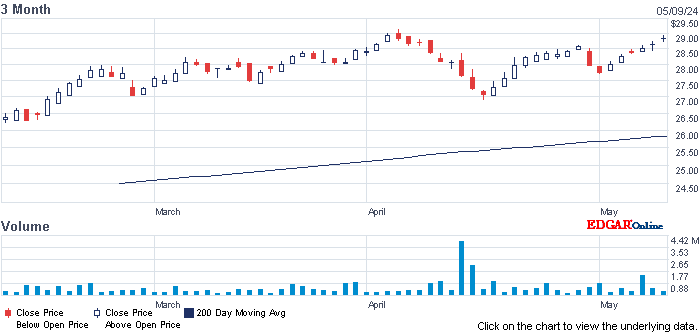
AMJ (Alerian MLP Index tracking fund)


The US economy maintained a steady pace of growth in Q4, according to new data. GDP, a measure of how much the US produces in goods & services, grew at a 2.1% annualized rate during the 3-month period from Oct-Dec, according to the Commerce Dept. That matched the 2.1% growth rate in Q3. For the full year, the economy grew 2.3%, below the 2.9% from 2018 & the 2.4% gain in 2017, amid fading fiscal stimulus from Pres Trump's 2017 Tax Cuts & Jobs Act & an 18-month trade war between the US & China that rattled global financial markets. Consumer spending, which accounts for more than 2/3 of GDP, continued to boost the now $21.7T economy. Still, it rose a modest 1.8% in the final months of 2019, sharply below the 3.2% increase in Q3. Net exports also contributed to growth, rising 1.4% in Q4. Imports fell 8.7 %, caused by a drop in consumer goods & motor vehicles, as the US has made strides to reduce its global trade imbalance. The US & China recently signed a partial trade deal, easing tensions, though the trade war continued to impact businesses & investment.
Commerce Secretary Wilbur Ross said the rapidly spreading coronavirus will bring jobs back to North America. He added that it gives businesses "another thing to consider" when they review their supply chain & it could help accelerate the return of some jobs to the US & Mexico. US companies that operate in China have begun closing some locations due to the outbreak. Airlines have grounded Los Angeles flights to & from Shanghai & Beijing. Ross said that along with the outbreak of the SARS that impacted nearly 5000 on China's mainland & claimed 329 lives in the early 2000s, & the African swine virus, a recent epidemic that killed a vast number of pigs in China, the coronavirus is another “risk factor” that companies need to take into account. Head of the Centers for Disease Control & National Institute of Health's Infectious Disease are expected to brief house lawmakers today on the spread of the virus in the US & the World Health Organization will also meet in Geneva to discuss whether to issue a public health emergency. The death toll from the virus has reached 170, with 7711 confirmed cases in China. 5 cases were reported in the US & officials are urging citizens to avoid unwarranted travel to China.
Pres Trump signed the historic US-Mexico-Canada Agreement (USMCA), replacing the Clinton-era North American Free Trade Agreement that he called a "disaster." The USMCA, which is the biggest trade deal of all-time, covers more than $1.3T of commerce & is the 2nd major trade deal secured by the Trump administration this year. The agreement has already been ratified by Mexico, but not yet by Canada. "You're going to see more jobs all across the economy, in the automobile sector, in the agricultural sector and of course in the energy sector as well," Energy Secretary Dan Brouillette said. The USMCA requires 75% of automobile components be manufactured in the US, Canada or Mexico in order to avoid tariffs. By 2023, some 40-45% of automobile parts must be made by workers who earn at least $16 an hour. The agreement is expected to create 80K new jobs tied to the auto industry & bring in up to $30B of new investment in the sector. The pact will also open new markets for American wheat, poultry and eggs, among other things. "This is a colossal victory for our farmers and ranchers," Trump said at the signing ceremony. "Everybody said this was a deal that could not be done," he added, "but we got it done." Once fully implemented, the USMCA is expected to lift US GDP by as many as 1.2 percentage points & create up to 589K jobs, according to the Intl Trade Commission. After the trade deal was approved by the Senate on Jan 16, by a vote of 89 to 10, Sen Charles Grassley hailed it as a "major achievement for President Trump and a very big win for the American people." The signing of the USMCA comes nearly 2 weeks after Trump inked an initial trade deal with China. Combined, the 2 agreements encompass more than $2T worth of trade & could add as much as 1.7 percentage points to US economic growth. The US economy expanded at a 2.1% pace in the 3 months thru Sep. “We’re restoring America’s industrial might like never before,” Trump declared Tues. “They’re all coming back. They want to be where the action is.”
News from the GDP data & USMCA being signed was encouraging for investors, but the coronavirus story is very threatening. More updates are coming later today. The Dow was in the red at the opening & then rose to about breakeven. However sellers took command in the last hour with heavy selling. Without favorable word about the coronavirus scare, the short-term outlook for stocks is gloomy. However this is good news for those investing in safe haven gold & Treasuries.
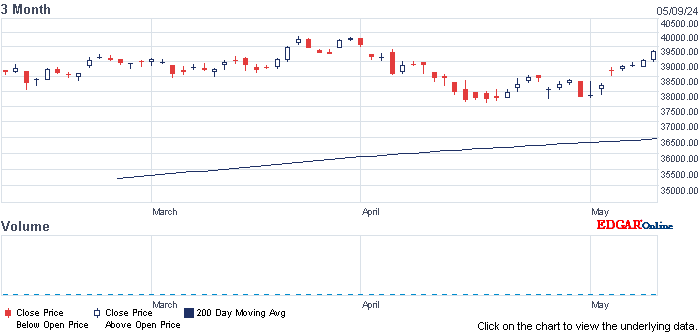
Dow Jones Industrials


AMJ (Alerian MLP Index tracking fund)
| CL=F | Crude Oil | 52.33 | -1.00 | -1.9% |
| GC=F | Gold | 1,583.30 | +7.30 | +0.5% |


The US economy maintained a steady pace of growth in Q4, according to new data. GDP, a measure of how much the US produces in goods & services, grew at a 2.1% annualized rate during the 3-month period from Oct-Dec, according to the Commerce Dept. That matched the 2.1% growth rate in Q3. For the full year, the economy grew 2.3%, below the 2.9% from 2018 & the 2.4% gain in 2017, amid fading fiscal stimulus from Pres Trump's 2017 Tax Cuts & Jobs Act & an 18-month trade war between the US & China that rattled global financial markets. Consumer spending, which accounts for more than 2/3 of GDP, continued to boost the now $21.7T economy. Still, it rose a modest 1.8% in the final months of 2019, sharply below the 3.2% increase in Q3. Net exports also contributed to growth, rising 1.4% in Q4. Imports fell 8.7 %, caused by a drop in consumer goods & motor vehicles, as the US has made strides to reduce its global trade imbalance. The US & China recently signed a partial trade deal, easing tensions, though the trade war continued to impact businesses & investment.
US economy expanded at 2.1% rate in fourth quarter
Commerce Secretary Wilbur Ross said the rapidly spreading coronavirus will bring jobs back to North America. He added that it gives businesses "another thing to consider" when they review their supply chain & it could help accelerate the return of some jobs to the US & Mexico. US companies that operate in China have begun closing some locations due to the outbreak. Airlines have grounded Los Angeles flights to & from Shanghai & Beijing. Ross said that along with the outbreak of the SARS that impacted nearly 5000 on China's mainland & claimed 329 lives in the early 2000s, & the African swine virus, a recent epidemic that killed a vast number of pigs in China, the coronavirus is another “risk factor” that companies need to take into account. Head of the Centers for Disease Control & National Institute of Health's Infectious Disease are expected to brief house lawmakers today on the spread of the virus in the US & the World Health Organization will also meet in Geneva to discuss whether to issue a public health emergency. The death toll from the virus has reached 170, with 7711 confirmed cases in China. 5 cases were reported in the US & officials are urging citizens to avoid unwarranted travel to China.
Coronavirus will help return jobs to North America: Wilbur Ross
Pres Trump signed the historic US-Mexico-Canada Agreement (USMCA), replacing the Clinton-era North American Free Trade Agreement that he called a "disaster." The USMCA, which is the biggest trade deal of all-time, covers more than $1.3T of commerce & is the 2nd major trade deal secured by the Trump administration this year. The agreement has already been ratified by Mexico, but not yet by Canada. "You're going to see more jobs all across the economy, in the automobile sector, in the agricultural sector and of course in the energy sector as well," Energy Secretary Dan Brouillette said. The USMCA requires 75% of automobile components be manufactured in the US, Canada or Mexico in order to avoid tariffs. By 2023, some 40-45% of automobile parts must be made by workers who earn at least $16 an hour. The agreement is expected to create 80K new jobs tied to the auto industry & bring in up to $30B of new investment in the sector. The pact will also open new markets for American wheat, poultry and eggs, among other things. "This is a colossal victory for our farmers and ranchers," Trump said at the signing ceremony. "Everybody said this was a deal that could not be done," he added, "but we got it done." Once fully implemented, the USMCA is expected to lift US GDP by as many as 1.2 percentage points & create up to 589K jobs, according to the Intl Trade Commission. After the trade deal was approved by the Senate on Jan 16, by a vote of 89 to 10, Sen Charles Grassley hailed it as a "major achievement for President Trump and a very big win for the American people." The signing of the USMCA comes nearly 2 weeks after Trump inked an initial trade deal with China. Combined, the 2 agreements encompass more than $2T worth of trade & could add as much as 1.7 percentage points to US economic growth. The US economy expanded at a 2.1% pace in the 3 months thru Sep. “We’re restoring America’s industrial might like never before,” Trump declared Tues. “They’re all coming back. They want to be where the action is.”
Trump signs USMCA, paving way for job market boom
News from the GDP data & USMCA being signed was encouraging for investors, but the coronavirus story is very threatening. More updates are coming later today. The Dow was in the red at the opening & then rose to about breakeven. However sellers took command in the last hour with heavy selling. Without favorable word about the coronavirus scare, the short-term outlook for stocks is gloomy. However this is good news for those investing in safe haven gold & Treasuries.
Dow Jones Industrials


![Live 24 hours gold chart [Kitco Inc.]](https://www.kitco.com/images/live/gold.gif?0.2180338269244485)


