


Dow fell 123 (around session lows), decliners over advancers 3-2 & NAZ went up 15. The MLP index dropped 4+ to the 178s (again, not seen in over 10 years) & the REIT index fell 2+ to the 416s. Junk bond funds rose in price & Treasuries traded higher, taking the yield on the 10 year Treasury down 2 basis points to 1.31% (another record low). Oil dropped 1+ to the high 48s & gold pulled back 4 to 1645 (more on both below).
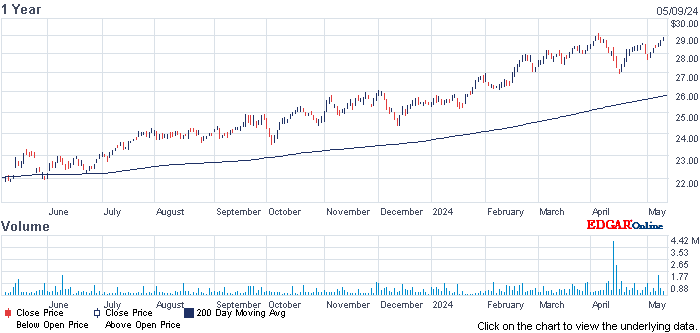
AMJ (Alerian MLP Index tracking fund)
![Live 24 hours gold chart [Kitco Inc.]](https://www.kitco.com/images/live/gold.gif?0.2180338269244485)


Retail sales in 2020 are forecast to rise 3.5-4.1%, topping $3.9T, despite the headwinds of a lingering trade war, the coronavirus outbreak & an upcoming presidential election, the industry's trade group said. “The nation’s record-long economic expansion is continuing, and consumers remain the drivers of that expansion,” National Retail Federation President (NRF) CEO Matthew Shay said. “With gains in household income and wealth, lower interest rates and strong consumer confidence, we expect another healthy year ahead,” he added. “There are always wild cards we cannot control like coronavirus and a politically charged election year. But when it comes to the fundamentals, our economy is sound and consumers continue to lead the way.” The 2020 forecast assumes the coronavirus does not become a global pandemic. Business confidence & 2020 retail sales could be hit “if factory shutdowns in China continue, particularly if delivery of holiday season merchandise is affected.” “I feel we are fortunate we are lagged here [in America]. [Coronavirus] occurred elsewhere sooner,” NRF Chief Economist Jack Kleinhenz said. “We have had time to think about it.” In some ways, it is “fortunate” the outbreak is taking place when the US economy is on strong footing, Kleinhenz added. “If this had happened back in 2007 ... it would have been probably worse.” For now, Kleinhenz called coronavirus a “wait and see situation.” In recent days, manufacturing facilities have been coming back online in China, offering “encouraging news” for retailers dependent on the region for their supply chains, Shay added. In the US, where the number of coronavirus cases has been much less severe, “there is a lot of preparation going on out of an abundance of caution,” the CEO said. Meantime, preliminary results show retail sales grew 3.7% in 2019, to $3.79T, falling short of its forecast for growth of at least 3.8%. But it said its forecast for last year was based on “incomplete data” because of the gov shutdown. E-commerce sales, which are included in NRF’s overall forecast, are expected to grow 12-15%, to $870-$894B, in 2020. The trade group expects the overall economy to gain 150-170K jobs each month this year, compared with an average of 175K last year. It expects the unemployment rate in the US to remain around 3.5%.
Retail sales to rise 3.5% to 4.1% in 2020, unless coronavirus derails growth
Gold prices ended lower, building on the previous session's retreat, even as worries remain over the spread of coronavirus outside of China. Gold for Apr fell $6.90 (0.4%) to settle at $1643 an ounce. The yellow metal jumped to a 7-year high on Mon as worries about COVID-19 sparked a global equity rout, prompting investors to pile into traditional havens. Worries about the spread of COVID-19 outside of China continue to drive trade across financial markets, with assets perceived as risky, including equities & commodities, under pressure as investors pile into haven assets. The number of confirmed cases & deaths outside China has continued to rise, particularly in Italy, Iran, Japan & South Korea. Stocks extended losses yesterday after the Centers for Disease Control & Prevention said Americans should prepare for the spread of the coronavirus in the US. Analysts have tied the retreat by gold in part to positioning, noting that data had shown extremely high net long speculative positions in gold futures ahead of the recent push to a 7-year high. Still, the degree of the pullback in light of the continued selloff in equities was widely described as a surprise.
Gold posts a second straight session loss as coronavirus worries continue to swirl
Amazon (AMZN) is warning sellers on its platform not to inflate face mask prices amid global concerns about the new coronavirus, according to emails obtained by tech news magazine Wired. Hospitals around the world are facing a shortage of masks & other supplies as producers face increasing demand & longer work hours. 96% of local US pharmacies said they were selling masks faster than they could replace them, according to a xurvey published Feb 6 by The National Community Pharmacists Association. AMZN warned sellers about selling masks "not in compliance" with its pricing policies, Wired reported. AMZN did not immediately respond for a comment. AMZN's "Fair Pricing Policy" requires its sellers to set fair prices for its products that are not "significantly higher than recent prices offered on or off Amazon" & mislead buyers. "Amazon regularly monitors the prices of items on our marketplaces, including shipping costs, and compares them with other prices available to our customers," its website reads. "If we see pricing practices on a marketplace offer that harms customer trust, Amazon can remove the Buy Box, remove the offer, suspend the ship option, or, in serious or repeated cases, suspending or terminating selling privileges." The #1 product in AMZN's "Health & Household" section is a 3-pack of black, "unisex" cotton face masks selling for a whopping $19.99. The masks are made by the Shenzhen, China-based accessory company Aniwon, which markets itself as "a fashion brand which main market in Euro & U.S." In response to a question from an AMZN user about inserting filters into the mask, Aniwon responded, "Understand that this mask is not made to keep out coronavirus."
Revenue projections for Hispanic small business owners are at a 4-year high, & Hispanic entrepreneurs are more optimistic about the local & national economies than their non-Hispanic peers, according to a Bank of America (BAC) report. "They're the most optimistic, fastest-growing demographic of entrepreneurs. ... They’re a big part of the thriving economy," John Gomez, senior VP/Small Business Region exec at Bank of America, said. Hispanic small business owners' concerns over major economic issues "remained flat or declined." They're still most concerned by health care costs, although it's less of a concern than in 2019. "Regardless of where a small business is in its life cycle, health care will always be a concern for entrepreneurs because they want to offer the best benefits possible. … Especially with low unemployment, it's not an easy market to find top talent," Gomez said. In addition, 30% of Hispanic business owners surveyed envision significantly growing their staff in the next decade, something that Gomez said will be a boon for local economies. Some of the biggest obstacles Hispanic entrepreneurs said they faced are a lack of resources and challenges accessing capital. Gomez highlighted BAC's resources for small businesses as well as the federal Community Development Financial Institutions (CDFI) Fund it supports. Hector Barreto, chair of The Latino Coalition, credited the optimism to Trump administration policies, including the US-Mexico-Canada Agreement, & tax cuts. "Something people aren't talking about has been simplification with regards to regulations," Barreto said. "Big businesses can deal with changing regulations. For small businesses, it gets very tough. The rollback on redundant regulation made it easier to comply." He added that Hispanic women are starting businesses at a higher rate than any other group. "When you look at it from a 30,000-foot view, 4 million Hispanic companies generate $800 billion in revenue each year," Barreto added. "Small businesses generate more than half of the economy."
Oil futures marked a 4th consecutive decline, pushing US prices back below $50 a barrel for their lowest finish in more than a year. Worries about the spread of COVID-19 outside China, & its impact on demand for crude, extinguished earlier support from a smaller-than-expected weekly rise in US crude inventories. West Texas Intermediate crude for Apr fell by $1.17 (2.3%) to settle at $48.73 a barrel. That was the lowest front-month contract finish since Jan 7, 2019. Prices briefly traded above $50 after the supply data. Apr Brent crude lost $1.52 (2.8%) to $53.43 a barrel, for the lowest settlement since Feb 10. Data from the Energy Information Administration revealed that US crude edged up by 500K barrels last week. The forecast called for the data to show a rise of 2.8M barrels. The American Petroleum Institute yesterday reported a climb of 1.3M barrels. Worries about the spread of COVID-19 outside of China continue to drive trade across financial markets, with assets perceived as risky, including equities & commodities, under pressure.
Oil price falls a 4th session in a row, and U.S. crude hits lowest finish in over a year
Stocks had an ugly day again. Not .as bad as the 2 previous declines, but bad nevertheless. A meager rally from bargain hunters in the AM did not last. The Dow sank in the PM & & could not hold above the important 27K resistance level. The fight against the coronavirus continues with no end in sight, at least for the time being. The Volatility Index remained about even in the mid 27s (double where it was in better times). Investors do want to commit money in risky investments (i.e. stocks).
Dow Jones Industrials


AMJ (Alerian MLP Index tracking fund)


Retail sales in 2020 are forecast to rise 3.5-4.1%, topping $3.9T, despite the headwinds of a lingering trade war, the coronavirus outbreak & an upcoming presidential election, the industry's trade group said. “The nation’s record-long economic expansion is continuing, and consumers remain the drivers of that expansion,” National Retail Federation President (NRF) CEO Matthew Shay said. “With gains in household income and wealth, lower interest rates and strong consumer confidence, we expect another healthy year ahead,” he added. “There are always wild cards we cannot control like coronavirus and a politically charged election year. But when it comes to the fundamentals, our economy is sound and consumers continue to lead the way.” The 2020 forecast assumes the coronavirus does not become a global pandemic. Business confidence & 2020 retail sales could be hit “if factory shutdowns in China continue, particularly if delivery of holiday season merchandise is affected.” “I feel we are fortunate we are lagged here [in America]. [Coronavirus] occurred elsewhere sooner,” NRF Chief Economist Jack Kleinhenz said. “We have had time to think about it.” In some ways, it is “fortunate” the outbreak is taking place when the US economy is on strong footing, Kleinhenz added. “If this had happened back in 2007 ... it would have been probably worse.” For now, Kleinhenz called coronavirus a “wait and see situation.” In recent days, manufacturing facilities have been coming back online in China, offering “encouraging news” for retailers dependent on the region for their supply chains, Shay added. In the US, where the number of coronavirus cases has been much less severe, “there is a lot of preparation going on out of an abundance of caution,” the CEO said. Meantime, preliminary results show retail sales grew 3.7% in 2019, to $3.79T, falling short of its forecast for growth of at least 3.8%. But it said its forecast for last year was based on “incomplete data” because of the gov shutdown. E-commerce sales, which are included in NRF’s overall forecast, are expected to grow 12-15%, to $870-$894B, in 2020. The trade group expects the overall economy to gain 150-170K jobs each month this year, compared with an average of 175K last year. It expects the unemployment rate in the US to remain around 3.5%.
Retail sales to rise 3.5% to 4.1% in 2020, unless coronavirus derails growth
Gold prices ended lower, building on the previous session's retreat, even as worries remain over the spread of coronavirus outside of China. Gold for Apr fell $6.90 (0.4%) to settle at $1643 an ounce. The yellow metal jumped to a 7-year high on Mon as worries about COVID-19 sparked a global equity rout, prompting investors to pile into traditional havens. Worries about the spread of COVID-19 outside of China continue to drive trade across financial markets, with assets perceived as risky, including equities & commodities, under pressure as investors pile into haven assets. The number of confirmed cases & deaths outside China has continued to rise, particularly in Italy, Iran, Japan & South Korea. Stocks extended losses yesterday after the Centers for Disease Control & Prevention said Americans should prepare for the spread of the coronavirus in the US. Analysts have tied the retreat by gold in part to positioning, noting that data had shown extremely high net long speculative positions in gold futures ahead of the recent push to a 7-year high. Still, the degree of the pullback in light of the continued selloff in equities was widely described as a surprise.
Gold posts a second straight session loss as coronavirus worries continue to swirl
Amazon (AMZN) is warning sellers on its platform not to inflate face mask prices amid global concerns about the new coronavirus, according to emails obtained by tech news magazine Wired. Hospitals around the world are facing a shortage of masks & other supplies as producers face increasing demand & longer work hours. 96% of local US pharmacies said they were selling masks faster than they could replace them, according to a xurvey published Feb 6 by The National Community Pharmacists Association. AMZN warned sellers about selling masks "not in compliance" with its pricing policies, Wired reported. AMZN did not immediately respond for a comment. AMZN's "Fair Pricing Policy" requires its sellers to set fair prices for its products that are not "significantly higher than recent prices offered on or off Amazon" & mislead buyers. "Amazon regularly monitors the prices of items on our marketplaces, including shipping costs, and compares them with other prices available to our customers," its website reads. "If we see pricing practices on a marketplace offer that harms customer trust, Amazon can remove the Buy Box, remove the offer, suspend the ship option, or, in serious or repeated cases, suspending or terminating selling privileges." The #1 product in AMZN's "Health & Household" section is a 3-pack of black, "unisex" cotton face masks selling for a whopping $19.99. The masks are made by the Shenzhen, China-based accessory company Aniwon, which markets itself as "a fashion brand which main market in Euro & U.S." In response to a question from an AMZN user about inserting filters into the mask, Aniwon responded, "Understand that this mask is not made to keep out coronavirus."
Amazon issues warning to sellers amid global coronavirus mask shortage
Revenue projections for Hispanic small business owners are at a 4-year high, & Hispanic entrepreneurs are more optimistic about the local & national economies than their non-Hispanic peers, according to a Bank of America (BAC) report. "They're the most optimistic, fastest-growing demographic of entrepreneurs. ... They’re a big part of the thriving economy," John Gomez, senior VP/Small Business Region exec at Bank of America, said. Hispanic small business owners' concerns over major economic issues "remained flat or declined." They're still most concerned by health care costs, although it's less of a concern than in 2019. "Regardless of where a small business is in its life cycle, health care will always be a concern for entrepreneurs because they want to offer the best benefits possible. … Especially with low unemployment, it's not an easy market to find top talent," Gomez said. In addition, 30% of Hispanic business owners surveyed envision significantly growing their staff in the next decade, something that Gomez said will be a boon for local economies. Some of the biggest obstacles Hispanic entrepreneurs said they faced are a lack of resources and challenges accessing capital. Gomez highlighted BAC's resources for small businesses as well as the federal Community Development Financial Institutions (CDFI) Fund it supports. Hector Barreto, chair of The Latino Coalition, credited the optimism to Trump administration policies, including the US-Mexico-Canada Agreement, & tax cuts. "Something people aren't talking about has been simplification with regards to regulations," Barreto said. "Big businesses can deal with changing regulations. For small businesses, it gets very tough. The rollback on redundant regulation made it easier to comply." He added that Hispanic women are starting businesses at a higher rate than any other group. "When you look at it from a 30,000-foot view, 4 million Hispanic companies generate $800 billion in revenue each year," Barreto added. "Small businesses generate more than half of the economy."
Hispanic small business owners expect revenues to reach four-year high
Oil futures marked a 4th consecutive decline, pushing US prices back below $50 a barrel for their lowest finish in more than a year. Worries about the spread of COVID-19 outside China, & its impact on demand for crude, extinguished earlier support from a smaller-than-expected weekly rise in US crude inventories. West Texas Intermediate crude for Apr fell by $1.17 (2.3%) to settle at $48.73 a barrel. That was the lowest front-month contract finish since Jan 7, 2019. Prices briefly traded above $50 after the supply data. Apr Brent crude lost $1.52 (2.8%) to $53.43 a barrel, for the lowest settlement since Feb 10. Data from the Energy Information Administration revealed that US crude edged up by 500K barrels last week. The forecast called for the data to show a rise of 2.8M barrels. The American Petroleum Institute yesterday reported a climb of 1.3M barrels. Worries about the spread of COVID-19 outside of China continue to drive trade across financial markets, with assets perceived as risky, including equities & commodities, under pressure.
Oil price falls a 4th session in a row, and U.S. crude hits lowest finish in over a year
Stocks had an ugly day again. Not .as bad as the 2 previous declines, but bad nevertheless. A meager rally from bargain hunters in the AM did not last. The Dow sank in the PM & & could not hold above the important 27K resistance level. The fight against the coronavirus continues with no end in sight, at least for the time being. The Volatility Index remained about even in the mid 27s (double where it was in better times). Investors do want to commit money in risky investments (i.e. stocks).
Dow Jones Industrials


