Monday, March 30, 2020

Higher markets after virus measures extended

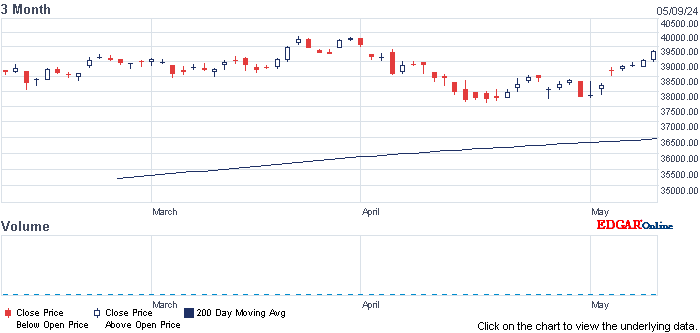
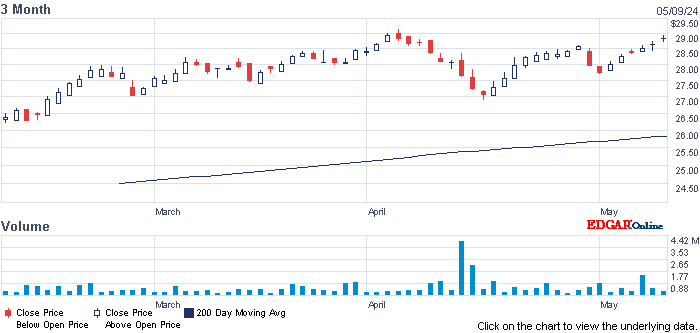
Dow jumped up 348, but decliners modestly ahead of advancers & NAZ went up 190.  The MLP index fell 2+ to the 83s & the REIT index lost 3+ to the 306s.  Junk bond funds fluctuated & Treasuries rose in price.  Oil dropped 1, nearing the important resistance level of 20, (more below), & gold climbed 4 to 1629.

AMJ (Alerian MLP Index tracking fund)
stock chart

CL=FCrude Oil20.11
-1.40-6.5%

GC=FGold   1,648.80
-5.30-0.3%


3 Stocks You Should Own Right Now - Click Here!


Treasury Secretary Steve Mnuchin said that small business owners could receive instructions on how to file for federal aid set as soon as today, as the coronavirus pandemic batters bars, restaurants & retailers across the US.  "These loans will be available starting on Friday," he said.  “We hope later today we’ll be releasing the documents and instructions."  A key piece of the $2.2T relief bill passed by Congress last week is $350B in funding  for small businesses.  Businesses with fewer than 500 employees are eligible for up to $10M in loans, which can be used for payroll & other expenses, like insurance premiums, mortgages, rent or utilities.  The gov will pay off the loan balance so long as the companies either do not lay off workers or rehire ones they've already let go.  Although Mnuchin said he believed $350B would be enough -- he estimated that it covers roughly 50% of the private workforce -- he said the Trump administration was willing to ask Congress for more money if the number of applications surges.  "This is a very popular program with Republicans and Democrats, and the president likes it a lot," he added.  "If we run out of money, and this is a huge success, we will absolutely go back to Congress and ask for more money."  "And by the way, it makes economic sense," he continued.  "Because every person we put through this program, we don't have to pay unemployment insurance."  Mnuchin said the 3rd stimulus package signed into law by Pres Trump last week, the largest relief bill in recent memory, is slated to last 8-12 weeks.  If the pandemic continues to weigh on workers & companies, however, he suggested the Trump administration would be open to a 4th deal -- one that may include hazard pay for front-line workers like nurses, who earn too much to qualify for a $1200 cash check.  (Under the legislation, workers who earn less than $99K are eligible for a check of up to $1200.  Children receive $500).  "We have a lot of money now that we’re deploying," he said.  "Our number one job at Treasury right now is making sure we get these programs up and running."

Mnuchin: Virus relief directions for small businesses released today


West Texas Intermediate crude oil tumbled after Pres Trump extended COVID-19 social-distancing guidelines to Apr 30.  WTI futures for May delivery were down 5.9% at $20.24 per barrel after falling 7.3%, to $19.92 a barrel, last evening & were on track for their lowest close since 2002 before trimming their losses.  Pres Trump said that he would speak to Russian Pres Vladimir Putin later today about low energy prices.  This slide comes after prices plunged Fri in response to Saudi Arabia saying it has not held talks with Russia regarding a “joint agreement to balance oil markets.”  Crude oil prices have crashed 68% this year as the price war between Saudi Arabia & Russia has added to a supply glut at the same time the COVID-19 pandemic has caused demand destruction.

Oil flirts with first sub-$20 close since 2002


Contracts to buy previously owned homes rose for the 2nd straight month in Feb, the National Association of Realtors (NAR) said.  The NAR's pending home sales index increased to 111.5, up 2.4% from the prior month.  Jan''s index was revised slightly to 108.9 from 108.8.  The forecast pending home sales falling 1.0% last month.  Pending home contracts generally are seen as a forward-looking indicator of the health of the housing market because they become sales 1-2 months later.  But Lawrence Yun, NAR's chief economist, noted that the data did not capture the significant fallout from the coronavirus pandemic, which is likely to derail the housing market as layoffs surge & the economy falters.  US existing home sales surged to a 13-year high in Feb, data earlier this month showed.  Compared to one year ago, pending sales were up 9.4% in Feb.

Pending home sales rise 2.4% in February


Today's rally is very suspicious.  The advance decline line is negative while high yield securities (i.e. junk bond funds & Treasuries) are sliding lower after last week's big gains.  Gold & Treasuries are in demand.  Making matters worse for the bull scenario, Boeing (BA), a Dow stock, sank 20 after its rebound last week.

Dow Jones Industrials


Friday, March 27, 2020

Markets trim losses after the House approves stimulus package

Dow finished down 915 (with selling into the close), decliners over advancers 3-1 & NAZ lost 295.  The MLP index fell 5+ to 86 & the REIT index was even in the 309s.  Junk bond funds continued mixed & Treasuries remained in demand by investors.  Oil dropped to the 21s & gold dropped 26 to 1625 (more on both below).

AMJ (Alerian MLP Index tracking fund)


Live 24 hours gold chart [Kitco Inc.]


3 Stocks You Should Own Right Now - Click Here!


The House of Representatives passed an unprecedented $2.2T coronavirus stimulus package, rushing the legislation to Pres Trump in hopes of providing relief for American workers & businesses left reeling from the tandem health & economic crises.  The House approved the measure by a voice vote, with the majorities of both parties supporting the largest relief bill in recent memory.  It will provide payments of up to $1200 to Ms of Americans, expand unemployment benefits, extend financial help for businesses both large & small, offer Bs to state & local govs & grant money to the nation's hard-hit hospitals.  “The American people deserve a government-wide, visionary, evidence-based response to address these threats to their lives and their livelihood," House Speaker Nancy Pelosi said.  "And they need it now."  Trump has promised to sign the bill "immediately."  White House officials & congressional leaders have suggested that some Americans will see direct payments of up to $1200 within 3 weeks.  The proposal comes at a key moment for the nose-diving economy:  Yesterday, the Labor Dept revealed that 3.3M filed unemployment claims last week after businesses across the country closed to slow the disease's spread, shattering a decades-old record.  Hospitals have been inundated with patients & have struggled to gain access to the necessary equipment & resources.  The US has more than 94K coronavirus cases, the most in the world, according to a database compiled by Johns Hopkins University.  There have been 1438 deaths related to the virus in the country.

House passes historic $2T stimulus in virus response, sends to Trump


The Trump administration wants to open the country back up as quickly as possible, but will make sure it's safe first.  “We are going to do it responsibly,” VP Mike Pence said.  “We’re going to do it based on data."  He added that some parts of the country could be opened up before others & that the data will be reviewed on a county-by-county basis.  The COVID-19 pandemic has infected 86K in the US & killed 1300, according to the latest data provided by Johns Hopkins University & Medicine.  More than ½ of the nation's confirmed cases are from the NY metropolitan area.  "There's gonna be areas of the country where we just we have to support our governors and mitigation efforts have to stay very strong and in some cases even become stronger," the VP added.  "But for much of the country, where the outbreak is very limited, the president is anxious to give guidance based on the data to our governors so that they can decide whether it be reopening businesses or reopening schools."  Pence said the best thing people can do to help slow the pandemic is to put into practice Trump's "15 Days to Slow the Spread" guidelines.  Practices include listening to state & local authorities, staying home if you fell sick, using good hygiene & avoiding social gatherings.

Pence: US will be reopened 'responsibly'


IMF chief Kristalina Georgieva said that the global economy is now in a recession thanks to COVID-19, but that she's heartened to see world leaders finally realizing that only a coordinated effort will be able to stem the spread of the novel coronavirus.  “We have stated that the world is now in recession and that the length and depth of this recession depend on two things: Containing the virus and having an effective, coordinated response to the crisis,” she said.  “I’m very encouraged by what I see now. I see much clearer understanding [among global leaders] that if we don’t beat it everywhere we won’t be able to get out of it,” she added.  “We should not go ... with small measures now when we know that it is a gigantic crisis,” she continued.  “We’ve never seen the world economy standing still. Now we [do]. How we go about revitalizing it is another important topic.”  The IMF has taken extraordinary measures in recent weeks to help combat the economic toll COVID-19, & efforts to contain its spread, has had on economies around the globe.  On Mar 16 the intl body said it “stands ready” to use its $1T lending capacity to help countries around the world that are struggling with the humanitarian & economic impact of the novel coronavirus.   Georgieva wrote at the time that such support could be used to aid its members, especially emerging & developing countries.  The IMF's Catastrophe Containment and Relief Trust “can help the poorest countries with immediate debt relief, which will free up vital resources for health spending, containment, and mitigation.”  Her comments came near the end of yet another violent week in the stock market. The S&P 500 & Dow are up more than 10% this week after the Federal Reserve moved to pump cash into the US economy through historic easing policies & zero-interest loans.

IMF chief Georgieva says the world is in a recession

American consumers' confidence in the economy is deteriorating as anxiety over the coronavirus takes hold.  The Univ of Mich index of consumer sentiment dropped to 89.1 in Mar from 101.0 in Feb.  That’s the lowest level in more than 3 years & the monthly decline is among the worst on record.  The forecast called for a slightly less severe drop to 90.0.

U.S. Consumer Confidence Drops to Lowest Level in More Than 3 Years


Oil prices tumbled after Saudi Arabia said it hasn't recently held talks with Russia to end a price war that began earlier this month.  Brent crude oil, the intl benchmark, plunged 6% to $24.77 a barrel while West Texas Intermediate crude oil, the US benchmark, slid 4.9% to $21.50.  The 2 countries have had no “discussion of a joint agreement to balance oil markets,” the Saudi Energy Ministry said.  Crude oil prices crashed into a bear market this year after Russia refused to join Saudi Arabia & other OPEC members in cutting production to trim a supply glut due to demand destruction from the COVID-19 pandemic.  Saudi Arabia responded to Russia's refusal by lowering prices for its customers & increasing output, despite declining sales as govs responded to the disease by ordering the temporary closure of businesses and the cancellation of non-essential travel.  Crude oil prices crashed into a bear market this year after Russia refused to join Saudi Arabia & other OPEC members in cutting production to trim a supply glut due to demand destruction from the COVID-19 pandemic.  Saudi Arabia responded to Russia’s refusal by lowering prices for its customers & increasing output, despite declining sales as gos responded to the disease by ordering the temporary closure of businesses & the cancellation of non-essential travel.

Oil plunges again after talks stall between Saudis, Russians


Gold futures settled with a loss today but still scored the biggest weekly rise in more than 11 years in a rebound fueled in part by a weaker $ & concerns about disruptions in the physical market for the precious metal.  Gold for Apr fell $26 (1.6%) to settle at $1625 an ounce.  For the week, prices for the most-active contract rose 9.5%, which marked the biggest weekly rise since 2008.  Downbeat US economic data failed to provide support for haven gold.  The final results for US consumer sentiment index fell to 89.1 in Mar from a preliminary 95.9 & 101.0 in the prior month, according to the Univ of Mich.

Gold scores biggest weekly gain since 2008


This was an usually wild week for stocks.  The Dow finished up 2400 this week, dragged down by selling in the last ½ of trading today.  Trump should be signing the stimulus package as this is written.  Investors feel better than they did last week.  However, the data on COVID-19 is troubling, although the news seems to be getting better.  The money from the bill needs to reach people & troubled businesses quickly to do good.  There are no shortage of unknowns for investors.  Plan for extremely high volatility in stock market next week.

Dow Jones Industrials


Markets retreat after an historic 3 day rally

Dow tumble 782, decliners over advancers 7-1 & NAZ lost 221.  The MLP index fell 3+ to the 88s & the REIT index was off 2+ to the 306s.  Junk bond funds were mixed after being in a rally mode & Treasuries continued in strong demand.  Oil dropped 1+ to the 21s & gold gave back 26 to 1625.

AMJ (Alerian MLP Index tracking fund)

stock chart

CL=FCrude Oil21.38
  -1.22-5.4%

GC=FGold   1,614.00
-37.20-2.3%


3 Stocks You Should Own Right Now - Click Here!


Treasury Secretary Steve Mnuchin said the small business relief included in the massive $2T coronavirus stimulus package could keep 50% of Americans at work.  A key piece of the largest relief bill in recent memory is the more than $370B in funding for small businesses.  Businesses with fewer than 500 employees are eligible for up to $10M in loans, which can be used for payroll & other expenses, like insurance premiums, mortgages, rent or utilities.  The gov will pay off the loan balance so long as the companies either do not lay off workers or rehire ones they've already let go.  "As long as you hire those people, your loan will be forgiven," Mnuchin said.  "This keeps 50 percent of American workers at work."  Once businesses receive the loans, they'll have 2 months to use the money to avoid repaying it.  The banks lending the money would be reimbursed by the Treasury Dept, which is receiving $377B to fund the program.  The program does come with some restrictions.  Businesses that have recently laid off workers would be required to repay a larger portion of their loans & loans covering salaries of more than $100K a year wouldn't qualify for forgiveness.  Businesses would not have to repay loans covering up to 8 weeks' worth of payroll costs.  This is not the fault of the American public & we want to get all of those people paid," Mnuchin added.  "This is a Herculean effort that people will go into banks next Friday and be able to get loans. It's going to be a very simple process."

Mnuchin: Relief could keep 50% at work


House members are scrambling back to the Capitol as one member's opposition to a $2T coronavirus rescue package threatens to delay its passage.  With few representatives in DC this week as the outbreak tears across the country, the House hoped to approve the legislation quickly today without a recorded vote.  But after Rep Thomas Massie indicated he would oppose the bill, House Majority Leader Steny Hoyer's office advised members last night “that it is possible this measure will not pass by voice vote.”  In a voice vote, members yell their yeas & nays & the presiding member decides which are louder.  The recorded vote is the typical method for major legislation, where members log a yes or no.  By the time the House convened this AM, though, the Maryland Dem's office said “we are hopeful the bill will pass by voice vote.”  Facing the prospect of the aid's approval getting pushed to Sat, Hoyer's office encouraged lawmakers to come back to DC “with caution” if they are “willing and able” to make the trip.  The roadblock prompted lawmakers to rush to come back more quickly than they expected — though it is unclear now if the House can gather the quorum needed to pass the bill presently.  House members shared photos as they hopped on near-empty flights.  Some expressed outrage that Massie would force lawmakers to come back & risk their safety — particularly after 2 representatives & a senator tested positive for COVID-19.  The stimulus measure, which includes one-time direct payments to individuals, beefed-up unemployment insurance, more health-care funding & loans to businesses, passed the Senate unanimously on Wed night.  Yesterday, House Speaker Nancy Pelosi described the bill “as mitigation” of the crisis, predicting there would be more legislation to aid “recovery.”  The rush to pass the bill comes a day after data showed unemployment claims spiked to a record 3.3M last week after businesses across the country shuttered to slow the pandemic's spread.  Hospitals, particularly in ravaged NY, lack resources as they struggle to keep up with a rush of coronavirus patients.

House rushes back to Washington to try to pass $2 trillion coronavirus stimulus bill

Profits at China's industrial firms during the first 2 months of the year plunged by the most since record-keeping began in 1990 as Beijing’s response to the COVID-19 pandemic brought the economy to a screeching halt.  Their earnings sank 38% from the prior year to 411B yuan ($58B), according to China's National Bureau of Statistics.  The data from Jan & Feb are combined to smooth the impact of the Chinese Lunar New Year.  COVID-19, which originated in Wuhan, China, has infected 81K in the country & killed 3300, according to the latest data from Worldometer.  In response to the virus, Beijing locked down hundreds of Ms, paralyzing key economic sectors including mining, manufacturing & power.  Profits from petroleum, coal & other fuel-processing firms sank 117% & those from manufacturing companies fell 43%.  Elsewhere, the mining industry saw a 21% drop & the utilities sector witnessed a 23% slide.  Just 4 sectors – tobacco products, non-ferrous metals, oil & gas exploitation & processing of non-staple agricultural goods – of the 41 that are counted saw their profits increase.  A sharp drop in industrial profit isn't the only evidence that the Chinese economy is suffering. Manufacturing activity in Feb plunged at the fastest pace & to its lowest level on record.  Additionally, vehicle sales saw a 79% drop & retail sales tumbled 20%.

China sees historic drop in industrial profits


Nothing like a a little drama in getting the House to approve the big spending package.  But it looks like it will get one, one way or the other.  After an historic rally this week, traders are taking their profits.  That was expected.   But there is a lof of damage to the economy & the minds of investors which will  time to repair,  The Dow began the day in the dumps & continued at those levels so far.

Dow Jones Industrials