Thursday, May 28, 2020

Markets rise cautiously after weak economic data

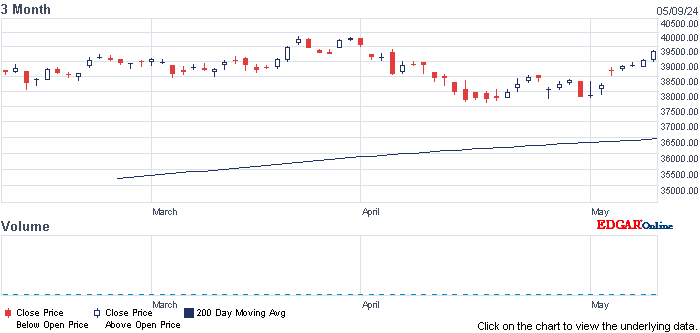
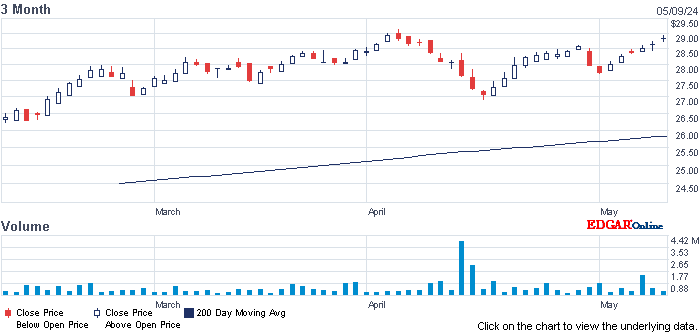
Dow went up 67, advancers over decliners about 5-4 & NAZ rose 42  The MLP index lost 1 to the 145s & the REIT index was flat in the 341s.  Junk bond funds inched higher & Treasuries edged lower.  Oil was fractionally lower in the 32s & gold added 10 to 1720.

AMJ (Alerian MLP Index tracking fund)
stock chart

CL=FCrude Oil32.61
  -0.20 -0.6%

GC=FGold  1,737.80
+11.00+0.6%


3 Stocks You Should Own Right Now - Click Here!


First-time claims for unemployment benefits totaled 2.1M last week, the lowest total since the coronavirus crisis began though indicative that a historically high number of Americans remain separated from their jobs.  The forecast was looking for 2.05M.  The total represented a decrease of 323K from the previous week's upwardly revised 2.4M.  Continuing claims, or those who have been collecting for at least 2 weeks, numbered 21.1M, a clearer picture of how many workers are still sidelined.  That number dropped sharply, falling 3.86M from the previous week.  The insured unemployment rate, which is a basic calculation of those collecting benefits vs. the total labor force, came down sharply to 14.5% from 17.1% the previous week.  Since the pandemic was declared in mid-Mar, 40.8M have filed claims as social distancing measures aimed at containing the coronavirus outbreak resulted in much of the $21.5T US economy being in lockdown for 2½ months.  A separate report showed that Q1 GDP contracted by 5%, while the Atlanta Fed's GDPNow tracker is indicating a 41.9% plunge in Q2, the worst in history.  That would put the US firmly in recession territory, though most economists are expecting a rebound in H2 after restrictions are lifted.  A total 1.2M filed claims thru the Pandemic Unemployment Assistance program last week.  The high jobless numbers persist even as all states have reopened their economies to various extents.  Las Vegas casinos will be resuming activities late next week, Disney (DIS), a Dow stock, resorts also have targeted Jul reopening dates & Los Angeles is allowing retail stores to resume business.  Restrictions are likely to be loosened soon in New York as well.  Still, businesses are wrestling with multiple dynamics stemming from the biggest surge in in layoffs since the depression.  The Federal Reserve reported that business owners are seeing workers reluctant to return to their jobs because of safety concerns, child-care issues & “generous” unemployment benefits from the gov.

Another 2.1 million file jobless claims, but total unemployed shrinks


The American  economy shrank more than expected in Q1 as the coronavirus-pandemic triggered an unprecedented lockdown of the nation, according to new figures published by the Commerce Dept.  GDP, the broadest measure of goods & services produced across the economy, fell at a seasonally adjusted annual rate of 5% in the 3-month period Jan-Mar, the Commerce Dept said in its 2nd reading of the data.  GDP was expected to remain unrevised at 4.8%.  It was the worst drop since 2009, when the economy contracted by 4.4% in the midst of the financial crisis.  The revision, which relies on more complete data, reflected a drop in weaker investment by businesses in their inventory, which was partially offset by stronger consumer spending.  Still, the severity of the coronavirus-induced downturn will be reflected more accurately in Q2, when the nation's economy came to a near standstill to mitigate the spread of the virus.  Estimates vary widely, but economists agree it'll be grim, possibly surpassing the worst of the depression. The economy is expected to see a rebound in the 3rd & 4th-qtrs of the year.  The Congressional Budget Office, a nonpartisan agency, has forecast that GDP could increase 23.5% in Q2 & 10.5% in Q4.

US economy shrinks more than expected as virus triggers unprecedented lockdown


Sales of long-lasting goods tumbled in Apr, as businesses cut investment in response to the global coronavirus-pandemic.  Orders for durable goods -- products designed to last longer than 3 years such as washing machines, bulldozers & cars -- fell 17.2% from a month earlier, the Commerce Dept reported.  The forecast called for a 17% drop in orders.  Sales fell across major product categories.  Excluding transportation products, which can be volatile, orders fell 7.4%.  Excluding defense, orders dropped 16.2%.  The drop followed a decline of 16.6% in Mar.  So far this year orders have fallen 11.4% compared with a year earlier.  Perhaps most ominous is a sharp decline in business investment, which could spell slower economic growth beyond the pandemic.  A key measure of business spending -- orders for nondefense capital goods, excluding aircraft -- fell 5.8%.  This year they're down 1.3% to the same period last year.  The drop followed a decline of 16.6% in Mar.  So far this year orders have fallen 11.4% compared with a year earlier.  Several factors are restraining investment spending.  The pandemic has disrupted supply chains, impairing factories' ability to get key parts.  Depressed oil prices have prompted energy companies to pull back on purchases of drilling equipment.  The collapse of air travel has sapped airlines' demand for new aircraft.  More broadly, businesses are reluctant to invest in equipment, software & facilities given the uncertainty about how long lockdowns will last, whether the country will suffer a 2nd virus outbreak, & how robust a recovery might be.

Durable goods orders in US tumbled 17.2% in April


Investors were buying stocks, but not aggressively after the grim economic news.  The forecasts were negative but investors were somewhat relieved that the news shows improvement over previous reports.  Continued talk about some degree of recovery in H2 is welcomed & the Dow extended its 2+ month rally.

Dow Jones Industrials


Wednesday, May 27, 2020

Markets climb higher when Fed officials talk about an economic rebound

Dow gained 553 (session high), advancers over decliners 3-1 & NAZ went up 72.  The MLP index added 1 to the 146s & the REIT index rose 5 to 340.  Junk bond funds continued in demand & Treasuries rose in price.  Oil gave back 1+ to the 32s & gold edged up 5 to 1710 (more on both below).

AMJ (Alerian MLP Index tracking fund)


Live 24 hours gold chart [Kitco Inc.]


3 Stocks You Should Own Right Now - Click Here!


Secretary of State Mike Pompeo reported to Congress that Hong Kong was no longer autonomous from China, a move that could jeopardize the special administrative region's favorable trade relationship with the US & open up Chinese officials to sanctions.  The State Dept was required to issue a determination on Hong Kong's autonomy under pro-democracy legislation passed late last year.  The law also requires the pres to impose sanctions on foreigners who undermine “fundamental freedoms and autonomy in Hong Kong.”  Pompeo's move comes amid a controversy in Hong Kong over a proposed national security law from Beijing that has spurred protests in the streets of the former British colony.  The proposed law from China's National People's Congress would effectively bypass Hong Kong's own legislature and targets acts of sedition against the central govt in Beijing.  Fears over China's encroachment on the business center's independence have roiled the region for months & contributed to sending Hong Kong's economy into recession last year.  “No reasonable person can assert today that Hong Kong maintains a high degree of autonomy from China, given facts on the ground,” Pompeo said . “Hong Kong and its dynamic, enterprising, and free people have flourished for decades as a bastion of liberty, and this decision gives me no pleasure. But sound policy making requires a recognition of reality,” Pompeo said.  “While the United States once hoped that free and prosperous Hong Kong would provide a model for authoritarian China, it is now clear that China is modeling Hong Kong after itself.”  Hong Kong has so far been exempted from the punishing tariffs on exports to the US that the Trump administration has imposed on China as part of Pres Trump's multiyear trade war with the country.  That exemption could be eliminated, though it's far from certain it will be.  Business groups have warned of negative consequences if Hong Kong were to lose its special status & experts have expressed skepticism that the US will impose substantial costs on China over Hong Kong.  The US has a significant financial relationship with Hong Kong.  Trade in goods & services between the US & Hong Kong totaled more than $66B in 2018, according to the Office of the US Trade Representative.  The State Dept has said that there are more than 1300 US firms doing business in the special administrative region.  China hawks in Congress have pressed the administration to move forward with sanctions on Chinese officials. Sen Marco Rubio has said that if China moves forward with its national security legislation, the State Dept would have no choice but to certify that Hong Kong was no longer autonomous and “sanctions should follow.”  Tensions between the US & China have been rising as a result of the spreading coronavirus pandemic, which was first reported in Wuhan, China, last year.  Officials in both countries, the world's 2 largest economies, have sought to pin blame for the deadly virus on each other.

Pompeo declares that Hong Kong is no longer autonomous from China, threatening trade with U.S.


New data on the pace of restaurant reservations show that the national decline in bookings is starting to slow, a development that could suggest that the food service industry & the broader US economy may have already endured the worst of the Covid-19 outbreak.  Though statistics provided by online reservation platform OpenTable for May 26 show that the number of seated diners at its participating restaurants nationwide is down an eye-popping 40% compared to this time last year, that is still far better than the 100% slide observed as recently as earlier this month & throughout Apr.  The comeback in OpenTable reservations isn't spread evenly across the country, however, as each state takes a different tact in reopening portions of their economies.  States including Alabama, Arizona & Nebraska, which have approved restaurants to reopen with restrictions, are seeing year-over-year positive growth in bookings on OpenTable.  Reservations in other states like New York & New Jersey that have been harder hit by the virus & introduced stricter business closures to slow the spread of the disease are still down 100% compared to this time last year.  But even early signs that US consumers are willing to book restaurant tables are good news investors, who have for weeks only been able to guess at how quick patrons might return after state restrictions ease.  If diners return in numbers & faster than expected, the sector, & the US economy, may in turn see a faster return to growth.  Traders have pointed to reopening optimism for the stock market's robust week-to-date rally with the Dow & S&P 500 up 3.1% & 1.5%, respectively.  Stocks that could benefit the most under a full US reopening led the gains.  A comeback in booking would also come as welcome relief to US food service workers, who've suffered the brunt of layoffs during the Covid-19 pandemic.  According to the Dept of Labor's most-recent monthly jobs report, the leisure & hospitality sector (of which food service is part) lost 7.7M during the month of Apr.  That number represented 47% of total positions.  The vast majority of the industry’s layoffs were in food service, where the gov said nearly 5.5M chefs, waiters, cashiers & other restaurant staff lost employment.

Restaurant bookings data show U.S. economy is starting to revive after Covid closures

Boeing (BA), a Dow stock, is planning to lay off more than 6K employees this week in an effort to slash costs as the coronavirus pandemic continues to devastate the air travel & aerospace industries.  The aircraft manufacturer previously said it is seeking to reduce its head count by 10% thru voluntary & involuntary separations from the company.  The company has more than 160K employees.  “Following the reduction-in-force announcement we made last month, we have concluded our voluntary layoff (VLO) program,” CEO Dave Calhoun said in a note to employees.  “And now we have come to the unfortunate moment of having to start involuntary layoffs (ILO). We’re notifying the first 6,770 of our U.S. team members this week that they will be affected.”  Thousands of other employees will be laid off over the next few months & 5520 other employees have been approved for voluntary separations.  “I wish there were some other way,” Calhoun added.   “For those of you who are notified, I want to offer my personal gratitude for the contributions you have made to Boeing, and I wish you & your families the very best.”  The virus has driven down demand for air travel, hurting the airline & leasing customers BA relies on.  Airlines are posting their first losses in years & the virus has sapped demand for new planes.  The pandemic is an additional crisis for BA.  The company had already been struggling with the aftermath of 2 crashes of its 737 Max planes that killed 346.  The jetliners, its most popular plane, have been grounded worldwide since shortly after the 2nd crash in Mar 2019.  Now, cancellations of orders are piling up.  Late last month, BA raised $25B in its largest ever debt sale to help it weather the downturn, a sum that it said allowed it to forgo federal aid.  The stock rose 4.77.
If you would like to learn more about BA, click on this link:
club.ino.com/trend/analysis/stock/BA?a_aid=CD3289&a_bid=6ae5b6f7

Boeing is laying off more than 6,000 employees this week as coronavirus pandemic hurts air travel

The US economy is starting to show some initial signs of increased activity as businesses reopen as the coronavirus pandemic recedes, said New York Federal Reserve Pres John Williams.  “I think we’re kind of in a good place...maybe near the bottom in terms of the economic downturn and, hopefully, we’ll start seeing improvement in coming months,” Williams added.  “We are seeing people willing to travel a little bit more, we’re seeing retail sales pick up some, especially in areas where restrictions have been lifted,” he added.  WIlliams said he expects to see a significant rebound in H2.  Asked if the worst was over, Williams replied “we’re pretty close.”  “Maybe May or June will be the low point,” he added.  Williams said what tools the Fed decides to use depends largely on how the economy evolved.  “These are issues that we’re obviously studying very carefully and we’ll be discussing as a group, so I don’t have anything to say about what will and will not happen,” the New York Fed pres said.
 
U.S. economy is near bottom, poised for rebound, Fed’s Williams says

The US economic downturn caused by the coronavirus pandemic remained in full strength in the middle of May, with activity falling sharply & steep job losses seen, according to the latest survey of economic conditions (the Beige Book) released by the Federal Reserve today.  The report, a summary of a survey of business contacts, found that most were pessimistic about the potential pace of recovery.  Some sectors, like leisure & hospitality continued to be hit hardest by the stay-at-home orders.  Factory activity was down sharply & agricultural conditions were deteriorating.  One bright spot was an upturn in auto sales towards the middle of May.  Wage pressure was mixed.  Pricing pressures varied but “were steady to down modestly” on balance.  Economic growth in the Apr-Jun qtr is going to contract at sharp rate.  Policy-makers are starting to turn their attention to what happens next. New York Fed Pres John Williams & St Louis Fed Pres James Bullard today said the economy was either at or near bottom & that there would be a rebound in H2.

Fed’s Beige Book says businesses are pessimistic about pace of a recovery

Gold futures pared earlier losses to finish off the session's lows, as tensions between the US & China worsened after Secretary of State Mike Pompeo announced that Hong Kong is no longer considered autonomous from China.  Under the US-Hong Kong Policy Act of 1992, the US treats Hong Kong, a semi-autonomous part of China, differently than the mainland in trade, commerce & other areas.  An estimated $38B in trade between Hong Kong & the US could be jeopardized, while nearly 300 US companies have regional headquarters in the city.  Aug gold, which is now the most-active contract, fell by $1 to settle at $1726 an ounce, off the day's low of $1701.  Earlier gold prices fell as US equities rose sharply on yesterday & most were higher again today, finding support from optimism over the easing of lockdowns & by fiscal & monetary stimulus efforts by govs & central banks.  That dulled some haven demand for gold.

Gold falls, but settles off session lows as U.S.-China tensions grow over Hong Kong


Oil futures retreated, with benchmark US prices down by nearly 6%, pressured by news reports that said Russia was in favor of easing up on supply cuts as planned in Jul, while simmering tensions between the US & China also weighed on commodities prices.  Moscow wants to begin easing production cuts in Jul, in keeping with the terms of the output curbs agreed to by OPEC & its allies earlier this year.  West Texas Intermediate crude for Jul fell $1.96 (5.7%,) to $32.39 a barrel.  Front-month Jul Brent crude, which expires at the end of Fri's session, was down $1.76 (4.9%) at $34.41 a barrel.  Traders also kept an eye on rising tensions in Hong Kong as China looks to impose new security laws that would crush Hong Kong’s autonomy & worsening relations between the US & China.

U.S. oil prices drop nearly 6% as Russia weighs easing supply cuts in July and U.S.-China tensions simmer

Trading began the day with selling in tech shares, taking NAZ lower.  However buyers returned bringing the NAZ into the black & taking the Dow above 25K (not seen since early Mar).  Investors are following the lead by Fed officials above with high hopes for an H2 economic recovery.

Dow Jones Industrials


Markets rise cautiously on increasing US-China tensions

Dow went up 180, advancers ove decliners better than 3-2 while NAZ sank 128.  The MLP index was fractionally lower to the 145s & the REIT index slid back 1 after yesterday's rise.  Junk bond funds crawled higher & Treasuries were in demand today.  Oil dropped 1+ to the 32s & gold fell 10 to 1695.

AMJ (Alerian MLP Index tracking fund)

stock chart

CL=FCrude Oil33.33
-1.02-3.0%

GC=FGold  1,695.60
-10.00-0.6%


3 Stocks You Should Own Right Now - Click Here!


Pres Trump is exploring a range of actions that he could take against the Chinese gov if it proceeds with a new law to curb protests in Hong Kong, Commerce Secretary Wilbur Ross said.  "There's a whole menu of potential things he could do," Ross said.  "And I'm sure they're working right now on how to refine the thinking and come up with something that's an appropriate response."  One year after last summer's chaotic & frequently violent anti-gov protests, the Chinese gov has announced that it plans to pass a controversial national security law to outlaw secession, subversion, terrorism & foreign interference in Hong Kong.  The National People's Congress, essentially a rubber stamp, is expected to ratify the bill today.  Legislation could be finalized this summer.  "I don't think we should get out ahead of the president," Ross said.  "This is a very complex situation. Our hearts go out to the individual civilians in Hong Kong. We're with them, but the president will have to decide what exactly is the appropriate response to it."  Yesterday Trump said the US is working on a strong response to the bill, which has reignited protests in Hong Kong, & could announce action by the end of the week.  “We’re doing something now. I think you’ll find it very interesting," Trump said.  "I’ll be talking about it over the next couple of days."  Hong Kong, a former British colony, was returned to China in 1997 under an agreement known as “one country, two systems,” which allowed the city to retain a “high-degree of autonomy” for 50 years.  The agreement expires in 2047.

Trump mulling 'menu' of actions against China over Hong Kong, commerce sec. says


The European Commission has unveiled plans for a €750B ($826B) recovery fund as the region faces the worst economic crisis since the 1930s.  It will borrow these funds and then disburse them via the European budget — the EU's common basket of cash that supports programs such as Erasmus.  They will be repaid between in 2028-2058.  The €750B includes €500B in grants & €250B in loans to member states.  Out of the €500B in loans, €310B will be invested in the green & digital transitions.  Germany & France opened the door to issuing mutual EU debt last week, suggesting that the Commission, the EU's exec arm, should raise €500B on the public markets to be distributed as grants.  The initiative was described as a “breakthrough” & a “historic” step as Germany had always opposed the idea of jointly-issued debt, even during previous crises.  However, there are 4 European countries that still broadly oppose issuing grants as a way to mitigate the economic fallout from the Covid-19 crisis, preferring instead loans that will be repaid. Austria, the Netherlands, Sweden & Denmark also want strong economic reform commitments in return for any financial help.  By including a component of grants and loans, the Commission is seeking to bridge these differences among the 27 EU countries.  A Dutch official said that “the positions are far apart and this is a unanimity file, so negotiations will take time. It’s difficult to imagine this proposal will be the end-state of those negotiations.”  This proposal kicks off a discussion among the 27 EU member states.  The leaders will meet, likely via video call, on Jun 18 in the hope of finding a consensus over the exact details of the recovery fund.  The European Parliament, the only directly-elected EU institution, will also have to approve any new financial aid as well.

EU unveils plan to borrow 750 billion euros to aid economic recovery

Congress will “probably” have to pass more legislation to mitigate the damage from the coronavirus pandemic, Senate Majority Leader Mitch McConnell said.  He added that a measure to lift the US economy would have a more narrow scope than the $3T package House Dems approved earlier this month.  He said states' progress in restarting their economies in the coming weeks will help to inform what Congress does.  McConnell noted that “we need to make sure we have unemployment insurance properly funded for as long as we need,” as tens of Ms lose paychecks.  “So, in the next few weeks, we’ll determine whether there is yet another bill,” he continued.  Congress has passed 4 bills to respond to the crisis, most recently approving a plan to replenish a small business aid program about a month ago.  Many lawmakers & Federal Reserve Chair Jerome Powell have argued the US should take more steps to jolt the economy as the unemployment rate stood at 14.7% in Apr & pockets of the country remain under restrictions to protect public health.  While Dems have pushed for more legislation for weeks, the GOP has started to warm to another round of stimulus in recent days.  Pres Trump & his top advisors signaled their support for another rescue bill last week. The pres mentioned the possibility of a 2nd direct payment to individual.  The Senate Rep leader again insisted he would push for liability protections for doctors & businesses as the economy reopened.  Dems have been uneasy about creating shields from lawsuits.  McConnell also said he would want additional relief for state & local gos to be tailored only to increased expenses & revenue lost due to the coronavirus pandemic.  Dems included nearly $1T for cash-strapped states & municipalities in their bill as leaders from both parties ask for more money.  Last week, the senator said the next congressional bill would not extend the $600 per week sum the US gov added to what recipients normally get from states which is due to expire at the end of Jul.

Congress will ‘probably’ have to pass another coronavirus stimulus bill, Mitch McConnell says

Stocks started higher but then pulled back on more US-China trade tensions.  Selling hit tech issues hard & shows up in the decline at NAZ.  Success of opening up the US economy is difficult to understand with so much stumbling.

Dow Jones Industrials