Tuesday, February 4, 2020

Markets rally, extending yesterday's advance

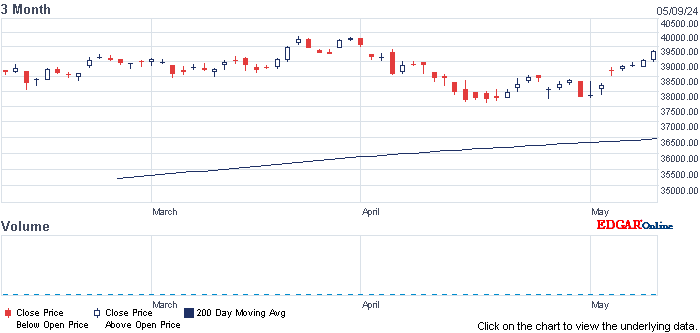
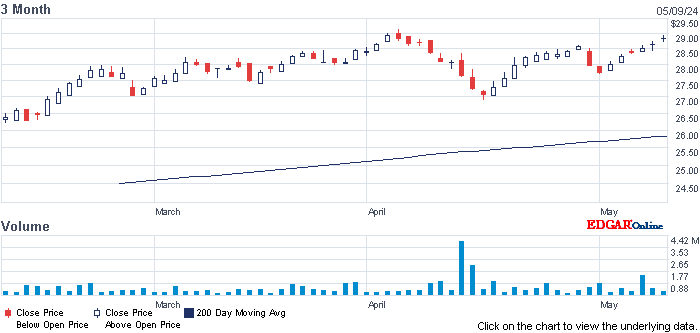
Dow surged 462, advancers over decliners an impressive 4-1 & NAZ rose 151.  The MLP index jumped up 4 to the 205s & the REIT index added 3+ to the 414s (nearing record highs).  Junk bond funds (stocks with high yields) edged higher & Treasuries were sold, bringing higher yields.  Oil was fractionally higher above 50 & gold sank 25 while stocks rallied.

AMJ (Alerian MLP Index tracking fund)
stock chart

CL=FCrude Oil50.65
+0.54+1.1%

GC=FGold   1,561.40
-21.00-1.3%


3 Stocks You Should Own Right Now - Click Here!


Pres Trump's chief economic adviser Larry Kudlow said exports in the "phase one" trade deal with China will take longer because of the coronavirus.  "It is true the 'phase one' trade deal, the export boom from that trade deal, will take longer because of the Chinese virus," Kudlow added.  "On the other hand, the North American trade deal, USMCA, is going to unlock tremendous investment ... Manufacturers will benefit."  But Kudlow was optimistic about the overall impact of the virus on the US economy.  "The U.S. economic impact is going to be minimal," Kudlow said.  "This is all iffy. There's a lot of information we don't know."  China's loss could be the US's gain, he said.  "This may spur some business investment. Equipment and inventories were very, very low, as you may know, in the last GDP report, so you may get a step up in production here in the U.S., which would be very beneficial," Kudlow continued.  Kudlow addressed fears that US manufacturers will face hurdles if they can't get the components they need from China.  "It's not across the board," he said.  "Chipmakers are not going to be affected that much. Pharmaceutical stuff will probably be affected much more. Some things kind of in the middle when you get to automobiles and auto parts, but there's a lot we don't know. It sounds like the world has stopped. The world hasn't stopped."  The coronavirus, which has sickened more than 20K & killed 425, has brought parts of China to a standstill as more than 40M have been put under lockdown.

Kudlow: Deadly outbreak will take toll on exports under phase one China deal


Stocks rallied, building on solid gains from the previous session as the market recovers from a steep sell-off that was sparked by worries over the coronavirus.  The Dow traded 450 points higher (1.6%) & the S&P 500 gained 1.4% along with the NAZ.  Stocks that have been hit by fears of the coronavirus slowing the economy bounced today.  The Dow fell 600 (2.1%) on Fri & yesterday, the average bounced back by 144 points, or 0.5%.  Today's continued bounce comes after a report said China's central bank could cut its key lending rate as well as banks' reserve requirement ratios (RRRs) in the coming weeks to support economic growth.  The report came a day after the People's Bank of China (PBOC) unveiled liquidity injection measures to the tune of more than 1T yuan.  The PBOC also injected another 400B yuan in liquidity.   Chinese stocks jumped sharply overnight after a massive slump yesterday.  The Shanghai Composite closed 1.3% higher while the Shenzhen A Shares index gained 1.8%.  Other equity indices in the region, including Hong Kong's Hang Seng & the Korean Kospi, also posted strong gains.  That positive sentiment spilled over into European equity markets.  The Stoxx 600 index gained 1.1%.  Meanwhile, the German Dax climbed 1.2%& the France CAC 40 advanced 1.3%.

Stocks rally for a second day in a row with the Dow jumping 450 points

Macy's (M) has watched its shares lose well over ½ their value in the past 5 years.  Officers of the embattled department store chain will meet with investors tomorrow at the NYSE.  During the presentation, Macy's has to prove its plans to lure shoppers are working & that it can return to growing sales & earnings.  While the dropoff in its 2019 holiday sales wasn't as bad as some had feared, it was still a decline.  And it came as Macy's has been experimenting with initiatives aimed at boosting sales, such as growing Backstage, its off-price business, & getting into resale clothing.  How much of a contribution these efforts are making isn’t clear.  Meanwhile, competitive brands are increasingly pushing to sell directly to consumers thru their own stores & websites, thereby reducing their reliance on department stores for sales.  People are making fewer & fewer trips to shopping malls, & that has hurt department stores.  The category saw sales fall 1.8% from Nov 1 thru Dec 24, according to Mastercard Spending Pulse.  And apparel sales are struggling.  Consumers are spending less money on clothes, buying fewer items & making use of secondhand, rental or subscription services.  Macy's also faces heightened competition in the home category.  Same-store sales fell 0.6% at its owned & licensed stores during Nov-Dec, which wasn’t as large of a drop as analysts had anticipated.  The stock rose 38¢.
If you would like to learn more about Macy's, click on this link:
club.ino.com/trend/analysis/stock/M?a_aid=CD3289&a_bid=6ae5b6f7

Macy’s needs to show investors it has a plan to get back to sales growth

Buyers are have returned & they are bargain hunting.  This is difficult to figure since major problems, starting with the coronavirus scare, have not gone away.  Risky stocks are aggressively being purchased & that money is coming from selling safe haven gold.  Currently, the Dow is about 500 under its recent record high.

Dow Jones Industrials


Monday, February 3, 2020

Markets pare gains as coronavirus fears linger

Dow rose 143 (but well off AM highs), advancers over decliners about 2-1 & NAZ advanced 142.  The MLP index was off 2 to the 201s & the REIT index went up 2 to the 412s.  Junk bond funds edged higher & Treasuries were sold.  Oil fell 1+ to near 50 (a more than 1 year low) & gold dropped 7 to 1580 (more on both below).

AMJ (Alerian MLP Index tracking fund)


Live 24 hours gold chart [Kitco Inc.]


3 Stocks You Should Own Right Now - Click Here!


Oil prices tumbled into bear market territory today as the spreading of the coronavirus cast a dark spell over global demand.  The move was the 2nd-fastest plunge from recent highs over the past 7 years.  Brent crude oil, the intl benchmark, fell 4% to $54.36 a barrel while West Texas Intermediate crude oil, the US benchmark, slid 2.8% to $50.11 a barrel.  Both energy components finished down more than 20% from their Jan 6 peaks, officially placing them in bear-market territory.  Brent crude oil fell by as much as 31.4% after the World Health Organization issued a global alert regarding SARS in 2003.  West Texas Intermediate crude oil lost as much as 33.3% in the wake of the SARS outbreak.  Last week, the US declared coronavirus a public health emergency, following the stance from the WHO issued earlier.  There is already some evidence the virus’s outbreak is weighing on global growth.  Last week, US crude oil inventories posted a larger than expected build of 3.5M barrels, according to the Energy Information Administration.  Analysts surveyed were anticipating inventories to increase by 300K barrels.  The possibility of the coronavirus, which has now sickened more than 17K & killed 362, having a prolonged impact on the global economy has set off alarm bells among OPEC & its allies.  Both Saudi Arabia & Russia have expressed interest in moving the Mar meeting up to Feb.  “We have discussed it with the Saudi (energy) minister several times already ... Yesterday, we spoke for an hour, today, for half an hour,” said Russian oil minister Alexander Novak.  “We are discussing it very seriously."  The OPEC+ group is considering deepening the cuts it made in Dec by another 500K barrels per day.  The group has removed a total of 1.7M bpd since Jan 2017.

Fears over deadly coronavirus outbreak sends oil into bear market


Gold futures posted their first loss in 4 sessions, with haven demand for the metal taking a hit as US equities partially bounced back from a coronavirus-triggered selloff & the $ & gov bond yields rose.  A rise in the $, gains in the Dow & the S&P 500 as gold futures settled, as well as a climb in rates for the 10-year Treasury note yield to as high as 1.574% today helped to weigh on bullion prices, which tend to weaken when the buck strengthens & stocks rally.  Gold also competes with bond rates for haven buyers, with rising yields tending to attract investors in Treasuries & away from precious metals.  Gold for Apr delivery fell $5.50 (0.4%) to settle at $1582 an ounce, following gains in the last 3 consecutive sessions.  Prices had drifted up to an intraday peak touching $1598, the highest intraday level since 2013.  Price losses for the metal had worsened in the wake of data released today that US manufacturers grew their businesses in Jan for the first time in 6 months.  The survey by the Institute for Supply Management rose to 50.9% last month to 47.8%.  The moves for bullion come after the most-active Apr contract saw a weekly climb of 0.6% & a rise of about 3.8% for the month.  The settlement level also marked the highest weekly price finish since 2013.  China's National Health Commission yesterday said cases of the novel coronavirus reached 17K, while the death toll was more than 360.  Cases also have been reported outside the country, with the World Health Organization & Trump administration last week declaring public health emergencies.  The Asian influenza has drawn comparisons to SARS, or severe acute respiratory syndrome, & is expected to hurt near-term economic expansion in China, which is considered one of the biggest buyers of precious & industrial metals.  Still, gold mostly has been a beneficiary of the recent worries tied to the Asian outbreak & its potential to hurt the global economy, if only on a short-term basis.  The People's Bank of China has injected $1.2T yuan ($173B) into local money markets, to soften the shock from the coronavirus, among several measures enacted to help curtail sharp declines in China’s main indices, including the Shanghai Composite Index Chinese markets had been closed since Jan 24 due to an extended Lunar New Year holiday.  Chinese regulators also urged banks & other financial institutions to boost lending & avoid calling in debts in areas severely affected by the pandemic.

Gold logs first loss in 4 sessions as the U.S. stock market, dollar, bond yields climb


Oil fell to its lowest level in more than a year as the coronavirus outbreak & its potential impact on demand further hammered crude prices.  US West Texas Intermediate fell 2.8% ($1.45) to settle at $50.11 per barrel.  Earlier in the session, WTI fell more than 3% to $49.92, its lowest level since Jan 2019.  Intl benchmark Brent crude dropped 3.9% ($2.21) to $54.41, hitting its lowest level since Jan 2019.  China is the world's largest oil importer & the 2nd-largest oil consumer, so a demand slowdown could have a big impact on prices.  WTI & Brent are trading in bear-market territory of at least 20% price declines from recent highs & are coming off 4 straight weeks of losses.  The energy alliance's Joint Technical Committee, a nonministerial sub group that reviews the oil market, will reportedly hold meetings Tues & Wed in Vienna to discuss options to mitigate the impact from the coronavirus outbreak.  The action could include additional production cuts.  A full OPEC meeting could take place next week.  Earlier in the session, WTI briefly turned positive after it was reported that Saudi Arabia was considering a 1M barrels per day cut in order to stimulate prices. 

Oil drops 2.8% on coronavirus fears, dips below $50 per barrel

US construction spending unexpectedly fell in Dec, posting its first drop since Jun, as investment in both private & public projects declined.  The Commerce Dept said construction spending decreased 0.2%.  Data for Nov was revised up to show construction outlays rising 0.7% instead of increasing 0.6% as previously reported.  The forecast called for construction spending gaining 0.5% in Dec.  Construction spending increased 5.0% on a year-on-year basis in Dec.  For all of 2019, construction spending fell 0.3%, the first annual decline since 2011, after rising 3.3% in 2018.  In Dec, spending on private construction projects slipped 0.1% after increasing 0.6% in Nov.  It was pulled down by a 1.8% tumble in spending on nonresidential structures, which includes manufacturing plant & mining exploration, shafts & wells, to the lowest level since Nov 2018.  Spending on nonresidential structures fell 0.5% in Nov.  The gov in its Q4 GDP report last week said spending on nonresidential structures contracted in 2019 by the most since 2016.  Outlays on private nonresidential structures have been depressed by a manufacturing downturn due to trade tensions & cheaper energy products.  Spending on homebuilding increased 1.4% after surging 1.5% in Nov.  Residential construction is being supported by lower mortgage rates.  Residential investment increased solidly in H2-2019, after contracting for 6 straight qtrs, the longest such stretch since the recession.  Investment in public construction projects dropped 0.4% in Dec after rebounding 1.0% in Nov.   Spending on state & local gov construction projects fell 0.6% after rising 0.9% in Nov.  Outlays on federal gov construction projects surged 2.1% in Dec to the highest level since Dec 2012.  That followed a 1.7% advance in Nov.

This was hardly a convincing rally.  While finishing higher on the day, the Dow was more than 200 below sessions's highs in early trading.  The coronavirus has created substantial problems & there seems to be no quick fix.  The 1 year chart below shows the Dow has fallen 1000 from its Jan peak.

Dow Jones Industrials


Markets rebound after Friday's selloff

Dow jumped up 345, advancers over decliners better than 3-1 & NAZ rose an impressive 145.  The MLP index was slightly lower to the 203s & the REIT index rose 3+ to the 413s.  Junk bond funds crawled higher & Treasuries were sold while stock were purchased.  Oil slid lower in the 51s & gold was off 11 to 1576.

AMJ (Alerian MLP Index tracking fund)

stock chart

CL=FCrude Oil51.23
-0.33-0.6%

GC=FGold   1,580.20
-7.70-0.5%


3 Stocks You Should Own Right Now - Click Here!


US equity markets were higher, shrugging off the nearly 8% plunge in China's Shanghai Composite, which had been closed since Jan 22 for the Lunar New Year holiday.  The early gains have the major averages on track to win back some of the big losses that occurred Fri as the number of confirmed cases of coronavirus surged.  The coronavirus outbreak has now sickened more than 17K & killed 361, according to the latest figures released by China's National Health Commission.  In response to the outbreak, the People's Bank of China announced plans to inject 1.2T Chinese yuan ($173B) into the system to cushion its blow to the economy.  Mon was the first day of trading for Chinese markets, which have been closed since Jan 22.  West Texas Intermediate crude oil was little changed near $51.60 a barrel & gold was lower by 0.4% at $1582 an ounce.  Treasuriss fell, running the yield on the 10-year note up 2.5 basis points to 1.544%.  In Europe, Britain's FTSE was trading down 0.9% in its first day of trading following Brexit while Germany's DAX & France's CAC added 0.3% & 0.4%, respectively.  Markets across Asia finished mixed despite the Shanghai Composite's plunge.  Hong Kong's Hang Seng edged up 0.2% while Japan's Nikkei fell 1% .

US stocks rebound, Chinese markets plunge as coronavirus outbreak spreads


British Prime Minister Boris Johnson is setting out a tough opening gambit in negotiations with the EU, saying the UK will walk away without a free-trade deal rather than agree to follow rules set by the 27-nation bloc.  Just 60 hours after Britain left the EU, the first country ever to do so, Johnson is digging in his heels about future relations.  In a speech to business leaders & intl diplomats in London, Johnson plans to say “we want a free trade agreement,” but not at any cost.  “The choice is emphatically not ‘deal or no-deal,’” Johnson plans to say.  “The question is whether we agree a trading relationship with the EU comparable to Canada’s – or more like Australia’s.”  Australian-style trade would mean a panoply of new tariffs & other barriers between the UK & the EU, its near neighbor & biggest trading partner.  In their divorce agreement, Britain & the EU agreed to strike an “ambitious, broad, deep & flexible partnership,” including a free trade deal & agreements for security & other areas.  They gave themselves 11 months to do it.  A post-Brexit “transition period,” in which relations stay essentially unchanged, runs until the end of 2020.  For the rest of this year the UK will continue to follow EU rules, although it will no longer have a say in EU decision-making.  Britain says it wants a “Canada-style” free trade agreement with the EU covering both goods & services.  But it is adamant it won't agree to follow the EU's entire rule book in return for unfettered trade, because it wants to be free to diverge in order to strike other new deals around the world.  The bloc insists there can be no trade deal unless Britain agrees to a “level playing field” & does not undercut EU regulations, especially in areas of environmental protections, worker rights & health and safety standards.  Johnson intends to double down on Britain's tough stance.  “There is no need for a free trade agreement to involve accepting EU rules on competition policy, subsidies, social protection, the environment, or anything similar, any more than the EU should be obliged to accept U.K. rules,” he will say.  “The U.K. will maintain the highest standards in these areas — better, in many respects, than those of the EU -– without the compulsion of a treaty. And it is vital to stress this now.”  It’s a message aimed as much at a domestic audience as it is at the bloc, but EU leaders are unlikely to be impressed by what they'll see as British intransigence & wishful thinking.

'We want free trade': UK's Johnson talks tough over post-Brexit trade with EU


China's central bank said it will inject 1.2T yuan ($174B) worth of liquidity into the markets via reverse repo operations today as its stock markets prepare to reopen amid an outbreak of a new coronavirus.  Chinese authorities have pledged to use various monetary policy tools to ensure liquidity remains reasonably ample & to support firms affected by the virus epidemic, which has so far claimed 305 lives, all but one in China.  The People's Bank of China made the announcement yesterday, adding the total liquidity in the banking system will be 900B yuan higher than the same period in 2019 after the injection.  Calculations based on official central bank data, 1.05T yuan worth of reverse repos are set to mature today, meaning that 150B yuan in net cash will be injected.  Investors are bracing for a volatile session in Chinese markets when onshore trades resume after a break for the Lunar New Year which was extended by the gov.  There will be no further delays to the reopening, the securities market regulator said.  The China Securities Regulatory Commission (CSRC) said it had taken the decision after balancing various factors & believed the outbreak's impact on the market would be short term.  To support firms affected by the epidemic, the CSRC said companies that had expiring stock pledge agreements could apply for extensions with securities firms & it would urge corp bond investors to extend the maturity dates of debt.  The CSRC is also considering launching hedging tools for the A-share market to help alleviate market panic & will suspend evening sessions of futures trading starting from Mon.  "We believe that the successive introduction and implementation of policy measures will play a better role in improving market expectations and preventing irrational behavior,'' it told the People's Daily.  China is facing mounting isolation as other countries introduce travel curbs, airlines suspend flights and governments evacuate their citizens, risking worsening a slowdown in the world's 2nd-largest economy.  State news agency Xinhua said that China's economy was resilient enough to counter the shock caused by the virus & said remarks made by a US federal official - whom it did not name - that the virus could bring jobs back to the US were "self-centered, unprofessional & unethical.''  Secretary of Commerce Wilbur Ross said last week that the virus could force companies to re-evaluate their supply chains, potentially returning some jobs to the US.

China to juice markets with liquidity to fight coronavirus downturn


US factory activity unexpectedly rebounded in Jan after contracting for 5 straight months amid a surge in new orders, offering hope that a prolonged slump in business investment has probably bottomed out.  The Institute for Supply Management (ISM) said its index of national factory activity increased to a reading of 50.9 last month, the highest level since Jul, from an upwardly revised 47.8 in Dec.  A reading above 50 indicates expansion in the manufacturing sector, which accounts for 11% of the economy.  The ISM index had held below the 50 threshold for 5 straight months. The forecast called for the index rising to 48.5 in Jan from the previously reported 47.2 in Dec.  The improvement in the ISM data likely reflects ebbing trade tensions between the US & China.  The ISM's forward-looking new orders sub-index jumped to a reading of 52.0 last month, the highest since May, from a revised 47.6 in Dec.  Manufacturers also reported paying more for raw materials & other inputs.  The measure of prices paid hit its highest level in 10 months, suggesting some building up of inflation pressures at the factory level.  The factory employment index rose to 46.6 last month from a revised reading of 45.2 in Dec, suggesting manufacturing payrolls could remain weak.  Factory employment increased by 46K jobs in 2019 after rising 264K in 2018.  The improvement in ISM's closely watched national survey follows a series of mixed readings on the manufacturing sector at the regional level.  A purchasing manager survey tracking the Chicago region slumped to a 4-year low in Jan & manufacturing indexes from the Federal Reserve banks of Richmond & Dallas continued to show contraction in those districts.  But factory activity in areas tracked by the Philadelphia & Richmond Feds both showed significant improvement in Jan, tracking more closely with ISM's findings.

US manufacturing activity rebounds in January

The bulls have returned in force, bidding higher stock prices. Today the Volatility Index (VIX) is down a big 1½ to the low 17s .  That's in the lower end of its recent range & not far above the mid teens where it was during high points for stock averages.  Risk is low & welcomed by investors, at least for the time being.

Dow Jones Industrials