Dow gave up 4, advancers over decliners better than 3-2 & NAZ added 13. The MLP index rebounded 3+ to the 305s & the REIT index lost 1 to 340. Junk bond funds were a little higher & Treasuries were weak. Oil went up to the high 49s & gold hardly changed.
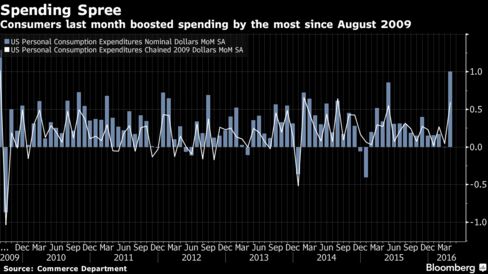
Consumer spending climbed in Apr by the most in almost 7 years,
a sign US households are ready to help jump start growth after a Q1 slowdown. Consumer purchases climbed 1% (versus a 0.7% forecast) after little change in Mar. Increase in spending was the biggest since Aug 2009. Personal income climbed 0.4% for a 2nd month. Fed's
preferred measure of inflation (tied to consumer spending) climbed 0.3% from month before, the biggest May 2015 (1.1% from year
before).
Households
will need to do the heavy lifting if a growth rebound is to materialize
this quarter as global demand & corp investment remain sluggish.
Continued increases in payrolls & a gradual pickup in wages should
help give consumers the means & the willingness to spend.
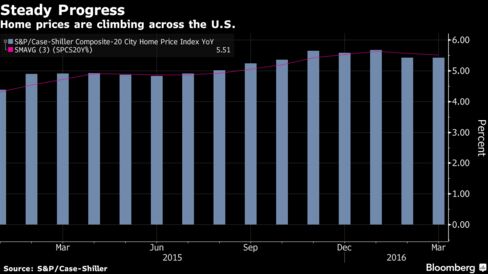
Home prices in 20 US cities rose faster than projected in Mar
from a year earlier, adding to signs of healthy demand at the onset of
the industry's busy selling season, reported by S&P/Case-Shiller. 20-city property values
index increased 5.4% from Mar 2015 (forecast was 5.16%)
after climbing 5.4% in the year thru Feb. National home-price gauge rose 5.2% from 12 months earlier. On
a monthly basis, seasonally adjusted 20-city measure advanced 0.9% from Feb, the same as the unadjusted gain (the most in 4 months). The Mar home-price gains
follow a round of more timely data that showed purchases of existing &
new homes & contract signings on previously owned houses all
strengthened more than expected in Apr after the economys sluggish
start to the year. Potential buyers still might be challenged by limited
inventories, especially among lower-priced homes, while finding support
from steady job gains & cheap borrowing costs.
“The
economy is supporting the price increases with improving labor markets,
falling unemployment rates and extremely low mortgage rates,” David
Blitzer, chairman of the S&P index committee, said.
“Another factor behind rising home prices is the limited supply of homes
on the market.
A gauge of US consumer confidence slipped in May, a sign of continued
caution that could restrain household spending & broader economic
growth. The Conference Board consumer-confidence index fell
to 92.6 from an upwardly revised 94.7 in Apr. It was the 2nd consecutive monthly decline. Economists had expected a May reading of 96.0. "Consumer confidence declined slightly in May, primarily due to
consumers rating current conditions less favorably than in April," said
Lynn Franco, the group's director of economic indicators. "Expectations declined further, as consumers remain cautious about the outlook for business and labor market conditions."
Stocks are marking time after uninspiring economic data. The thought of higher interest rates in a couple of weeks is a drag on thinking for stock buyers. Month end data will be coming during the rest of the week.
Dow gained 33, advancers over decliners almost 2-1 & NAZ rose 20. The MLP index was up fractionally in the 301s & the REIT index added 1+ to go over 340. Junk bond funds were a little higher & Treasuries pulled back. Oil fell below 49 on profit taking (see below) & gold declined, getting close to the important 1200 floor.
The US economy expanded at a slightly faster pace in Q1 than previously estimated, reflecting less damage from trade &
inventories. GDP rose at a 0.8 % annualized rate, the smallest gain in a year, according to the Commerce
Dept. That compares with the 0.5%
advance reported last month. The figures do little to alter views of the 3rd consecutive
sluggish start to the year, & could portend a tougher slog in Q2 as businesses work to continue to pare stockpiles. At the
same time, household income gains were stronger than previously
reported as the labor market strengthened, which will help support
consumer spending. The forecast called for a 0.9%
gain. After-tax personal income adjusted for inflation
climbed at a 4% annualized rate in Q1, revised up
from a prior estimate of 2.9%. The saving rate was also pushed
up to 5.7%, the highest since Q4-2012, from
5.2%.The figures also offered a first look at corp profits.
Before-tax earnings rose 0.3% from the prior qtr, but were
down 5.8% from the same time last year. Total income in the economy, which combines all forms of earnings,
increased at a 2.2% annualized rate, the most since Household purchases, which account for almost 70% of the
economy, grew at a 1.9% annualized rate, the same as initially
estimated.
Consumer confidence in the US climbed less than forecast in May as
Americans were a little less ebullient about the economy's prospects in
the run up to the presidential election, the University of Michigan’s
report showed. Final index rose to 94.7 (estimate 95.4) from 89 in Apr, down from May preliminary reading of 95.8. Current
conditions index, which takes stock of Americans' view of their
personal finances, climbed to 109.9, the highest since Jan 2007,
from 106.7. Measure of expectations 6 months from now advanced to 84.9 from 77.6 in Apr. Consumers expect year-ahead inflation rate of 2.4%, lowest since Sep 2010 & down from 2.8% in Apr survey. Consumers
see inflation over next 5-10 years at 2.5% rate, same as
in Apr, matching the record lows in data going back almost 5 decades. Household
purchasing power is getting a boost as more Americans than at any time
in the last 10 years said they expect their finances to improve over the
next 12 months. That would help consumer spending, the biggest part of
the economy. At the same time, as the election campaign heats up,
concerns are mounting about how the US may fare once a new pres
is elected. “The
late month falloff was due to a slightly less favorable outlook for the
overall economy,” Richard Curtin, director of the University of
Michigan consumer survey, said. Households’ biggest
uncertainty, said Curtin, was “the outlook for future government
economic policies under a new president. This has increased their
emphasis on maintaining precautionary savings.”
Oil fell below $49, moving further away from a 7-month high hit a day earlier, with analysts predicting range-bound
markets for the next few months as supply outages slowly help to clear a
glut of crude. Prices also came under pressure from a strong $, buoyed
by generally positive US economic data amid growing expectations of a
near-term increase in interest rates. Oil pushed through $50 for the first time in about 7 months yesterday after supply disruptions from Canadian wildfires &
militant attacks in Nigeria helped cut global daily output by 4M
barrels.
Revised GDP for Q1 brought out a few stock buyers, but their enthusiasm was subdued by continued weak data. Chances are that thoughts about the Jun meeting for the Fed has more to do with price movements in stocks. With buyers winning out today, they are praying for the FOMC to postpone a rate hike at least one more time (tomorrow will take care of itself).




 ...0.21


