Dow fell 60, decliners over advancers 3-2 & NAZ was off 8. The MLP index went down 1+ to the 247s & the REIT index added 1+ to the 366s. Junk bond funds slid lower & Treasuries were also lower. Oil crawled higher in the 56s & gold lost another 4 to 1283 (its 7th straight day of declines).
AMJ (Alerian MLP Index tracking fund
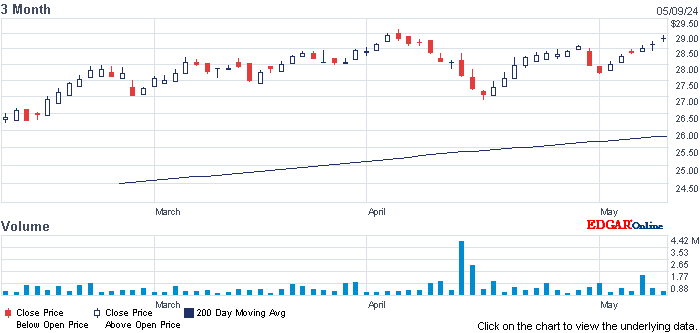








Stocks trade mixed following Monday's selling
A $5.7T borrowing binge by US companies could make a slowdown in the world's biggest economy even more painful and is one more reason the Federal Reserve was wise to put interest rate hikes on hold, Robert Kaplan, pres of the Dallas Fed, said. "It's something that I'm aware of, which sort of reinforces for me why I feel we should be taking no action for some period of time," Kaplan said ahead of the publication of an analysis of US corp debt. Companies with big debt loads may be more likely to cut spending & hiring in a downturn, "and the danger is that with a sufficient enough slowing, you'll have a greater deterioration in credit quality than you would otherwise, which could in turn amplify the slowdown," Kaplan added. He said that is "yet another reason why I think we are wise -- inflation is not running away from us -- I think we are wise to take a very patient approach." The Fed in Jan put 3 years of rate hikes on hold, citing weakening global growth & an expectation for slower US growth ahead as it said it would be "patient" before making any further moves. Companies gorged for years on cheap debt made possible by the Fed's near-zero interest rates after the financial crisis. With America's corp debt load now equating to a record 46% of GDP, a growing number of bankers & investors have urged the Fed to pay more attention. It appears now that it is. Though Fed Chair Jerome Powell told Congress last week he does not view leveraged loans & other forms of risky debt to be big threats to financial stability, he does believe high corp indebtedness could make any US downturn worse. Kaplan's essay added meat to that argument. "Vigilance is warranted as these issues have the potential to impact corporate investment and spending plans," Kaplan said. Central bankers have had extended discussions about corp America's rising debt load, Kaplan added. And while he is not clanging the alarm bells over it, he said, "Is it a concerning factor that, along with other factors needs to be taken into account? Yes."
Sales of new US single-family homes rose to a 7-month high in Dec, but Nov''s outsized jump was revised lower, pointing to continued weakness in the housing market. The Commerce Dept said new home sales increased 3.7% to a seasonally adjusted annual rate of 621K units, the highest level since May 2018. Nov's sales pace was revised down to 599K units from the previously reported 657K units. The forecast called for new home sales, which account for about 11.2% of housing market sales, falling 8.7% to a pace of 600K units in Dec. New home sales are drawn from permits & tend to be volatile on a month-to-month basis. They fell 2.4% from a year ago while single-family home sales rose 1.5% in 2018. The housing market hit a soft patch last year amid higher mortgage rates, expensive lumber as well as land & labor shortages, which led to tight inventories & less affordable homes. Reports last month showed homebuilding dropping to more than a 2-year trough in Dec & home resales in Jan hitting their lowest level since Nov 2015. Though house price inflation has slowed & mortgage rates are hovering at 12-month lows, the housing market is expected to remain weak for a while because of persistent land & labor shortages. Investment in homebuilding contracted 0.2% in 2018, the weakest performance since 2010. New home sales in the South, which accounts for the bulk of transactions, increased 5.0% to a 7-month high in Dec. Sales rose 1.4% in the West & jumped 44.8% in the Northeast. But they fell 15.3% in the Midwest to their lowest level since Apr 2016. The median new house price fell 7.2% to $318K in Dec from a year ago. There were 344K new homes on the market in Dec, the most since 2008 & up 3.0% from Nov. Supply is, however, just over ½ of what it was at the peak of the housing market boom in 2006. At the Dec sales pace, it would take 6.6 months to clear the supply of houses on the market, down from 6.7 months in Nov. Just under 2/3 of the houses sold last month were either under construction or yet to be built.
New home sales rise to 7-month high in December
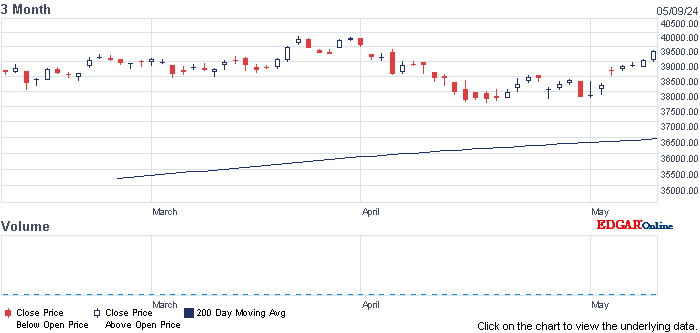
Today is starting as a quiet day for stocks. China trade talks are getting the most attention & there is little new to report. The Dow is back to where it was in mid Feb. The 2019 market advance has stalled.
Dow Jones Industrials






AMJ (Alerian MLP Index tracking fund
| CL=F | Crude Oil | 56.72 | +0.13 | +0.2% |
| GC=F | Gold | 1,287.00 | -0.50 | -0.0% |
Stocks traded in a tight range, a day after stocks retreated following weak economic data. This will be a busy week for retail earnings. In Asian market trading, China's
Shanghai composite gained 0.9%, Hong Kong's Hang Seng finished
unchanged & Japan's Nikkei fell 0.4%. In Europe, London's FTSE added 0.4%, Germany's DAX slipped 0.3% & France's CAC also added 0.3%. At the end of the week, the gov will release the biggest report of them all, the monthly jobs report on Fri.
Stocks trade mixed following Monday's selling
Optimism among US manufacturers remains high despite continued workforce concerns brought on by the tight labor markets, rising health care costs & the state of the nation's infrastructures, according to a quarterly survey by the industry's top trade group. The report by the National Association of Manufacturers (NAM) comes as fears of a potential economic recession in 2019 subside among some experts.
Nearly 90% of manufacturers have a positive outlook for their
business, up from 69% in 2016 but down year-over-year, according
to NAM's recent survey of 14K companies. It is the 9th
straight quarter of record optimism. “Manufacturing
in the United States is on the rise, and manufacturers are confident
about the future,” said CEO Jay Timmons. “We have to get serious about
infrastructure investment and attracting, recruiting and training our
people for the high-tech, high-paying modern manufacturing jobs.” Alongside
the study, VP Mike Pence is also slated to address the
group's board today. Former
Ambassador to the United Nations Nikki Haley, spoke at the retreat on yesterday. Over 77% of respondents cited the US
infrastructure system as a top concern, while 72% also listed
attracting & keeping a talented workforce. Nearly 57% of
respondents said rising health care costs was a primary challenge &
roughly 53% also listed global trade tensions. Sales
are expected to grow 4.4% in the next 12 months, up slightly
from the Q4-2018 survey, while full-time employment is
slated to rise 2.1% & wages are poised to increase 2.3%
in 2019. In the same time frame, respondents
said prices could rise as much as 2.4% as raw material costs
increase 3.3%, a decrease from the Dec report. While
the industry says it has benefited from the GOP-led tax law &
deregulatory efforts by the White House, manufacturers of all stripes
are suffering from added costs due to Pres's tariffs on steel & aluminum imports, as well as the duties on $250B in Chinese
imports.
Manufacturer optimism high despite concerns over health care costs, trade
A $5.7T borrowing binge by US companies could make a slowdown in the world's biggest economy even more painful and is one more reason the Federal Reserve was wise to put interest rate hikes on hold, Robert Kaplan, pres of the Dallas Fed, said. "It's something that I'm aware of, which sort of reinforces for me why I feel we should be taking no action for some period of time," Kaplan said ahead of the publication of an analysis of US corp debt. Companies with big debt loads may be more likely to cut spending & hiring in a downturn, "and the danger is that with a sufficient enough slowing, you'll have a greater deterioration in credit quality than you would otherwise, which could in turn amplify the slowdown," Kaplan added. He said that is "yet another reason why I think we are wise -- inflation is not running away from us -- I think we are wise to take a very patient approach." The Fed in Jan put 3 years of rate hikes on hold, citing weakening global growth & an expectation for slower US growth ahead as it said it would be "patient" before making any further moves. Companies gorged for years on cheap debt made possible by the Fed's near-zero interest rates after the financial crisis. With America's corp debt load now equating to a record 46% of GDP, a growing number of bankers & investors have urged the Fed to pay more attention. It appears now that it is. Though Fed Chair Jerome Powell told Congress last week he does not view leveraged loans & other forms of risky debt to be big threats to financial stability, he does believe high corp indebtedness could make any US downturn worse. Kaplan's essay added meat to that argument. "Vigilance is warranted as these issues have the potential to impact corporate investment and spending plans," Kaplan said. Central bankers have had extended discussions about corp America's rising debt load, Kaplan added. And while he is not clanging the alarm bells over it, he said, "Is it a concerning factor that, along with other factors needs to be taken into account? Yes."
Fed's Kaplan says US corporate debt a reason for rate hike pause
Sales of new US single-family homes rose to a 7-month high in Dec, but Nov''s outsized jump was revised lower, pointing to continued weakness in the housing market. The Commerce Dept said new home sales increased 3.7% to a seasonally adjusted annual rate of 621K units, the highest level since May 2018. Nov's sales pace was revised down to 599K units from the previously reported 657K units. The forecast called for new home sales, which account for about 11.2% of housing market sales, falling 8.7% to a pace of 600K units in Dec. New home sales are drawn from permits & tend to be volatile on a month-to-month basis. They fell 2.4% from a year ago while single-family home sales rose 1.5% in 2018. The housing market hit a soft patch last year amid higher mortgage rates, expensive lumber as well as land & labor shortages, which led to tight inventories & less affordable homes. Reports last month showed homebuilding dropping to more than a 2-year trough in Dec & home resales in Jan hitting their lowest level since Nov 2015. Though house price inflation has slowed & mortgage rates are hovering at 12-month lows, the housing market is expected to remain weak for a while because of persistent land & labor shortages. Investment in homebuilding contracted 0.2% in 2018, the weakest performance since 2010. New home sales in the South, which accounts for the bulk of transactions, increased 5.0% to a 7-month high in Dec. Sales rose 1.4% in the West & jumped 44.8% in the Northeast. But they fell 15.3% in the Midwest to their lowest level since Apr 2016. The median new house price fell 7.2% to $318K in Dec from a year ago. There were 344K new homes on the market in Dec, the most since 2008 & up 3.0% from Nov. Supply is, however, just over ½ of what it was at the peak of the housing market boom in 2006. At the Dec sales pace, it would take 6.6 months to clear the supply of houses on the market, down from 6.7 months in Nov. Just under 2/3 of the houses sold last month were either under construction or yet to be built.
New home sales rise to 7-month high in December
Today is starting as a quiet day for stocks. China trade talks are getting the most attention & there is little new to report. The Dow is back to where it was in mid Feb. The 2019 market advance has stalled.
Dow Jones Industrials


![Live 24 hours gold chart [Kitco Inc.]](https://www.kitco.com/images/live/gold.gif?0.2180338269244485)