Friday, August 2, 2019

Markets decline as US-China trade war heats up

Dow sank 315, decliners over advancers  about 3-1 & NAZ tumbled 155.  The MLP index fell 2+ to the 241s & the REIT index went up 1+ to 390.  Junk bond funds slid lower & Treasuries remained in demand.  Oil rebounded 1+ to the 55s & gold jumped up 26 to 1459 (a 6 year high).

AMJ (Alerian MLP Index tracking fund)

CL=FCrude Oil55.60
 +1.65 +3.1%

GC=FGold   1,451.10
+18.70+1.3%


3 Stocks You Should Own Right Now - Click Here!


Stocks added to declines after Pres Trump's announcement that additional tariffs will be put on Chinese goods.  The Dow was down more than 200.  Investors are also dissecting the Jul jobs report which showed 164K nonfarm jobs were created in July, in line with expectations.  The unemployment rate held steady at 3.7%.  Trump ratcheted things up yesterday with a surprise announcement of 10% tariffs on $300B of Chinese imports, effective Sep 1. That sent stocks plunging with the Dow ending down 280.  The tit-for-tat trade war continues as China has threatened to retaliate if Pres Trump's planned tariff hikes go ahead.  Trump's announcement surprised investors after the White House said Beijing promised to buy more farm goods.  It came as their latest trade talks ended in Shanghai with no sign of a deal.  The next round of trade talks between the US & China are scheduled for Sep.  The news roiled Asian markets, China's Shanghai fell 1.4%, Hong Kong's Hang Seng dropped more than 2% & Japan's Nikkei hit a 6-week low with a loss of  2.1%.  In Europe, London's FTSE was down 2.2%, Germany's DAX dropped 2.8% & France's CAC lost 3.1%.  The tariff news also led to an 8% drop in oil.  US crude was trading another 3% lower today.

Stocks pressured by US-China trade tensions

US employers added 164K jobs in Jul, in line with expectations — a fairly unnoteworthy number, but evidence that the record-long economic expansion is continuing to chug along at a healthy pace.  The unemployment rate remained steady at 3.7%, near a 50-year-low, while the labor force participation rate was also little unchanged at 63%.  Average hourly earnings, meanwhile, rose by 8¢ to $27.98.  Over the year, average hourly earnings have increased by 3.2%, slightly beating expectations of 3.1% growth but continuing to disappoint.  For an economy with historically low unemployment, wage growth continues to fall short of expectations.  It's not a new development for the US economy, however:  Since 1979, productivity has risen 6 times faster than hourly compensation for the typical US worker.  Plus, analysts caution that the greatest salary gains are going to already high-earning employees.  The number of positions the US added in Jun dropped to 193K, down from a previously reported 224K, according to revised data from the Bureau of Labor Statistics.  Today's report comes after strong private sector growth in Jul, with employers adding a solid 219K jobs.  Investors who wanted to see cause for a 2nd interest rate cut by the Federal Reserve will likely be disappointed by the middle-of-the-road report.  Although Fed Chair Jerome Powell said it was not the start of a “long series of rate cuts,” he also noted, “I didn’t say it was just one, or anything like that.”  Policymakers, Powell said, will continue to monitor the economic outlook to determine whether a rate cut is warranted at the Fed’s September meeting.  "The issue is more the downside risks and the shortfall in inflation," Powell added.  "We’re trying to address those. In addition, going forward, I would say, we’re going to be monitoring those same things, the evolution of trade uncertainty, of global growth and of low inflation. We’ll also, of course, be watching the performance of the U.S. economy ... We’ll be putting all of those together, and that’s how we’ll be thinking of policy going forward."

US job growth remains steady in July with 164,000 added


The tit-for-tat trade war continues as China has threatened to retaliate if Pres Trump's planned tariff hikes go ahead.  Trump ratcheted things up yesterday with the announcement of 10% tariffs on $300B of Chinese imports, effective Sep 1.  Trump's announcement surprised investors after the White House said Beijing promised to buy more farm goods.  It came as their latest trade talks ended in Shanghai with no sign of a deal.  The news sent US stock markets into a reversal, plunging before trading ended for the day.  The next round of trade talks between the US & China are scheduled for Sep & would be extended to everything the US buys from China.  China's gov accused Trump of violating his Jun agreement with Pres Xi Jinping to revive negotiations aimed at ending a costly fight over Beijing's trade surplus & technology ambitions.   If that goes ahead, "China will have to take necessary countermeasures to resolutely defend its core interests," said a foreign ministry spokeswoman, Hua Chuying.  The US & Beijing are locked in a battle over complaints China steals or pressures companies to hand over technology.  The Trump administration worries American industrial leadership might be threatened by Chinese plans for gov-led creation of global competitors in robotics & other technologies.  Europe & Japan echo US complaints those plans violate Beijing's market-opening commitments.  TYhe US earlier imposed 25%  tariffs on $250B in Chinese products & Beijing has retaliated by raising import duties on $110B of US goods.

China threatens retaliation for Trump's planned tariff hike

Pres Trump stood fast by his decision to implement 10% tariffs on an additional $300B worth of goods coming into the US from China, saying the pain will continue for Beijing until an agreement is struck.  “Until such time as there is a deal, we will be taxing the hell out of China,” Trump said.  The US announced the latest round of tariffs as negotiations have stalled as US representatives returned home from meeting with the delegation in Shanghai.  Trump said earlier that China decided to renegotiate the deal before signing, & had agreed to buy more agricultural products from the US – but has yet to follow thru on that promise.  And 10% could just be the beginning, Trump warned.  He said that he could "always do much more" or he could "do less" with respect to tariffs, depending on what happens with the trade negotiations.  He added the 10% rate could be lifted in stages to "well beyond 25 percent," though his administration is not necessarily looking to do   In reaction to the tariffs, Chinese sources said that the directive in Beijing is to “decouple” from its reliance on the US economy.  When it comes to intellectual property, US representatives were told that they would have to trust that China would honor its promise to protect it – but the US wants an enforceable deal.  Trump also said that because China devalues their currency & “pours money into their system,” Americans aren't paying for the tariffs; the Chinese are instead.  The pres has noted that this round of tariffs could hit large US corps.  He told companies yesterday to make their products in the US if they don't want to be impacted.  Trump sounded an optimistic note about trade discussions earlier in the day, classifying the dialogue as "positive" & the future as "very bright."  The White House said negotiations will continue in DC next month.

Trump: 'We will be taxing the hell out of China' until a trade deal is reached

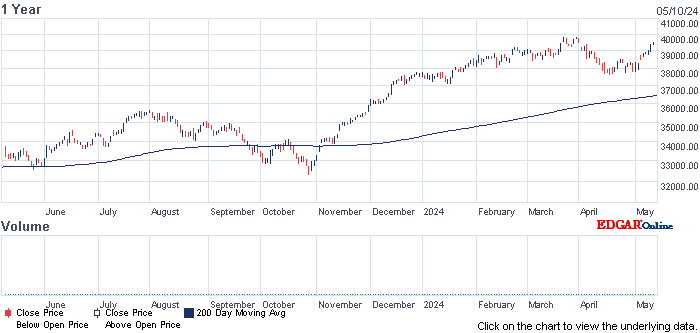
Tariff wars are driving buyers away from stocks.  The Dow opened lower & continue to drop.  Now it's 1K below the record reached in mid Jul.  The outlook is dreary.  Good news on the tariff war looks far, far away & then there's the uncertainty about the Fed's next move on interest rates.  Gold is at its highest since 2013.  Aug is shaping up to be a dreary month.

Dow Jones Industrials


Thursday, August 1, 2019

Markets tumble after Trump announces new tariffs on China trade

Dow sank 280 (500 below session highs), decliners over advancers better than 3-2 & NAZ lost 64.  The MLP index dropped 3+ to the 244s & the REIT index was flattish at 389.  Junk bond funds hardly changed in price & Treasuries skyrocketed in price, taking the yield on the 10 year Treasury below 1.9% (more below).  Oil plunged 4+ to the 54s on the tariff news (more below) & gold soared 16 to 1454.

AMJ (Alerian MLP Index tracking fund)


Live 24 hours gold chart [Kitco Inc.]


3 Stocks You Should Own Right Now - Click Here!


The US gov is prepared to implement tariffs on another $300B worth of goods from China as negotiations between the 2 largest economies sputter.  Pres Trump took to Twitter to announce the new round of 10%  tariffs, after US representatives returned home from meeting with the delegation in Shanghai.  The pres said China decided to renegotiate the deal before signing, & had agreed to buy more agricultural products from the US– but has not yet done so.  The Dept of Agriculture confirmed a small sale of soybeans to China, the first in more than a year.  Pres Xi Jinping promised to ramp up larger-scale purchases during the G-20 summit in Japan to help advance trade talks.  Trump sounded an optimistic note, classifying the dialogue as "positive" & the future as "very bright."  The White House said negotiations will continue in DC next month.  The US has already implemented 25% tariffs on $250B worth of Chinese goods.  The new round of tariffs is expected to take effect on Sep 1.  The pres has noted that this round of tariffs could hit large US corps is expected that Trade Representative Robert Lighthizer will come up with a list of items that will be subject to the tariffs.

TRUMP ANNOUNCES CHINA TARIFFS ON REMAINING $300B WORTH OF GOODS


The Senate approved a 2-year budget deal that set new spending limits & suspended limits on The US's borrowing capabilities.  The massive, bipartisan legislation passed the Rep-controlled Senate by a margin of 67-28 & will now go to Pres Trump's desk for his signature.  Altogether, the bill increases discretionary spending limits by nearly $324B over the next 2 years & raises the debt ceiling well beyond the 2020 presidential election.  It allocates about $1.37T in funding for the first year, with $738B for defense spending & $632B in non-defense spending.  "Given the exigencies of divided government, we knew that any bipartisan agreement on funding levels would not appear perfect to either side. But the administration negotiated a strong deal, ” Senate Majority Leader Mitch McConnell said.  Although some conservative Reps worried the package was too expensive — FreedomWorks, a conservative policy group, called the budget deal a "disgrace" — Trump urged them to pass it ahead of the vote.  "There is always plenty of time to CUT!" he wrote.  The conservative House Freedom Caucus took an official position opposing the budget deal.  The US was expected to hit the debt ceiling in early Sep, so establishing an agreement on spending levels could help Congress avert another gov shutdown — lawmakers still need to pass individual spending bills to avoid an Oct 1 shutdown, but the spending deal could help reduce the chances of that.

Senate passes two-year budget deal, sending bill to Trump's desk


Crude oil plunged on concerns the global economy would weaken further after Pres Trump ended a tariff ceasefire with China.  The pres said additional tariffs of 10% on the remaining $300B in Chinese goods would be added in Sep.  Futures for WTI crude dropped 7.9% to $53.95, breaking a 5-day winning streak - its worst daily performance in more than 4 years.  Brent crude, the intl benchmark, also fell more than 6% to $60.67 following Trump's tweets.  “Trade talks are continuing, and during the talks the U.S. will start, on September 1st, putting a small additional Tariff of 10% on the remaining 300 Billion Dollars of goods and products coming from China into our Country...We look forward to continuing our positive dialogue with China on a comprehensive Trade Deal, and feel that the future between our two countries will be a very bright one!” Trump tweeted.  Although the trade war with China has been going on for over a year, in May, Pres Trump hiked tariffs to 25% from 10% on $250B in Chinese goods.  China immediately retaliated with tariffs on US goods.  Trade talks resumed this week in Shanghai & although the White House called the talks “constructive”  Trump added “sadly, China decided to re-negotiate the deal prior to signing” which caused him to impose new tariffs.  Earlier today, oil was down because the Federal Reserve dampened hopes for a string of interest rate cuts.  The Fed lowered interest rates 25 basis points yesterday but did not signal it was entering a deep easing cycle. 

Oil plunges the most in 4 years after Trump’s new China tariffs raise fears of a global slowdown

The yield on the benchmark 10-year Treasury note fell to its lowest level since 2016 after Pres Trump announced new tariffs on Chinese goods.  The pres said that 10% duties will be imposed on $300B worth of Chinese goods, effective Sep 1.  His tweets came after a US delegation met with Chinese trade officials earlier this week.  Around 2:30 PM, the yield on the benchmark 10-year Treasury note had fallen approximately 15 basis points to 1.878%, its lowest level since Nov 2016.  The yield on the 30-year Treasury bond, which clinched its lowest level since Oct 2016, last traded at 2.428%.  It hit a low of 2.422% earlier in the session.  Yields were also under pressure after the Fed in the prior session cut interest rates for the first time since 2008.  In approving the cut, the FOMC pointed to “implications of global developments for the economic outlook as well as muted inflation pressures.”  It also characterized economic growth as “moderate” & the labor market “strong,” but eased policy regardless.  The 2-year Treasury note yield, more representative of changes to Fed policy, fell 16 basis points to 1.72%, off an earlier low of 1.694%, its lowest since Nov 2017.  The policymaking committee made explicit reference to inflation, a threat to bonds as rising prices chip away at the real value of their fixed payments.

10-year Treasury yield dives to lowest level since 2016 after Trump announces new China tariffs

China's manufacturing activity contracted in Jul, according to results of a private survey.  The Caixin/Markit factory Purchasing Managers’ Index (PMI) was 49.9 in Jul — slightly better than expected, but still in contractionary territory.  The forecast was for the indicator to come in at 49.6.  The reading for Jun was 49.4.  PMI readings above 50 indicate expansion, while those below that signal contraction.  Data from the Chinese statistics bureau showed official manufacturing PMI contracted for 3 straight months, coming in at 49.6 for the month of Jul.  For China, the PMI is among economic indicators that investors globally watch closely for signs of trouble amid domestic headwinds & the ongoing US-China trade dispute.

China’s factory activity contracted in July, a private survey shows

Stocks began the new month with buyers bidding up prices following yesterday's selloff.  Then came the announcement on the new tariffs & the Dow plunged 500.  Buyers went home & have not returned.  As expected, safe haven gold & Treasuries were in heavy demand.  There is a lot to digest.  The Dow is down 3% from its high in mid Jul & suddenly the new month is shaping up as looking to be a very choppy time for stocks.

Dow Jones Industrials


Markets jump following yesterday's selloff

Dow shot up 195, advancers over decliners 3-2 & NAZ gained 95.  The MLP index pulled back 1+ to the 246s & the REIT index was flattish in the 388s.  Junk bond funds crawled higher & Treasuries rose in price.  Oil fell 1+ to 57 & gold tumbled 14 to 1423 as the $ continues to climb.

AMJ (Alerian MLP Index tracking fund)


CL=FCrude Oil56.77
-1.81-3.1%

GC=FGold   1,417.60
-20.20-1.4%


3 Stocks You Should Own Right Now - Click Here!


Stocks trading higher, a day after the Federal Reserve cut interest rates for the first time in a decade & comments by the Fed Chair sent stocks plunging.  Chair Jerome Powell had suggested that the cut wasn't the beginning of a long easing cycle.  He also reiterated that the central bank would continue monitoring incoming economic data.  That helped send the Dow to a loss of 333 (1.2%).   Weekly jobless claims came in at 215K, slightly higher than expected.  Yesterday, ADP reported the private sector added 156K jobs in July.  This comes ahead of Fri's monthly employment report.  Economists estimate that 164K workers were added to payrolls.

Stocks steady following Fed-led selling

As capital comes back home to the US, we are seeing Pres Trump's tax reform pay off big time for our country.  US based Pfizer (PFE), a Dow stock, this week announced that it will combine its off-patent drug business with Dutch company Mylan (MYL) & form a new US-based company.  And Illinois-headquartered AbbVie (ABBV), a Dividend Aristocrat, recently announced it would acquire the Irish company Allergan (AGN).  These are both fresh new demonstrations that Pres Trump's tax reform enacted at the end of 2017 is clearly doing what it was intended to do, making the US more competitive.  Not so long ago, companies viewed the U.S. as a poor choice for headquartering intl business operations because the US had one of the highest corp income tax rates in the world & a worldwide tax system that compared unfavorably with the territorial systems in 28 of the other 33 OECD countries.  This territorial system allowed active business income to be repatriated with little or no additional home country tax.  Because the US taxed active foreign earnings once they were repatriated to the US, corps had a strong incentive to leave earnings of foreign subsidiaries offshore.  In 2016, US companies held more than $2T offshore while borrowing in the US to fund domestic investments.  The pre-tax reform out-of-step US rules were also causing US companies to engage in heavily criticized “inversion” transactions in which they reincorporated as foreign companies thru cross-border mergers.  Pres Trump’s 2017 tax reform bill changed all of that by lowering the corp tax rate to 21% which allowed US companies to repatriate foreign subsidiary income at greatly reduced US tax rates.  The tax reform bill also included provisions removing the incentive to locate intellectual property in low-tax foreign jurisdictions rather than the US.  The new law substantially eliminated incentives for corporate inversions 2 created an environment in which the US is a more competitive location from which to hold intl business operations.

Trump tax reform delivering on promises as money comes back home to US

The US manufacturing sector expanded in Jul, but the pace of growth decelerated to its weakest in nearly 3 years stemming from a broad decline in activities from the month before, according to an industry report.  The Institute for Supply Management's (ISM) index of national factory activity fell to 51.2, the lowest reading since Aug 2016, below the figure of 51.7 in Jun.  The forecast called for a reading of 52.0.   US construction spending fell by the most in 7 months in Jun as investment in private construction projects tumbled to a more than 1.5-year low.  The Commerce Dept construction spending dropped 1.3%, the biggest decline since last Nov.  Data for May was revised up to show construction outlays falling 0.5% instead of decreasing 0.8% as previously reported.  The forecast called for construction spending rising 0.3% in Jun.  Construction spending fell 2.1% on a year-on-year basis in Jun.  Spending on private construction projects dropped 0.4% in June to $962.9B, the lowest level since Oct 2017.  Homebuilding has remained weak even as mortgage rates have dropped sharply from last year’s high levels.  Spending on residential construction has contracted for 6 straight qtrs, the longest such stretch since the 2009 recession.  Spending on private nonresidential structures, which includes manufacturing & power plants, fell 0.3% in Jun after decreasing 0.6% in the prior month.  Private nonresidential investment has now declined for 3 straight months.  Investment in nonresidential construction fell at its steepest pace in more than 3 years in Q2, helping to hold back economic growth to a 2.1% annualized rate. The economy grew at a 3.1% pace in Q1.  In Jun, investment in public construction projects tumbled 3.7%, the largest drop since 2002, after decreasing 1.2% in May.  Spending on state & local gov construction projects fell 4.1%, also the biggest decline since 2002.  That followed a 0.9% decrease in May.  Outlays on federal gov construction projects rebounded 2.6% in Jun after plunging 5.6% in the prior month.

ISM manufacturing index falls to 51.2 in July; construction spending down 1.3% in June

A gauge of US manufacturing from IHS Markit fell to the lowest since Sep 2009.  The IHS Markit Manufacturing Purchasing Managers’ Index fell to 50.4 in Jul, down from 50.6 in Jun, driven by a weaker demand.  The firm also noted managers' signaled slower hiring.  A gauge of employment within the report fell to the lowest since mid-2013 in Jul.  Stocks rose and bond yields fell following the release from IHS Markit as traders bet more weak readings such as this one could cause the Federal Reserve to follow thru with more rate cuts following its one yetersday.  “US manufacturing has entered into its sharpest downturn since 2009, suggesting the goods-producing sector is on course to act as a significant drag on the economy in the third quarter,” added IHS Markit economist Chris Williamson.  Readings above 50 signal expansion.

Gauge of US manufacturing hits lowest since September 2009, raising concerns about the economy

Bargain hunters returned to buy stocks today.  There is confusion about the Fed's next move on interest rates, but optimism reigns today.  Meanwhile stalled US-China trade talks are not a bother to the bulls as they keep the Dow at essentially record highs.

Dow Jones Industrials