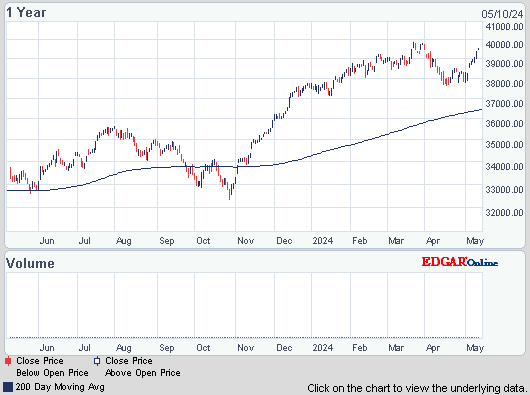
Dow fell 61 from yesterday's record, decliners over advancers 5-2 & NAZ was off 21. The MLP index index slid pocket change in the 457s while the REIT index lost 2+ to the 281s. Junk bond funds slipped back & Treasuries gave up early gains after the FOMC announcement. Oil
decreased, extending a 2nd monthly loss, after a gov
report showed that US inventories surged to a 4-month high & gold was about even.
AMJ (Alerian MLP Index tracking fund)





![Live 24 hours gold chart [Kitco Inc.]](http://www.kitco.com/images/live/gold.gif)


Photo: Bloomberg
The Federal Reserve (FED) says the US economy still needs support from its low interest-rate policies because it is growing only moderately, so it will keep buying $85B a month in bonds to keep long-term interest rates low & encourage borrowing & spending. Yet the FED seemed to signal that it thinks the economy is improving despite some recent sluggish data & uncertainties caused by the partial gov shutdown. It no longer expresses concern, as it did in Sep, that higher mortgage rates could hold back hiring & economic growth. Its statement makes no reference to the 16-day shutdown, which is believed to have slowed growth. Some suggest that the FED might be prepared to reduce its bond purchases by early next year, sooner others some have assumed. The yield on the 10-year Treasury note, a benchmark for rates on mortgages & other loans, rose from 2.49% to 2.54%, signaling that investors think long-term rates may rise because of less bond buying by the FED. However, the FED noted again that budget policies in DC have restrained economic growth. It will stick to its low-rate policy: It reiterated that it plans to hold its key short-term rate at a record low near zero at least as long as the unemployment rate stays above 6.5% & the inflation outlook remains mild.
Treasuries Fall After Fed Says U.S. Economic Activity Improving
Automatic Data Processing, a Dividend Aristocrat, fiscal Q1 net income rose 9%, thanks to an increase in the number of workers on clients' payrolls. The company said the number of employees on its clients' payrolls rose 2.6% on an adjusted basis, while client retention "remained strong." ADP provides payroll management and other services for 620K clients. EPS rose to 68¢, up from 63¢ a year ago. Revenue rose 8% to $2.84B from $2.64B. Analysts expected EPS of 66¢ & revenue of $2.81B. For fiscal 2014, ADP expects EPS from continuing operations to rise to 8-10% from $2.89 in 2013. That implies EPS of $3.12-$3.18 & is in line with the $3.16 expected. The company says revenue should rise 7%. Based on revenue of $11.3B in 2013, that would mean revenue at about $12.1B, in line with what expectations. The stock fell 2.06.
ADP fiscal 1Q net income rises 9 percent Associated Press
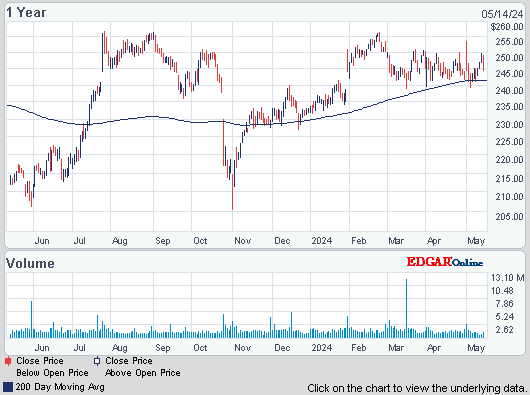

Photo: Bloomberg
German unemployment rose for a 3rd month in Oct, adding to signs of a slowdown in Europe’s largest economy. The number out of work climbed 2K to 2.97M, after gaining a revised 24K in Sep, according to the Federal Labor Agency. The prediction was for no change. The adjusted jobless rate was unchanged at 6.9%. The German economy, which helped to pull the 17-nation euro area out of recession in Q2, probably expanded at a slower pace in Q3, the Bundesbank said last week. Sentiment among companies on the economic outlook dipped for the first time in 6 months in Oct amid uncertainty over the pace of the recovery in the currency bloc. But the national rate of 6.9% is near the lowest level in 2 decades. “Demand for labor has stabilized at a good level in recent months,” the Labor Agency said. German GDP probably increased 0.4% in Q3 after climbing 0.7 % in Q2. The economy should expand 0.5% in 2013 & 1.8% next year
There were no great surprises in the FOMC announcement. The FED will keep buying bonds while it evaluates new economic data. Dow & the S&P 500 eased back from record highs after having another stellar year (without a lot of supporting economic data). Dow is still up an amazing 19% although the yield sectors are off their highs earlier in the year. GDP growth for Q3 will be reported next week & expectations are not high. For for those who want low rates to continue, that will be rated as "good."
Dow Jones Industrials
AMJ (Alerian MLP Index tracking fund)
Treasury yields:
U.S. 3-month |
0.04% | |
U.S. 2-year |
0.31% | |
U.S. 10-year |
2.53% |
| CLZ13.NYM | ....Crude Oil Dec 13 | ....96.82 |  ...1.38 ...1.38 | (1.4%) |
Photo: Bloomberg
The Federal Reserve (FED) says the US economy still needs support from its low interest-rate policies because it is growing only moderately, so it will keep buying $85B a month in bonds to keep long-term interest rates low & encourage borrowing & spending. Yet the FED seemed to signal that it thinks the economy is improving despite some recent sluggish data & uncertainties caused by the partial gov shutdown. It no longer expresses concern, as it did in Sep, that higher mortgage rates could hold back hiring & economic growth. Its statement makes no reference to the 16-day shutdown, which is believed to have slowed growth. Some suggest that the FED might be prepared to reduce its bond purchases by early next year, sooner others some have assumed. The yield on the 10-year Treasury note, a benchmark for rates on mortgages & other loans, rose from 2.49% to 2.54%, signaling that investors think long-term rates may rise because of less bond buying by the FED. However, the FED noted again that budget policies in DC have restrained economic growth. It will stick to its low-rate policy: It reiterated that it plans to hold its key short-term rate at a record low near zero at least as long as the unemployment rate stays above 6.5% & the inflation outlook remains mild.
Treasuries Fall After Fed Says U.S. Economic Activity Improving
Automatic Data Processing, a Dividend Aristocrat, fiscal Q1 net income rose 9%, thanks to an increase in the number of workers on clients' payrolls. The company said the number of employees on its clients' payrolls rose 2.6% on an adjusted basis, while client retention "remained strong." ADP provides payroll management and other services for 620K clients. EPS rose to 68¢, up from 63¢ a year ago. Revenue rose 8% to $2.84B from $2.64B. Analysts expected EPS of 66¢ & revenue of $2.81B. For fiscal 2014, ADP expects EPS from continuing operations to rise to 8-10% from $2.89 in 2013. That implies EPS of $3.12-$3.18 & is in line with the $3.16 expected. The company says revenue should rise 7%. Based on revenue of $11.3B in 2013, that would mean revenue at about $12.1B, in line with what expectations. The stock fell 2.06.
ADP fiscal 1Q net income rises 9 percent Associated Press
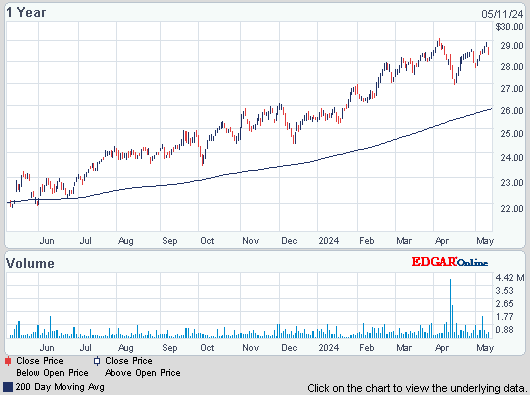
Automatic Data Processing (ADP)
Photo: Bloomberg
German unemployment rose for a 3rd month in Oct, adding to signs of a slowdown in Europe’s largest economy. The number out of work climbed 2K to 2.97M, after gaining a revised 24K in Sep, according to the Federal Labor Agency. The prediction was for no change. The adjusted jobless rate was unchanged at 6.9%. The German economy, which helped to pull the 17-nation euro area out of recession in Q2, probably expanded at a slower pace in Q3, the Bundesbank said last week. Sentiment among companies on the economic outlook dipped for the first time in 6 months in Oct amid uncertainty over the pace of the recovery in the currency bloc. But the national rate of 6.9% is near the lowest level in 2 decades. “Demand for labor has stabilized at a good level in recent months,” the Labor Agency said. German GDP probably increased 0.4% in Q3 after climbing 0.7 % in Q2. The economy should expand 0.5% in 2013 & 1.8% next year
There were no great surprises in the FOMC announcement. The FED will keep buying bonds while it evaluates new economic data. Dow & the S&P 500 eased back from record highs after having another stellar year (without a lot of supporting economic data). Dow is still up an amazing 19% although the yield sectors are off their highs earlier in the year. GDP growth for Q3 will be reported next week & expectations are not high. For for those who want low rates to continue, that will be rated as "good."
Dow Jones Industrials


I’m a huge fan of INO, and from what I have seen so far, their service Marketclub! This isn’t a stripped down version, everything in MarketClub is available to you. I don’t want to give everything away, but you’ll have unlimited access to my favorite three tools: Trade Triangles, Smart Scan, & Alerts! The best part is that the MarketClub customer support team will be providing UNLIMITED support! You can call or email for an instant response to any question, comment or concern.
Here’s that link:
https://club.ino.com/join/specialtrial/index_free.html?a_aid=CD3289&a_bid=359ef9a3
I’d recommend you jump on this now.