Dow closed up 43 (still above 25K), decliners modestly ahead of advancers & NAZ added 20. The MLP index fell 2+ to the 244s & the REIT index slid back 2+ to the 381s. Junk bond funds rose & Treasuries had a modest rise. Oil lost 2+ to the 56s (a low since early Mar) & gold went up 6 to 1293.
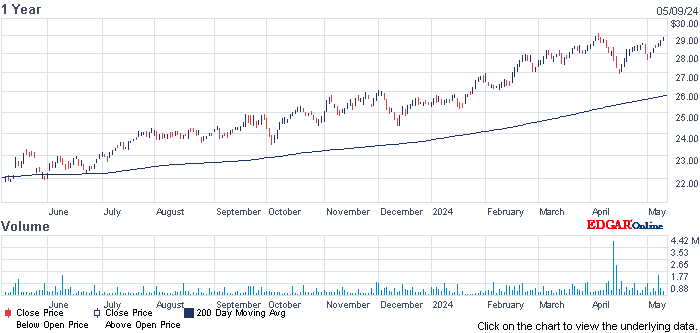
AMJ (Alerian MLP Index tracking fund)
![Live 24 hours gold chart [Kitco Inc.]](https://www.kitco.com/images/live/gold.gif?0.2180338269244485)









Interest rate policy is right where it should be considering the current state of the US economy, though that could change if conditions weaken, Federal Reserve Vice Chairman Richard Clarida said. Clarida gave generally high marks to the US economy & he reiterated the Fed's broader position that it will base policy on data as it unfolds. He did, however, outline the conditions under which he might consider cutting rates, which the market is expecting & Pres Trump is demanding. “If the incoming data were to show a persistent shortfall in inflation below our 2 percent objective or were it to indicate that global economic and financial developments present a material downside risk to our baseline outlook, then these are developments that the [Federal Open Market Committee] would take into account in assessing the appropriate stance for monetary policy,” Clarida said during a speech in NY. As things stand, he indicated policy is appropriate as unemployment remains low, inflation is around the Fed's 2% target & rates are near where the central bank considers neutral, or neither restrictive nor stimulative. “Midway through the second quarter of 2019, the U.S. economy is in a good place,” he added. “By most estimates, fiscal policy played an important role in boosting growth in 2018, and I expect that fiscal policies will continue to support growth in 2019.” The Fed's benchmark funds rate, which banks charge to each other for overnight lending & which forms a basis for most consumer rates, is targeted between 2.25-2.5%. That’s right where the current economic variables suggest it should be, Clarida said. Markets differ with the assessment — futures trading, which can be volatile, is currently pricing in 2 rate cuts by Jan. Fed officials, by contrast, say they are content with taking a “patient” approach, & they have forecast no moves in either direction at least through the end of 2019. Recent signs are showing that the economy is slowing after GDP rose 3.1% in Q1. Worries are mounting that the US-China trade war will have an impact on investment & demand, though the issue seemed to receive little attention at the most recent Fed meeting.
Fed’s Clarida says no need for rate cuts unless economy weakens
The number of Americans filing applications for new unemployment benefits increased last week but remained near historic lows. Initial jobless claims, a proxy for layoffs across the US, rose 3K to a seasonally adjusted 215K last week, the Labor Dept said. The forecast called for 215K new claims.
Oil futures dropped, with US & global benchmark prices posting their lowest settlements since Mar, after gov data revealed a weekly decline in domestic crude stockpiles that was much less than expected. The data also showed a further increase in production that was already in record territory. West Texas Intermediate crude for Jul delivery lost $2.22 (3.8%) to settle at $56.59 a barrel. Front-month prices settled at their lowest since Mar 8 & trade down by more than 11% for May. Global benchmark Jul Brent fell $2.58 (3.7%) to $66.87 a barrel, the lowest finish since Mar 12. The contract expires tomorrrow. Front-month contract prices have lost more than 8% in May. The Energy Information Administration (EIA) reported that US crude supplies edged lower by 300K barrels last week, the first weekly decline in 3 weeks, but significantly less than the 1.4M-barrel declined expected. The American Petroleum Institute yesterday also reported a much bigger decrease of 5.3M barrels. The EIA also estimated that domestic production rose 100K barrels to 12.3M barrels a day last week.
Oil prices drop as U.S. supply falls much less than expected and output grows
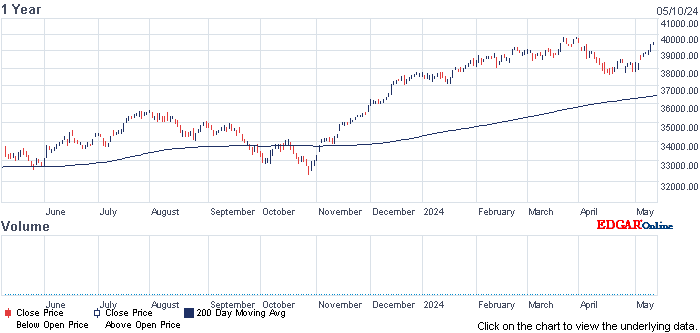
The Dow began the day in the black, but nervous investors lost their early enthusiasm. It bobbed around for the rest of the session & closed with a modest gain. Trade tensions are running high & there is no end in sight. The US economy continues to do well, but the US-China trade conflict is expected to lower the 3.1% growth rate in Q2 (& probably later). These are trying times for investors.
Dow Jones Industrials











AMJ (Alerian MLP Index tracking fund)
As both sides inch closer to a full-on trade war,
China lashed out again at the US, arguing that the US
“deliberately provoking trade disputes” is equivalent to “naked economic
terrorism.” Chinese Vice Foreign Minister
Zhang Hanhui spoke to reporters in Beijing & said the
country isn't frightened of a trade war with the US. The 2 countries have been embroiled in a standoff that escalated earlier
this month when Pres Trump increased tariffs on $200B worth
of Chinese imports to 25%. China hit back at the US by
announcing plans to raise tariffs on $60B worth of American
products starting next month. “We oppose a
trade war but are not afraid of a trade war. This kind of deliberately
provoking trade disputes is naked economic terrorism, economic
chauvinism, economic bullying,” Zhang said. Zhang
said there are no winners in a trade war, adding that a US-China
“trade clash will have a serious negative effect on global economic
development and recovery.” The senior Chinese diplomat also mentioned an
upcoming meeting between Chinese Pres Xi Jinping & Russian
Pres Vladimir Putin in Russia. “We will
definitely properly deal with all external challenges, do our own thing
well, develop our economy, and continue to raise the living standards of
our two peoples,” Zhang told reporters. “At the same time, we have the
confidence, resolve and ability to safeguard our country’s sovereignty,
security, respect and security and development interests.” The US also escalated the trade standoff by placing Chinese tech giant Huawei on
a blacklist that prevents US companies from supplying computer chips,
software & other components to the company without gov
approval. Google (GOOG),
which provides its Android operating system for Huawei smartphones,
announced it was issuing a ban in conjunction with Pres Trump's
executive order.
China slams US for escalating trade war: It's 'naked ...
Interest rate policy is right where it should be considering the current state of the US economy, though that could change if conditions weaken, Federal Reserve Vice Chairman Richard Clarida said. Clarida gave generally high marks to the US economy & he reiterated the Fed's broader position that it will base policy on data as it unfolds. He did, however, outline the conditions under which he might consider cutting rates, which the market is expecting & Pres Trump is demanding. “If the incoming data were to show a persistent shortfall in inflation below our 2 percent objective or were it to indicate that global economic and financial developments present a material downside risk to our baseline outlook, then these are developments that the [Federal Open Market Committee] would take into account in assessing the appropriate stance for monetary policy,” Clarida said during a speech in NY. As things stand, he indicated policy is appropriate as unemployment remains low, inflation is around the Fed's 2% target & rates are near where the central bank considers neutral, or neither restrictive nor stimulative. “Midway through the second quarter of 2019, the U.S. economy is in a good place,” he added. “By most estimates, fiscal policy played an important role in boosting growth in 2018, and I expect that fiscal policies will continue to support growth in 2019.” The Fed's benchmark funds rate, which banks charge to each other for overnight lending & which forms a basis for most consumer rates, is targeted between 2.25-2.5%. That’s right where the current economic variables suggest it should be, Clarida said. Markets differ with the assessment — futures trading, which can be volatile, is currently pricing in 2 rate cuts by Jan. Fed officials, by contrast, say they are content with taking a “patient” approach, & they have forecast no moves in either direction at least through the end of 2019. Recent signs are showing that the economy is slowing after GDP rose 3.1% in Q1. Worries are mounting that the US-China trade war will have an impact on investment & demand, though the issue seemed to receive little attention at the most recent Fed meeting.
Fed’s Clarida says no need for rate cuts unless economy weakens
The number of Americans filing applications for new unemployment benefits increased last week but remained near historic lows. Initial jobless claims, a proxy for layoffs across the US, rose 3K to a seasonally adjusted 215K last week, the Labor Dept said. The forecast called for 215K new claims.
U.S. Jobless Claims Increase but Remain Near Historic Lows
Oil futures dropped, with US & global benchmark prices posting their lowest settlements since Mar, after gov data revealed a weekly decline in domestic crude stockpiles that was much less than expected. The data also showed a further increase in production that was already in record territory. West Texas Intermediate crude for Jul delivery lost $2.22 (3.8%) to settle at $56.59 a barrel. Front-month prices settled at their lowest since Mar 8 & trade down by more than 11% for May. Global benchmark Jul Brent fell $2.58 (3.7%) to $66.87 a barrel, the lowest finish since Mar 12. The contract expires tomorrrow. Front-month contract prices have lost more than 8% in May. The Energy Information Administration (EIA) reported that US crude supplies edged lower by 300K barrels last week, the first weekly decline in 3 weeks, but significantly less than the 1.4M-barrel declined expected. The American Petroleum Institute yesterday also reported a much bigger decrease of 5.3M barrels. The EIA also estimated that domestic production rose 100K barrels to 12.3M barrels a day last week.
Oil prices drop as U.S. supply falls much less than expected and output grows
The Dow began the day in the black, but nervous investors lost their early enthusiasm. It bobbed around for the rest of the session & closed with a modest gain. Trade tensions are running high & there is no end in sight. The US economy continues to do well, but the US-China trade conflict is expected to lower the 3.1% growth rate in Q2 (& probably later). These are trying times for investors.
Dow Jones Industrials