

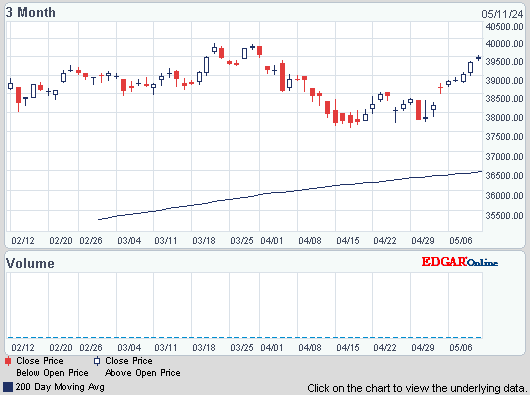
Dow rose 59, advancers 2-1 over decliners & NAZ added 28. The MLP index fell 2+ to 457 & the REIT index went up 1+ to 270. Junk bond funds edged higher & Treasuries slid lower. Oil rose
for the first time in 3 days on speculation distillate
inventories fell last week amid cold weather & as equities advanced. Gold lost ground, stuck in the mid 1200s.
AMJ (Alerian MLP Index tracking fund)
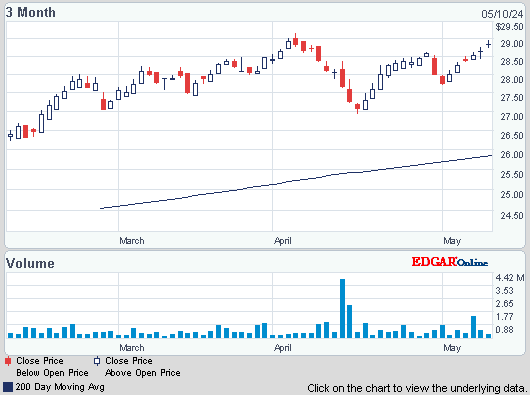





Photo: Bloomberg
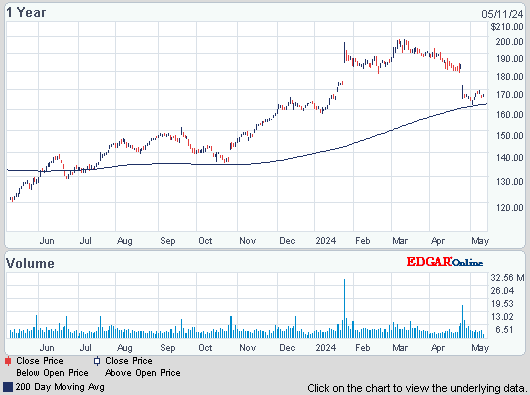
IBM, a Dow stock, has reduced its tax rate to a 2 decade low with help from a tax strategy that sends profits thru a Dutch subsidiary. The approach, which involves routing almost all sales in Europe, the Middle East, Africa, Asia & some Americas thru the Netherlands unit, helped IBM as it gradually reduced its tax rate over 20 years at the same time pretax income quadrupled. Then last year, the rate slid to the lowest level since at least 1994, lifting earnings above estimates. IBM is aiming for $20 in adjusted EPS by 2015, up from $11.67 in 2010, even though the company posted 7 straight quarters of declining revenue. Helping it achieve that goal is played by its subsidiary in the Netherlands, one of the most important havens for multinational companies looking for ways to legally reduce their tax rates. IBM ended 2013 with a tax provision $1.84B lower than it initially projected, thanks to a tax rate of 15.6%, compared with its forecast of 25%. Without the lower rate, EPS would have fallen from the previous year instead of rising, & net income would have missed the estimates by 14% instead of 2.9%. But offshore tax strategies like the one used by IBM are coming under increased scrutiny. As of the end of 2012, the latest year for which filings are available, IBM had accumulated $44.4B of offshore profits on which it hasn’t paid US taxes, the 6th-highest total of any American company. Since IBM Intl Group incorporation, its parent company’s tax rate has fallen in 12 of the past 14 years. Lower costs have helped IBM free up funds for its $65B in share repurchases since 2010.
IBM Uses Dutch Tax Haven to Boost Profits as Sales Drop for Seven Quarters
This is just a relief rally. The bulls are relieved that there is no bad news today, so they're back buying. But there is a lack of conviction behind the rally. In better times, the rally could have been substantial. All kinds of prbolems are popping around the globe, led by a slowdown in China which the leaders don't know how to fix. More macro data for the US is coming tomorrow & then the big jobs reports is on Fri. Dow remains down more than 1K YTD. The bulls have lost command of the markets.
Dow Jones Industrials
AMJ (Alerian MLP Index tracking fund)
Treasury yields:
U.S. 3-month |
0.05% | |
U.S. 2-year |
0.31% | |
U.S. 10-year |
2.62% |
| CLH14.NYM | ...Crude Oil Mar 14 | ...97.26 | ...0.83 | (0.9%) |
| GCG14.CMX | ...Gold Feb 14 | ......1,251.20 | ...9.20 (0.7%) |
Photo: Bloomberg
Defense spending globally will
increase this year for the first time since 2009 as military
budgets surge in Russia, Asia & the Middle East, according to
an annual defense budget review by IHS Jane’s. 4 of the 5 fastest-growing defense markets last year
were in the Middle East. The defense budgets of Russia &
China combined will exceed total defense spending of the
EU by 2015. “Russia, Asia and the Middle East will provide the impetus
behind the growth in global military spending expected this year
and will drive the recovery projected from 2016 onwards,” Paul
Burton, director of IHS Jane’s Aerospace, Defence & Security,
said. Russia, which is projected to increase defense spending by
more than 44% in the next 3 years, now ranks as the 3rd-largest military spender, pushing the UK into 4th
place. The US remained the top spender last year, at an
estimated $582B, followed by China with $139B & Russia spent $69B. No region has seen a faster surge in defense spending than
the Middle East, where Oman & Saudi Arabia have increased
their military budgets by more than 30% in the last 2
years. Saudi Arabia’s budget has tripled in 10
years. China, already the #2, will spend more than the
UK, France & Germany combined by 2015. Total global defense spending this year is projected to
reach $1.547T, a 0.6% increase from last year’s
$1.538T, after adjusting for inflation. Major US defense contractors are
expecting to increase intl sales.
A top US central banker gave a
relatively downbeat prediction for the US economic growth but
nonetheless said he expects the Federal Reserve to continue cutting its
monetary stimulus. Richmond
Fed President Jeffrey Lacker, cited muted spending by consumers &
businesses, & modest expected labor productivity in predicting GDP growth of "a little above" 2% this year, the low end of the range of predictions, of 2.2-3.3%, made in Dec by Fed policymakers. "The
pickup in growth late last year is certainly a welcome development, and
it may well be a harbinger of stronger growth ahead," Lacker, said. "But experience with similar growth spurts in the
recent past suggests that it is too soon to make that call," he added.
"My suspicion is that we will see growth subside this year to closer to 2
percent, about the rate we've seen since the Great Recession." Lacker,
who has long opposed the aggressive stimulus, repeated he
expects further reductions at upcoming meetings. He also predicted, as
most Fed officials have, that today's low inflation will rise to the
Fed's 2% goal over the next year or 2.
IBM, a Dow stock, has reduced its tax rate to a 2 decade low with help from a tax strategy that sends profits thru a Dutch subsidiary. The approach, which involves routing almost all sales in Europe, the Middle East, Africa, Asia & some Americas thru the Netherlands unit, helped IBM as it gradually reduced its tax rate over 20 years at the same time pretax income quadrupled. Then last year, the rate slid to the lowest level since at least 1994, lifting earnings above estimates. IBM is aiming for $20 in adjusted EPS by 2015, up from $11.67 in 2010, even though the company posted 7 straight quarters of declining revenue. Helping it achieve that goal is played by its subsidiary in the Netherlands, one of the most important havens for multinational companies looking for ways to legally reduce their tax rates. IBM ended 2013 with a tax provision $1.84B lower than it initially projected, thanks to a tax rate of 15.6%, compared with its forecast of 25%. Without the lower rate, EPS would have fallen from the previous year instead of rising, & net income would have missed the estimates by 14% instead of 2.9%. But offshore tax strategies like the one used by IBM are coming under increased scrutiny. As of the end of 2012, the latest year for which filings are available, IBM had accumulated $44.4B of offshore profits on which it hasn’t paid US taxes, the 6th-highest total of any American company. Since IBM Intl Group incorporation, its parent company’s tax rate has fallen in 12 of the past 14 years. Lower costs have helped IBM free up funds for its $65B in share repurchases since 2010.
IBM Uses Dutch Tax Haven to Boost Profits as Sales Drop for Seven Quarters
International Business Machines (IBM)
This is just a relief rally. The bulls are relieved that there is no bad news today, so they're back buying. But there is a lack of conviction behind the rally. In better times, the rally could have been substantial. All kinds of prbolems are popping around the globe, led by a slowdown in China which the leaders don't know how to fix. More macro data for the US is coming tomorrow & then the big jobs reports is on Fri. Dow remains down more than 1K YTD. The bulls have lost command of the markets.
Dow Jones Industrials









![Live 24 hours gold chart [Kitco Inc.]](http://www.kitco.com/images/live/gold.gif)



 ...0.08