Dow gained 39 after a choppy day of trading, advancers over decliners 4-3 & NAZ rose 46. The MLP index lst 1 to the 257s & the REIT index added 2+ to the 281s. Junk bond funds inched higher & Treasuries were sold. Oil was flattish in the 62s & gold hardly budged at 1295 (more on both below).
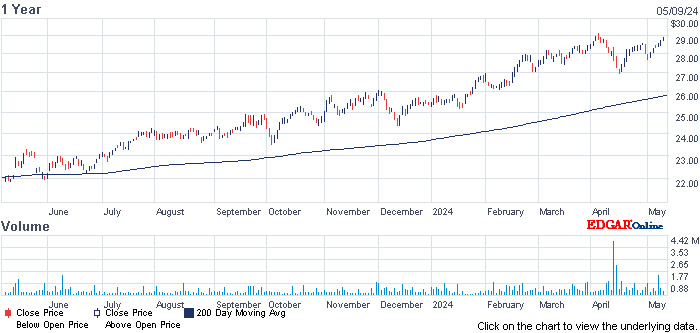
AMJ (Alerian MLP Index tracking fund)
![Live 24 hours gold chart [Kitco Inc.]](https://www.kitco.com/images/live/gold.gif?0.2180338269244485)









China has acknowledged for the first time that the US has legitimate gripes about IP theft, forced technology transfer & cyber hacking, White House economic advisor Larry Kudlow said. "They have for the first time acknowledged that we have a point. Several points," Kudlow said at an event hosted by The Christian Science Monitor. Previously, he said, "they were in denial." "And I think that has led to, you know, good negotiations," Kudlow added. Kudlow said the acknowledgement came out of trade talks between China & the US. He said even China's leader, Pres Xi Jinping, has signaled a willingness to listen to the US concerns at a dinner at the G20 summit in Argentina where he met with Pres Trump. "President Xi wasn't saying, 'no we didn't, no we didn't, no we didn't.' He was open to listening. And at the lower levels, we heard that. And that's great progress." Chinese smartphone maker Huawei did not come up during the talks. Huawei is facing charges from the Dept of Justice over 2 cases alleging the theft of trade secrets & fraud. "The Huawei stuff has generally not come up in the trade talks," Kudlow said. "We looked at it as a legal matter so far." Huawei claimed last month that the US law banning gov agencies from buying Huawei phones is unconstitutional. US security experts fear the Chinese gov could use Huawei's devices to spy on US gov agents. Huawei has previously denied it would hand its data over to the Chinese gov.
China admits for the first time that U.S. officials ‘have a point’ on IP theft
Oil futures ended modestly lower, snapping a 3-day winning streak after gov data showed an unexpectedly large rise in US crude inventories. West Texas Intermediate crude for May delivery fell 12¢ to end at $62.46 a barrel. The Energy Information Administration said US crude stocks rose 7.2M barrels last week. Analysts had called for a fall of 100K barrels. Oil has rallied sharply since the end of last year, with Saudi Arabia leading efforts by OPEC & its allies to curb output. The US benchmark had ended at a nearly 5-month high & remains up around 3.7% for the week & more than 37% YTD.
Gold futures finished near unchanged levels as reported progress in negotiations between the US & China bolstered appetite for stocks & away from bullion, while the $ softened. Gold for Jun delivery edged 10¢ lower to settle at $1295 an ounce. The yellow metal drifted up after data from payment processor ADP's report showed private-sector payrolls rose by 129K in Mar, below average estimates for 165K jobs & under the Feb reading of 197K. The data, which investors watch for clues to official jobs data due on Fri, appeared to weigh on the $. The $ index was off 0.3%. A weaker currency can provide a lift to commodities priced in the currency by making them cheaper to users of other currencies. Meanwhile, gold bulls said that while global bond yields have bounced back this week, their decline so far this year as global central banks turn more dovish should help set a floor for precious metals.
Stocks stumbled around for a 2nd day while waiting for news about the big trade deal. The economic news continues to be weak, not really disappointing, but weak. That has to be discouraging for the bulls. The Dow was up nearly 100 at midday, then enthusiasm waned which brought in some selling. However techs are strong with the NAZ approacing 8K, closing in on its record just above that level. Hard to believe that mediocre economic data, the faltering trade negotiations & Brexit going nowhere are not bringing in more selling.
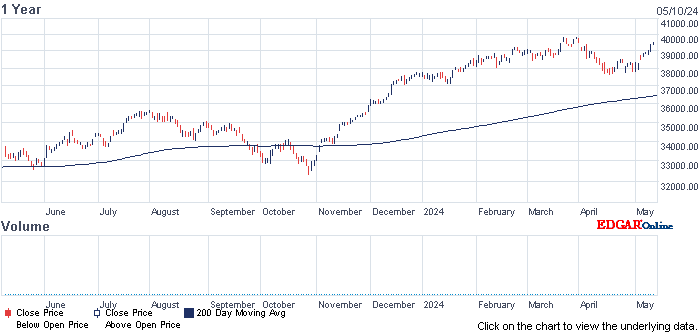
Dow Jones Industrials












AMJ (Alerian MLP Index tracking fund)
China has acknowledged for the first time that the US has legitimate gripes about IP theft, forced technology transfer & cyber hacking, White House economic advisor Larry Kudlow said. "They have for the first time acknowledged that we have a point. Several points," Kudlow said at an event hosted by The Christian Science Monitor. Previously, he said, "they were in denial." "And I think that has led to, you know, good negotiations," Kudlow added. Kudlow said the acknowledgement came out of trade talks between China & the US. He said even China's leader, Pres Xi Jinping, has signaled a willingness to listen to the US concerns at a dinner at the G20 summit in Argentina where he met with Pres Trump. "President Xi wasn't saying, 'no we didn't, no we didn't, no we didn't.' He was open to listening. And at the lower levels, we heard that. And that's great progress." Chinese smartphone maker Huawei did not come up during the talks. Huawei is facing charges from the Dept of Justice over 2 cases alleging the theft of trade secrets & fraud. "The Huawei stuff has generally not come up in the trade talks," Kudlow said. "We looked at it as a legal matter so far." Huawei claimed last month that the US law banning gov agencies from buying Huawei phones is unconstitutional. US security experts fear the Chinese gov could use Huawei's devices to spy on US gov agents. Huawei has previously denied it would hand its data over to the Chinese gov.
China admits for the first time that U.S. officials ‘have a point’ on IP theft
Oil futures ended modestly lower, snapping a 3-day winning streak after gov data showed an unexpectedly large rise in US crude inventories. West Texas Intermediate crude for May delivery fell 12¢ to end at $62.46 a barrel. The Energy Information Administration said US crude stocks rose 7.2M barrels last week. Analysts had called for a fall of 100K barrels. Oil has rallied sharply since the end of last year, with Saudi Arabia leading efforts by OPEC & its allies to curb output. The US benchmark had ended at a nearly 5-month high & remains up around 3.7% for the week & more than 37% YTD.
Oil ends lower, snaps 3-day winning streak as crude inventories rise
Gold futures finished near unchanged levels as reported progress in negotiations between the US & China bolstered appetite for stocks & away from bullion, while the $ softened. Gold for Jun delivery edged 10¢ lower to settle at $1295 an ounce. The yellow metal drifted up after data from payment processor ADP's report showed private-sector payrolls rose by 129K in Mar, below average estimates for 165K jobs & under the Feb reading of 197K. The data, which investors watch for clues to official jobs data due on Fri, appeared to weigh on the $. The $ index was off 0.3%. A weaker currency can provide a lift to commodities priced in the currency by making them cheaper to users of other currencies. Meanwhile, gold bulls said that while global bond yields have bounced back this week, their decline so far this year as global central banks turn more dovish should help set a floor for precious metals.
Gold ends little changed as dollar weakens, with risk appetite buttressed by U.S.-China trade talk
Britain's huge services sector contracted in Mar
for the first time since the immediate aftermath of the vote in June
2016 to leave the EU as firms put off new investments until
the fog of Brexit has been lifted, a survey found. Financial
information company IHS Markit said the downturn in the sector, which
accounts for around 4/5 of the British economy, reflected a lack
of new work to replace completed projects, with many execs wanting
Brexit clarity before making commitments. It said Brexit concerns &
worries about the economy also appeared to hold back household spending. The
firm's main services sector purchasing managers index, a gauge of
economic activity, fell to 48.9 points in Mar from 51.3 the previous
month. Readings below 50 indicate a contraction in activity & it's
the first time the index has fallen below that level since Jul 2016,
when firms were dealing with the shock of the referendum result. "Service
sector order books have contracted at the steepest rate since the
height of the global financial crisis in 2009 so far this year, with
companies reporting that Brexit uncertainty has dampened demand and led
to cancelled or deferred spending, exacerbating a headwind from slower
global economic growth," said the firm. According
to the firm, the services sector joins construction in being in
decline, with the wider economy held up only by the fact that
manufacturing is booming because many firms have started stockpiling
materials & other goods due to Brexit uncertainty. Overall, IHS Markit
said, the British economy flat-lined in Q1 & the protracted Brexit uncertainty risks weakening it further. "A
stalling of the economy in the first quarter will therefore likely turn
into a downturn in the second quarter unless demand revives suddenly
which, given the recent escalation of Brexit uncertainty, seems highly
improbable," said the firm.
UK services sector shrinks as Brexit uncertainty hits orders
Stocks stumbled around for a 2nd day while waiting for news about the big trade deal. The economic news continues to be weak, not really disappointing, but weak. That has to be discouraging for the bulls. The Dow was up nearly 100 at midday, then enthusiasm waned which brought in some selling. However techs are strong with the NAZ approacing 8K, closing in on its record just above that level. Hard to believe that mediocre economic data, the faltering trade negotiations & Brexit going nowhere are not bringing in more selling.
Dow Jones Industrials