Dow jumped up 477, advancers over decliners an impressive 5-1 & NAZ gained 135. The MLP index rebounded 2+ to the 175s & the REIT index shot up 9 to the 406s. Junk bond funds climbed higher along with stocks & Treasuries were purchased, taking the yield on the 10 year Treasury below1%. Oil rose to the 46s & gold slid back 5 to 1638.
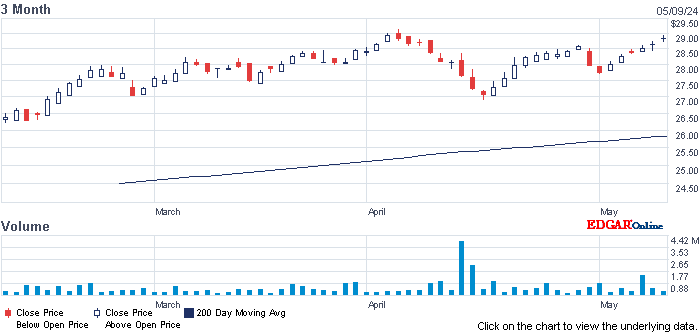
AMJ (Alerian MLP Index tracking fund)








US companies kept adding jobs in Feb despite the coronavirus scare, as private payrolls expanded well above the pace that had been anticipated. Employment excluding government jobs rose by 183K for the month, topping the 155K that was expected. The job growth came during a month in which fear spread that the COVID-19 strain would lead to a global economic slowdown. So far, 93K cases have been confirmed worldwide, including 3198 deaths. However, the economy remained resilient & companies continued to hire in the face of the worries & a wildly volatile stock market that reflected jitters over how widespread the coronavirus might get. “COVID-19 will need to break through the job market firewall if it is to do significant damage to the economy,” Mark Zandi, chief economist at Moody's Analytics, said. “The firewall has some cracks, but judging by the February employment gain it should be strong enough to weather most scenarios.” Zandi said that the coronavirus impact has not shown up in the data yet. “I haven’t seen anything to indicate that there’s any impact on the labor market at this point in time,” he said. However, he added that “it’s just a matter of time” before the numbers in future months reflect the situation. While the report was better than expected, the news was tempered by a big downward revision to Jan's number, which fell from an initially reported 291K down to 209K, still better than estimates but off the initial report that had pointed to the biggest monthly gain in nearly 5 years. The revised ADP number brought it almost in line with the gov's initial private payroll estimate of 206K for Jan. Total payrolls, including gov jobs, rose 225K for the month, according to the Bureau of Labor Statistics. Despite the cut to Jan's number, Feb's gain was well above the previous 12-month average of 154K a month. Some economists think that small business could take the biggest hit from a virus-induced slowdown & that was reflected in the ADP numbers. Almost all of Feb's job creation — 133K — came from companies that employ more than 55 workers. At the other end of the scale, those with fewer than 50 workers added just 24K jobs. By sector, the additions were concentrated in service industries, which added 172K & make up the bulk of the US economy. Gains were widespread, with education & health services leading with 46K, while leisure & hospitality added 44K. Another 38K came from professional & business services, while trade, transportation & utilities contributed 31K. Financial activities rose 9K & information services lost 2K positions. On the goods-producing side, construction was up 18K though manufacturing decreased 4K & natural resources & mining also saw contraction, down 3K. The ADP report serves as a precursor to the Labor Dept's monthly nonfarm payrolls report on Fri. The forecast calls for growth of 175K & for the unemployment rate to fall back to its 50-year low of 3.5%.
Private payrolls up 183,000 as hiring shows no signs of coronavirus scare
Passenger car retail sales in China, the world's biggest auto market, fell 80% in Feb because of the coronavirus epidemic, one of the country's industry associations said. The China Passenger Car Association (CPCA) said that China's overall passenger car sales dropped 80%, without giving a full sales figure for the month. "Dealers returned to work gradually in the first three weeks of February, and their showroom traffic is very low,'' CPCA said, adding it expects Feb's sales drop will be the steepest of this year. Japanese automaker Toyota (TM), the first major global automaker to report its Feb sales in China, said it sold 24K Toyota & premium Lexus cars last month, down by 70% from a year earlier. The world's biggest car market is bracing for further bad news as efforts to curb the spread of the coronavirus, which has killed more than 2900 in mainland China, disrupts global supply chains & dampens consumer demand. TM rival General Motors (GM), China's 2nd-biggest foreign automaker, said the industry will face ``serious challenges'' in the first qtr this year, but anticipates the situation will ease in the 2nd quarter, its China pres Matt Tsien said in a post on GM's official WeChat account. GM hopes China's auto sales will report year-on-year growth in the 2nd half of this year, Tsien added.
Market rout didn’t force US rate cut — but it was noted, Fed’s Mester says
There was heavy buying for stocks, however Treasuries are also in demand & gold prices are holding fairly well. The Volatility Index (VIX) is down 3 to the 33s (still a very high level from nervous investors). With the 10 year Treasury yield under 1%, all is not well for investors, & when the Dow has daily moves of 1-3%, forecasting is made very difficult.
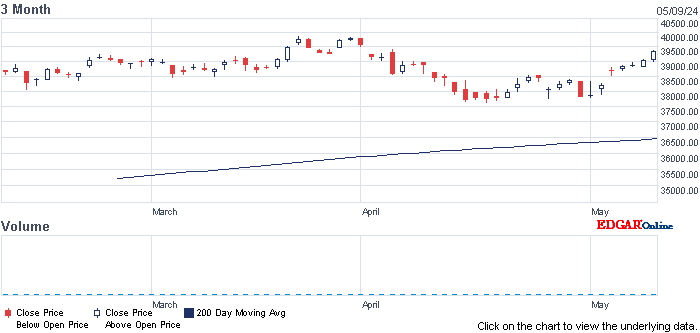
Dow Jones Industrials









AMJ (Alerian MLP Index tracking fund)
| CL=F | Crude Oil | 47.95 | +0.77 | +1.6% |
| GC=F | Gold | 1,644.60 | +0.20 | +0.0% |
US companies kept adding jobs in Feb despite the coronavirus scare, as private payrolls expanded well above the pace that had been anticipated. Employment excluding government jobs rose by 183K for the month, topping the 155K that was expected. The job growth came during a month in which fear spread that the COVID-19 strain would lead to a global economic slowdown. So far, 93K cases have been confirmed worldwide, including 3198 deaths. However, the economy remained resilient & companies continued to hire in the face of the worries & a wildly volatile stock market that reflected jitters over how widespread the coronavirus might get. “COVID-19 will need to break through the job market firewall if it is to do significant damage to the economy,” Mark Zandi, chief economist at Moody's Analytics, said. “The firewall has some cracks, but judging by the February employment gain it should be strong enough to weather most scenarios.” Zandi said that the coronavirus impact has not shown up in the data yet. “I haven’t seen anything to indicate that there’s any impact on the labor market at this point in time,” he said. However, he added that “it’s just a matter of time” before the numbers in future months reflect the situation. While the report was better than expected, the news was tempered by a big downward revision to Jan's number, which fell from an initially reported 291K down to 209K, still better than estimates but off the initial report that had pointed to the biggest monthly gain in nearly 5 years. The revised ADP number brought it almost in line with the gov's initial private payroll estimate of 206K for Jan. Total payrolls, including gov jobs, rose 225K for the month, according to the Bureau of Labor Statistics. Despite the cut to Jan's number, Feb's gain was well above the previous 12-month average of 154K a month. Some economists think that small business could take the biggest hit from a virus-induced slowdown & that was reflected in the ADP numbers. Almost all of Feb's job creation — 133K — came from companies that employ more than 55 workers. At the other end of the scale, those with fewer than 50 workers added just 24K jobs. By sector, the additions were concentrated in service industries, which added 172K & make up the bulk of the US economy. Gains were widespread, with education & health services leading with 46K, while leisure & hospitality added 44K. Another 38K came from professional & business services, while trade, transportation & utilities contributed 31K. Financial activities rose 9K & information services lost 2K positions. On the goods-producing side, construction was up 18K though manufacturing decreased 4K & natural resources & mining also saw contraction, down 3K. The ADP report serves as a precursor to the Labor Dept's monthly nonfarm payrolls report on Fri. The forecast calls for growth of 175K & for the unemployment rate to fall back to its 50-year low of 3.5%.
Private payrolls up 183,000 as hiring shows no signs of coronavirus scare
Passenger car retail sales in China, the world's biggest auto market, fell 80% in Feb because of the coronavirus epidemic, one of the country's industry associations said. The China Passenger Car Association (CPCA) said that China's overall passenger car sales dropped 80%, without giving a full sales figure for the month. "Dealers returned to work gradually in the first three weeks of February, and their showroom traffic is very low,'' CPCA said, adding it expects Feb's sales drop will be the steepest of this year. Japanese automaker Toyota (TM), the first major global automaker to report its Feb sales in China, said it sold 24K Toyota & premium Lexus cars last month, down by 70% from a year earlier. The world's biggest car market is bracing for further bad news as efforts to curb the spread of the coronavirus, which has killed more than 2900 in mainland China, disrupts global supply chains & dampens consumer demand. TM rival General Motors (GM), China's 2nd-biggest foreign automaker, said the industry will face ``serious challenges'' in the first qtr this year, but anticipates the situation will ease in the 2nd quarter, its China pres Matt Tsien said in a post on GM's official WeChat account. GM hopes China's auto sales will report year-on-year growth in the 2nd half of this year, Tsien added.
China's passenger car sales down 80%
The Federal Reserve's emergency 50 basis
point rate cut yesterday was not driven by last week's market
capitulation, but it was taken into account, Cleveland Federal Reserve
Pres Loretta Mester said. Mester revealed that she supported the cut on the
basis of fresh uncertainty over the medium-term outlook for the US
economy. “The
risks around that outlook had gone up significantly. There’s still a
lot of uncertainty about the course of the virus and what impact it’ll
have. We have already seen impacts in terms of travel and tourism, we’re
going to see a reduction in activity for the first half of the year.
This was really in response to the economy and the outlook and the risks
around the outlook,” Mester said. However, she acknowledged that the market rout had piqued the interest of Fed policymakers. “You
certainly have to take note when the markets are doing that. You don’t
respond to market volatility per se but if investors pull back as much
as they were showing that they did, that also influences business
sentiment and also consumer sentiment. There is a signaling in that
market about the reevaluation of the outlook on the part of investors,
consumers and businesses.” The Federal Reserve slashed interest rates by ½ a percentage
point in an emergency measure to combat the expected economic
fallout from the coronavirus outbreak, sparking a turbulent session which saw the 10-year yield dip below 1% for the first time. Other
major central banks have scheduled meetings in the coming weeks &
could follow the Fed's lead, including the ECB, the
Bank of England & the Bank of Japan. Mester said that the decision to cut by 50 basis points
reflected the need for monetary policy action to be “decisive” in the
face of a “classic supply shock.” “Certainly lowering interest
rates are not going to get people to start traveling again, their social
interactions are not going to be changed by a lower interest rate, but
the supply shock can easily manifest itself into demand shock if
uncertainty continues,” Mester said, adding that the situation could
“morph into something that could affect business sentiment, consumer
sentiment and investor sentiment.”
Market rout didn’t force US rate cut — but it was noted, Fed’s Mester says
There was heavy buying for stocks, however Treasuries are also in demand & gold prices are holding fairly well. The Volatility Index (VIX) is down 3 to the 33s (still a very high level from nervous investors). With the 10 year Treasury yield under 1%, all is not well for investors, & when the Dow has daily moves of 1-3%, forecasting is made very difficult.
Dow Jones Industrials


![Live 24 hours gold chart [Kitco Inc.]](https://www.kitco.com/images/live/gold.gif?0.2180338269244485)